Ambrosia salsola var. salsola
Burrobrush
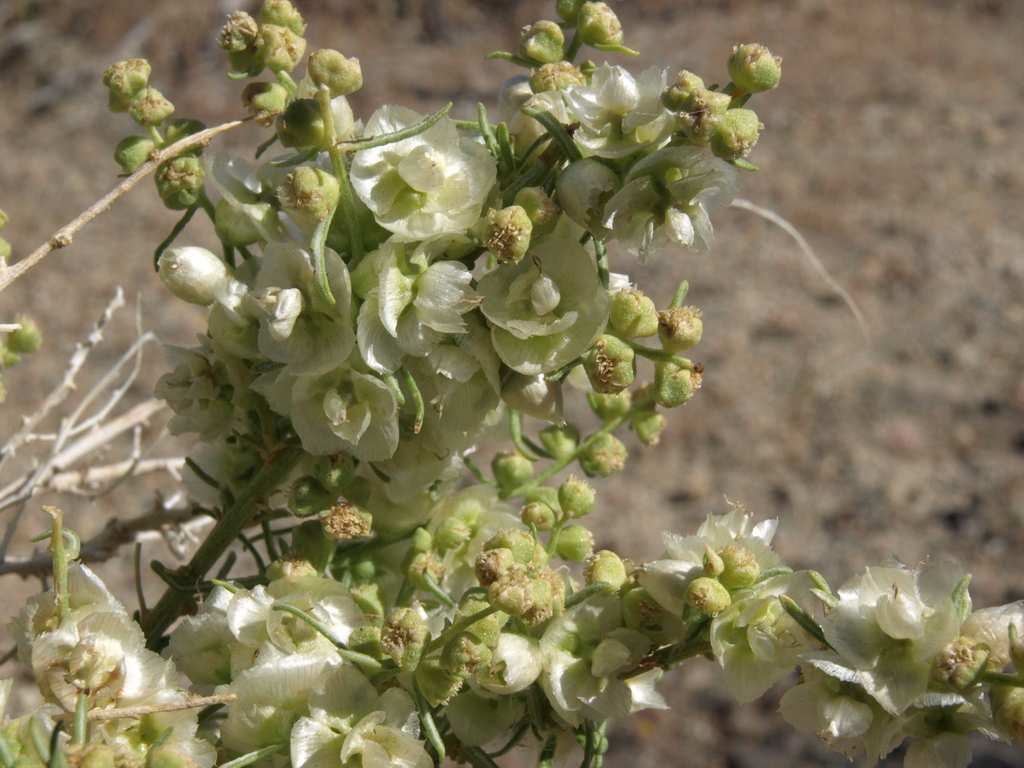
(c) Jim Morefield, some rights reserved (CC BY) · licence
Family: Asteraceae · Type: Subshrub · Native
Ambrosia salsola var. salsola (Burrobrush) is a native California subshrub in the Asteraceae family, recognized by distinctive 10-13 spiraled wings, either spreading or enwrapping bur.
Burrobrush is a California native shrub found in southern San Joaquin Valley, southern Coast Ranges, southwestern California, southern Great Basin, and desert regions in dry flats, washes, and alluvial fans at elevations from sea level to 1,850 meters. Flowering from February to June, this plant produces small greenish-white flowers in distinctive bur-like heads with spiraled wings. Growing with densely branched stems 0.5 to 2 meters tall, it forms a robust and intricate desert shrub. Its leaves are small and grayish-green, arranged alternately along the stems, providing excellent drought adaptation for arid environments. The fruit develops as a distinctive bur with 10 to 13 spiraled wings that can be 3.5 to 5.5 millimeters long, which help in seed dispersal across harsh desert landscapes.
Identification and appearance
Key characters: 15 sympatric species; distinctive 10-13 spiraled wings, either spreading or enwrapping bur
Habitat and range
Habitat: dry flats, washes, fans
Elevation: -70-1850 m
California counties: San Bernardino, Kern, Riverside, Los Angeles, Inyo, San Diego, Imperial, Mono, San Luis Obispo, Santa Barbara, Ventura
Outside California: to southwestern Utah, western Arizona, Baja California
Bloom period
Ambrosia salsola var. salsola blooms Feb-Jun.
How to tell it apart
vs Artemisia: Ambrosia produces spiny burs as fruits; Artemisia has tiny dry fruits without spines and strongly aromatic foliage.; vs Atriplex: Ambrosia has flower heads in spikes producing spiny burs; Atriplex has inconspicuous flowers with papery bracts and scurfy gray foliage.; vs Baccharis: Ambrosia has both male and female flowers on the same plant; Baccharis has male and female flowers on separate plants.; vs Eriogonum: Ambrosia has greenish flower heads producing spiny burs; Eriogonum has showy clusters of white, pink, or yellow flowers with papery bracts.; vs Salvia: Ambrosia has inconspicuous greenish flowers in the Asteraceae; Salvia has showy tubular lipped flowers typical of mints.
Frequently asked questions
Is Ambrosia salsola var. salsola native to California?
Yes. Ambrosia salsola var. salsola is native to California (recorded as native).
When does Ambrosia salsola var. salsola bloom?
Ambrosia salsola var. salsola blooms Feb-Jun.
Where in California does Ambrosia salsola var. salsola grow?
Ambrosia salsola var. salsola occurs in San Bernardino, Kern, Riverside, Los Angeles, Inyo, San Diego, Imperial, Mono and other counties, at elevations of -70-1850 m.
What plant family does Ambrosia salsola var. salsola belong to?
Ambrosia salsola var. salsola is in the Asteraceae family, genus Ambrosia.
What habitat does Ambrosia salsola var. salsola grow in?
Ambrosia salsola var. salsola grows in dry flats, washes, fans.
Related species
Other California species in the same genus, family, or bioregion.
Sources: Jepson eFlora · Index of California Plant Names · CalPhotos
Last updated 2026-10-07
Data from The California Species Project — 14,000+ California species with verified data from CNPS, CDFW, USFWS, Cal-IPC, and more.