Amelanchier alnifolia var. semiintegrifolia
Pacific serviceberry
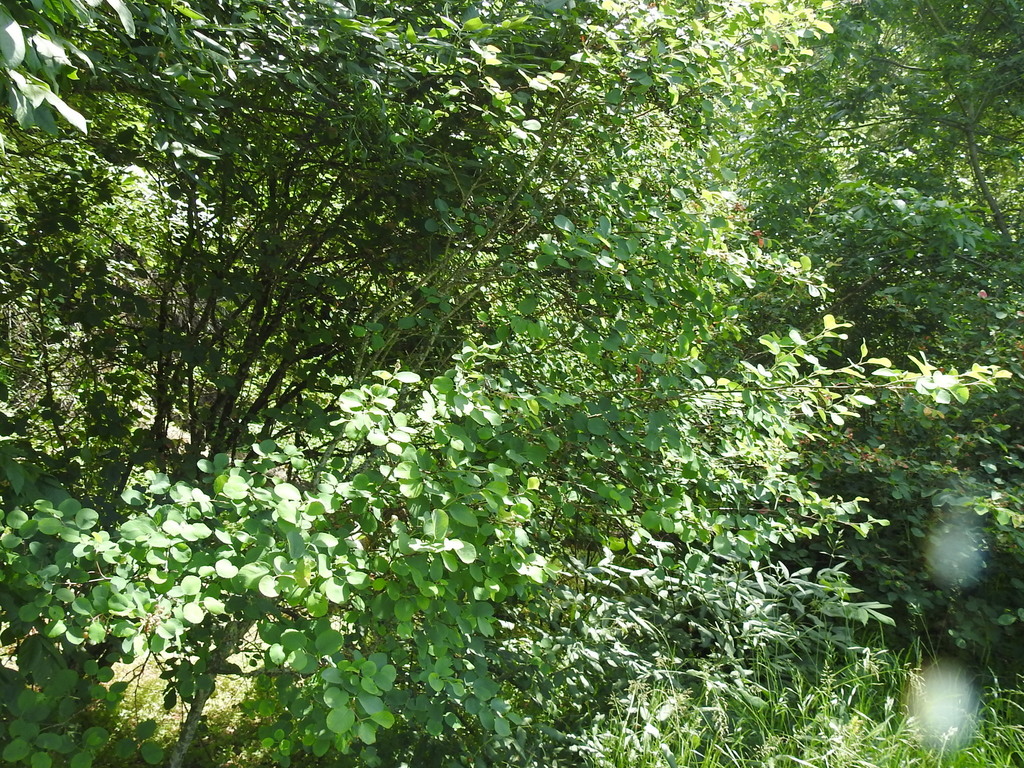
(c) Sam Kieschnick, some rights reserved (CC BY), uploaded by Sam Kieschnick · licence
Family: Rosaceae · Type: Shrub / Tree · Native
Amelanchier alnifolia var. semiintegrifolia (Pacific serviceberry) is a native California shrub / tree in the Rosaceae family, recognized by Co-occurs with A. utahensis; distinguished by larger stature, flowers, and fruits.
Pacific serviceberry is a native shrub found in northern coastal California, Klamath Ranges, and northern North Coast Ranges in open conifer or mixed-evergreen forest and slopes at elevations of 50 to 2,500 meters. Flowering from March to June, this plant produces white flowers in clusters 4 to 8 centimeters long with 5 to 15 individual blossoms, each with petals 12 to 15 millimeters long. Growing as a multi-stemmed shrub 1 to 12 meters tall with an upright, spreading form, it develops a woody structure with multiple branches. Its leaves have broad blades 30 to 40 millimeters long and 20 to 30 millimeters wide, typically finely hairy on the underside, especially when in flower. The plant produces edible fruits approximately 10 to 13 millimeters in diameter, making it an important species for wildlife and traditional ecological uses.
Identification and appearance
Key characters: Co-occurs with A. utahensis; distinguished by larger stature, flowers, and fruits
Habitat and range
Habitat: Open conifer or mixed-evergreen forest, slopes
Elevation: 50-2500 m
California counties: Humboldt, Plumas, Siskiyou, Del Norte, Madera, Mendocino, Trinity, Placer, Shasta, Sonoma, Napa, Lassen, Lake, Modoc, Glenn, Sierra
Outside California: to Alaska
Bloom period
Amelanchier alnifolia var. semiintegrifolia blooms Mar-Jun.
How to tell it apart
vs Prunus: Prunus has smooth or single-pitted fruits; Amelanchier has berries with papery segments like tiny apples.; vs Symphoricarpos: Symphoricarpos has opposite leaves and white berries; Amelanchier has alternate leaves and blue-black berries.; vs Frangula: Frangula has smooth leaf edges; Amelanchier has finely toothed leaf margins in the upper half.; vs Cercocarpus: Cercocarpus has dry fruits with feathery tails; Amelanchier has juicy blue-black berries.; vs Ceanothus: Ceanothus has dry capsule fruits; Amelanchier has fleshy blue-black berries.
Frequently asked questions
Is Amelanchier alnifolia var. semiintegrifolia native to California?
Yes. Amelanchier alnifolia var. semiintegrifolia is native to California (recorded as native).
When does Amelanchier alnifolia var. semiintegrifolia bloom?
Amelanchier alnifolia var. semiintegrifolia blooms Mar-Jun.
Where in California does Amelanchier alnifolia var. semiintegrifolia grow?
Amelanchier alnifolia var. semiintegrifolia occurs in Humboldt, Plumas, Siskiyou, Del Norte, Madera, Mendocino, Trinity, Placer and other counties, at elevations of 50-2500 m.
What plant family does Amelanchier alnifolia var. semiintegrifolia belong to?
Amelanchier alnifolia var. semiintegrifolia is in the Rosaceae family, genus Amelanchier.
What habitat does Amelanchier alnifolia var. semiintegrifolia grow in?
Amelanchier alnifolia var. semiintegrifolia grows in Open conifer or mixed-evergreen forest, slopes.
Related species
Other California species in the same genus, family, or bioregion.
Sources: Jepson eFlora · Index of California Plant Names · CalPhotos
Last updated 2026-10-07
Data from The California Species Project — 14,000+ California species with verified data from CNPS, CDFW, USFWS, Cal-IPC, and more.