Amorpha californica var. californica
California false indigo
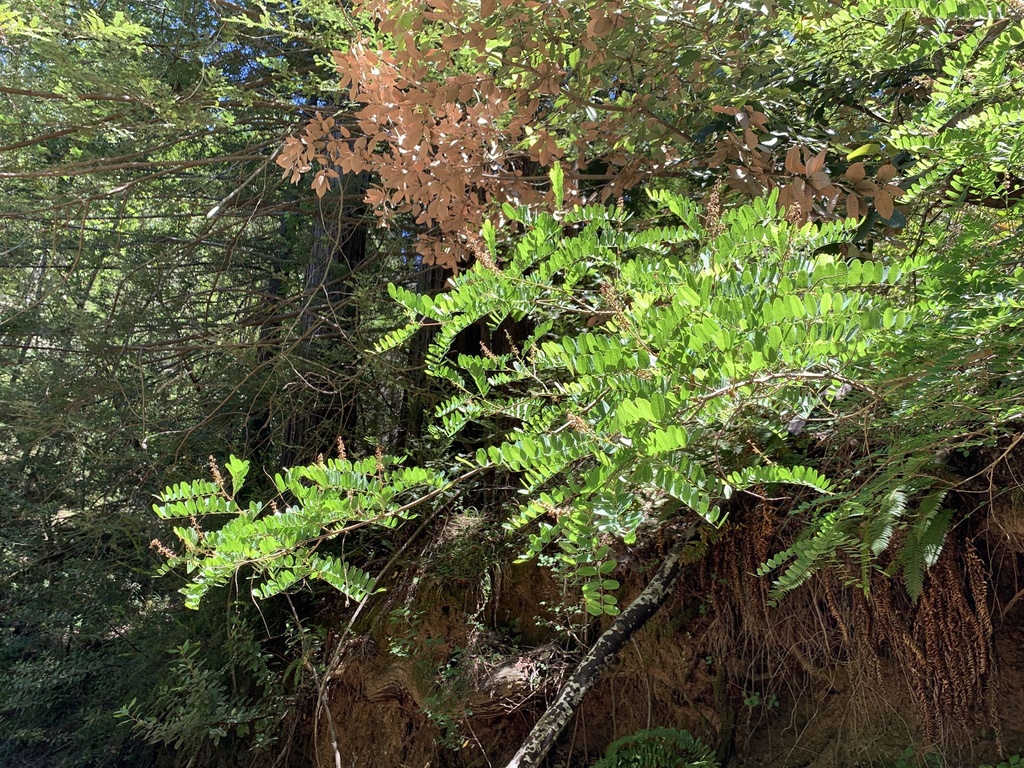
(c) John Hibbard, some rights reserved (CC BY) · licence
Family: Fabaceae · Type: Shrub · Native
Amorpha californica var. californica (California false indigo) is a native California shrub in the Fabaceae family, recognized by glandular leaf axis, hairy habit, and calyx lobe length.
California false indigo is a California native shrub found in the Klamath Ranges, northern Coast Ranges, northern Sierra Nevada foothills, Sacramento Valley, southern Coast Ranges, southern California, Transverse Ranges, and northern and eastern Peninsular Ranges in wooded, shrubby, or open slopes at elevations below 2,300 meters. Flowering from May to July, this shrub produces purple flowers with a distinctive pattern. Growing up to 2 to 3 meters tall with multiple woody stems, it forms a dense, spreading structure with rough, hairy branches. Its compound leaves are pinnately arranged with numerous leaflets, creating a soft, textured appearance. The shrub's delicate purple flowers and hairy stems make it a notable feature in its native woodland habitats.
Identification and appearance
Key characters: 3 sympatric species; key features are glandular leaf axis, hairy habit, and calyx lobe length
Habitat and range
Habitat: Wooded, shrubby, or open slopes
Elevation: < 2300 m
California counties: San Bernardino, Los Angeles, Yolo, Orange, Santa Barbara, Riverside, San Luis Obispo, Ventura, Monterey, El Dorado, Placer, Sonoma, Trinity, Shasta, Sutter, Nevada, San Diego
Bloom period
Amorpha californica var. californica blooms May-Jul.
How to tell it apart
vs Dalea: Amorpha flowers reduce to a single purple banner petal (no wings or keel) and its leaflets are gland-dotted; Dalea flowers retain more petal parts and it is generally a low herb or subshrub.; vs Astragalus: Amorpha is a woody shrub with erect spike-like clusters of 1-petaled flowers; Astragalus is an herb with normal banner-wing-keel pea flowers and an inflated or grooved pod.; vs Robinia: Amorpha bears dense erect spikes of tiny 1-petaled purple flowers and unarmed stems; black locust (Robinia) has drooping racemes of large white pea flowers and paired spines.; vs Colutea: Amorpha has narrow flower spikes and tiny 1--2-seeded gland-dotted pods; Colutea (bladder senna) has yellow pea flowers and large inflated papery pods.; vs Glycyrrhiza: Amorpha leaflets bear head-like glands and flowers keep only one petal; Glycyrrhiza has normal pea flowers and bur-like prickly pods.
Frequently asked questions
Is Amorpha californica var. californica native to California?
Yes. Amorpha californica var. californica is native to California (recorded as native).
When does Amorpha californica var. californica bloom?
Amorpha californica var. californica blooms May-Jul.
Where in California does Amorpha californica var. californica grow?
Amorpha californica var. californica occurs in San Bernardino, Los Angeles, Yolo, Orange, Santa Barbara, Riverside, San Luis Obispo, Ventura and other counties, at elevations of < 2300 m.
What plant family does Amorpha californica var. californica belong to?
Amorpha californica var. californica is in the Fabaceae family, genus Amorpha.
What habitat does Amorpha californica var. californica grow in?
Amorpha californica var. californica grows in Wooded, shrubby, or open slopes.
Related species
Other California species in the same genus, family, or bioregion.
Sources: Jepson eFlora · Index of California Plant Names · CalPhotos
Last updated 2026-10-07
Data from The California Species Project — 14,000+ California species with verified data from CNPS, CDFW, USFWS, Cal-IPC, and more.