Amphiscirpus nevadensis
Great basin bulrush, Nevada Bulrush
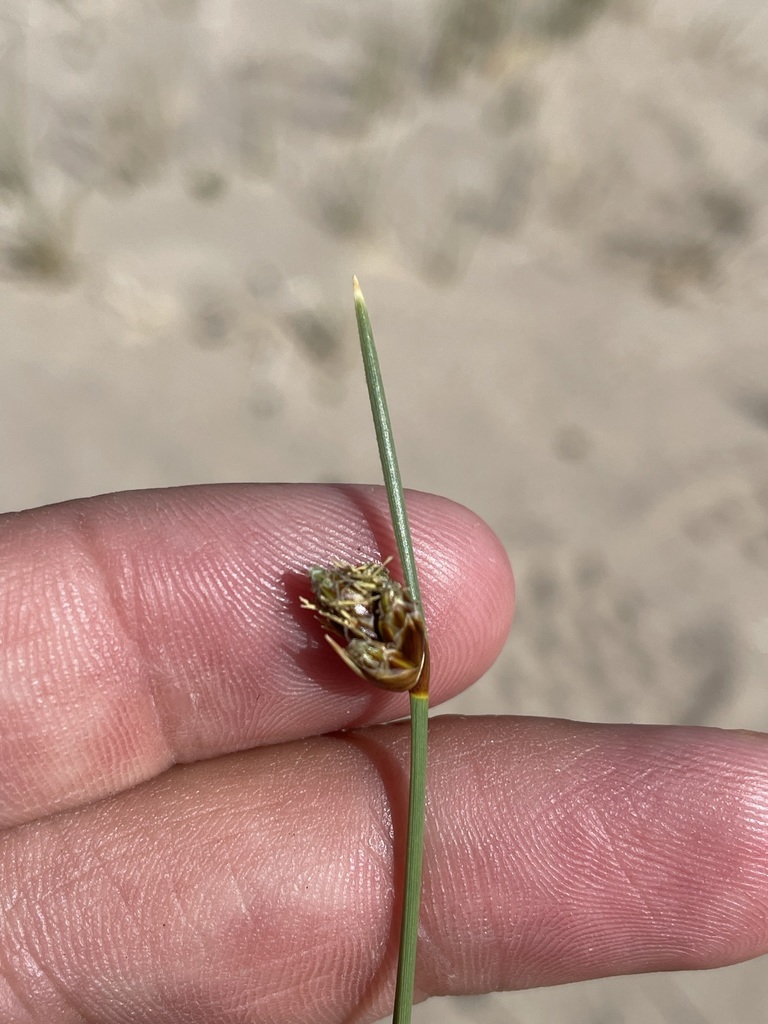
(c) Matt Berger, some rights reserved (CC BY) · licence
Family: Cyperaceae · Type: Grass · Native
Amphiscirpus nevadensis (Great basin bulrush) is a native California grass in the Cyperaceae family, recognized by Monotypic genus with disjunct distribution between western North America and southern South America, representing an ancient Cyperaceae….
Great basin bulrush is a California native perennial found in the California Ranges, Great Basin, and Desert regions in saline, often alkaline seasonal wetlands at elevations of 400 to 2,400 meters. Flowering during summer, this plant produces pale to dark red-brown flowers in small head-like clusters with 1 to 6 spikelets. Growing 10 to 70 centimeters tall with smooth, tough, and wiry stems, it spreads through long, hard rhizomes that are 1 to 4 millimeters in diameter. Its basal leaves are spiraled, C-shaped in cross-section, 5 to 10 in number, with sharp tips and sparse scabrous margins measuring 0.5 to 2 millimeters wide. The plant's flower bracts are shiny, papery to tough, with ciliate margins and varying from 3 to 9 veined.
Identification and appearance
Key characters: Monotypic genus with disjunct distribution between western North America and southern South America, representing an ancient Cyperaceae lineage
Habitat and range
Habitat: Saline, often alkaline seasonal wetlands
Elevation: 400-2400 m
California counties: Lassen, Inyo, Mono, Kern, Modoc, Siskiyou, Tulare
Outside California: southern South America
Bloom period
Amphiscirpus nevadensis blooms Summer.
How to tell it apart
vs Eleocharis: Amphiscirpus has shiny flower bracts with ciliate leaf sheaths; Eleocharis has dull bracts and smooth sheaths.; vs Lipocarpha: Amphiscirpus has wiry stems and shiny bracts; Lipocarpha is much shorter with dull multi-veined bracts.; vs Isolepis: Amphiscirpus has shiny glossy bracts; Isolepis bracts are dull but multi-veined.; vs Trichophorum: Amphiscirpus grows in alkaline desert wetlands; Trichophorum inhabits high mountain meadows above 8,000 feet.; vs Schoenoplectus: Amphiscirpus has shiny bracts and wiry solid stems; Schoenoplectus has dull bracts and spongy air-chambered stems.
Frequently asked questions
Is Amphiscirpus nevadensis native to California?
Yes. Amphiscirpus nevadensis is native to California (recorded as native).
When does Amphiscirpus nevadensis bloom?
Amphiscirpus nevadensis blooms Summer.
Where in California does Amphiscirpus nevadensis grow?
Amphiscirpus nevadensis occurs in Lassen, Inyo, Mono, Kern, Modoc, Siskiyou, Tulare, at elevations of 400-2400 m.
What plant family does Amphiscirpus nevadensis belong to?
Amphiscirpus nevadensis is in the Cyperaceae family, genus Amphiscirpus.
What habitat does Amphiscirpus nevadensis grow in?
Amphiscirpus nevadensis grows in Saline, often alkaline seasonal wetlands.
Related species
Other California species in the same genus, family, or bioregion.
Sources: Jepson eFlora · Index of California Plant Names · CalPhotos
Last updated 2026-10-07
Data from The California Species Project — 14,000+ California species with verified data from CNPS, CDFW, USFWS, Cal-IPC, and more.