Amsinckia lycopsoides
Bugloss-flowered fiddleneck
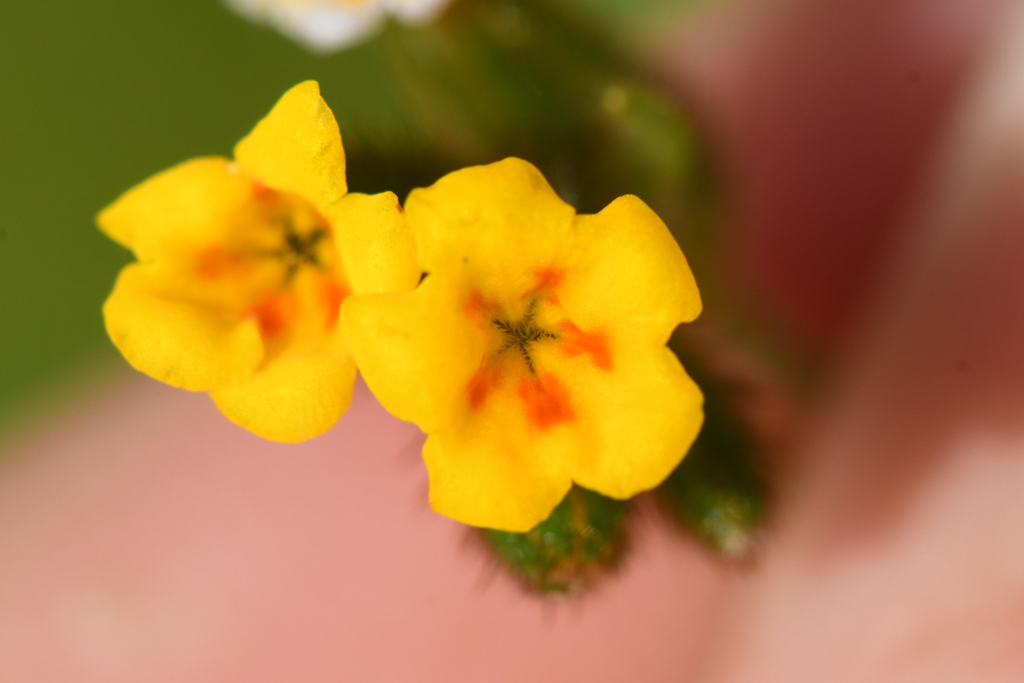
(c) Trevor Van Loon, some rights reserved (CC BY) · licence
Family: Boraginaceae · Type: Herb · Native
Amsinckia lycopsoides (Bugloss-flowered fiddleneck) is a native California herb in the Boraginaceae family, recognized by constricted tube with hairy appendages diagnostic.
Bugloss-flowered fiddleneck is a California native annual found in northwestern California, the Cascade Range foothills, Sierra Nevada foothills, Central Valley, central western California, southern California coastal areas, Channel Islands, and Peninsular Ranges in open grasslands and disturbed areas at elevations of 5 to 850 meters. Flowering from March to June, this plant produces yellow-orange flowers with distinctive dark spots, 7 to 11 millimeters long, with a throat partially closed by five hairy appendages. Growing with slender stems reaching up to 30 to 40 centimeters tall, it develops in open, disturbed habitats. Its leaves are lance-shaped, typically green and somewhat rough-textured, arranged alternately along the stem. The small fruits are 2.5 to 3 millimeters long with sharp tubercles, characteristic of the fiddleneck genus.
Identification and appearance
Key characters: 14 sympatric species; constricted tube with hairy appendages diagnostic
Habitat and range
Habitat: Common. Open, grassland, foothill woodland, generally disturbed areas
Elevation: 5-850(1770) m
California counties: Santa Barbara, San Benito, San Luis Obispo, San Joaquin, Shasta, Tehama, Butte, Siskiyou, Merced, Stanislaus, Colusa, Solano, Monterey, Tulare, Sutter, Contra Costa, El Dorado, Yolo, Sacramento, Glenn, Napa, Mariposa, Lake, San Diego, Alameda, Marin, Fresno, Tuolumne, Santa Clara, Placer, Trinity, Madera, Los Angeles, Sonoma, San Bernardino, Mendocino, San Mateo, Calaveras, Lassen, Santa Cruz, San Francisco, Plumas
Outside California: to British Columbia, Idaho
Bloom period
Amsinckia lycopsoides blooms Mar-Jun.
How to tell it apart
vs Phacelia: Amsinckia always has orange or yellow flowers; Phacelia flowers are blue, purple, or white.; vs Plantago: Amsinckia has coiled orange flower clusters; Plantago has dense spikes with tiny white-brown flowers.; vs Helminthotheca: Amsinckia has bristly stems but simple leaves; Helminthotheca leaves are prickly-bumpy textured.; vs Echium: Amsinckia flowers are orange-yellow; Echium flowers are blue-purple and distinctly lopsided.; vs Camissoniopsis: Amsinckia has coiled flower clusters; Camissoniopsis has 4-petaled evening primrose flowers.
Frequently asked questions
Is Amsinckia lycopsoides native to California?
Yes. Amsinckia lycopsoides is native to California (recorded as native).
When does Amsinckia lycopsoides bloom?
Amsinckia lycopsoides blooms Mar-Jun.
Where in California does Amsinckia lycopsoides grow?
Amsinckia lycopsoides occurs in Santa Barbara, San Benito, San Luis Obispo, San Joaquin, Shasta, Tehama, Butte, Siskiyou and other counties, at elevations of 5-850(1770) m.
What plant family does Amsinckia lycopsoides belong to?
Amsinckia lycopsoides is in the Boraginaceae family, genus Amsinckia.
What habitat does Amsinckia lycopsoides grow in?
Amsinckia lycopsoides grows in Common. Open, grassland, foothill woodland, generally disturbed areas.
Related species
Other California species in the same genus, family, or bioregion.
Sources: Jepson eFlora · Index of California Plant Names · CalPhotos
Last updated 2026-10-07
Data from The California Species Project — 14,000+ California species with verified data from CNPS, CDFW, USFWS, Cal-IPC, and more.