Amsinckiopsis kingii
Great basin popcornflower, Great Basin Popcornflower
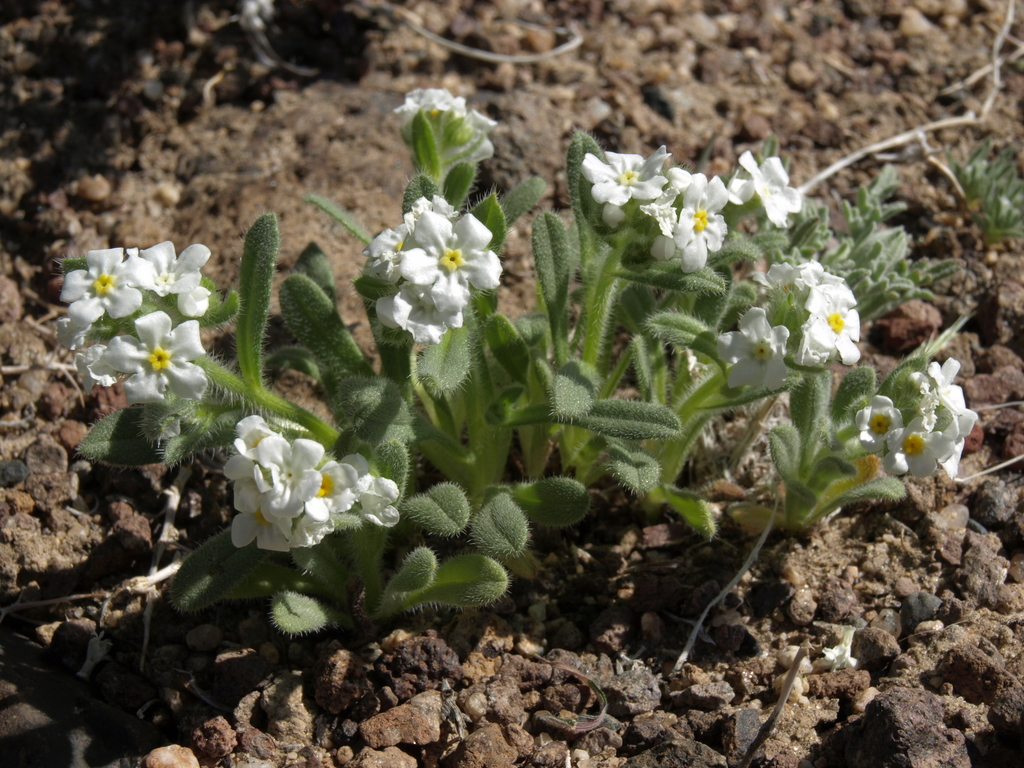
(c) Jim Morefield, some rights reserved (CC BY), uploaded by Jim Morefield · licence
Family: Boraginaceae · Type: Herb · Native
Amsinckiopsis kingii (Great basin popcornflower) is a native California herb in the Boraginaceae family, recognized by found in Riverside, Mono, and Inyo counties.
Great basin popcornflower is a California native annual found in Great Basin regions in dry, open habitats at moderate elevations. Flowering from March to May, this plant produces delicate white flowers with yellow appendages in small rotated clusters. Growing with ascending to erect stems 20 to 40 centimeters tall, it has distinctive coarse, stiff spreading hairs and a reddish taproot. Its leaves are primarily alternate, linear to lance-shaped, with lower leaves dense and clustered while upper leaves become increasingly sparse. The fruit consists of four small nutlets with irregular tubercled ridges, each 2 to 3 millimeters long and slightly arched.
Identification and appearance
Key characters: Geographically isolated from all other Amsinckiopsis species; found in Riverside, Mono, and Inyo counties
Habitat and range
California counties: Riverside, Mono, Inyo, Lassen, Siskiyou
Frequently asked questions
Is Amsinckiopsis kingii native to California?
Yes. Amsinckiopsis kingii is native to California (recorded as native).
Where in California does Amsinckiopsis kingii grow?
Amsinckiopsis kingii occurs in Riverside, Mono, Inyo, Lassen, Siskiyou.
What plant family does Amsinckiopsis kingii belong to?
Amsinckiopsis kingii is in the Boraginaceae family, genus Amsinckiopsis.
Related species
Other California species in the same genus, family, or bioregion.
Sources: Jepson eFlora · Index of California Plant Names · CalPhotos
Last updated 2026-10-07
Data from The California Species Project — 14,000+ California species with verified data from CNPS, CDFW, USFWS, Cal-IPC, and more.