Ancistrocarphus keilii
Santa ynez groundstar, Santa Ynez Groundstar, Santa Ynez groundstar, Santa Ynez groundstar
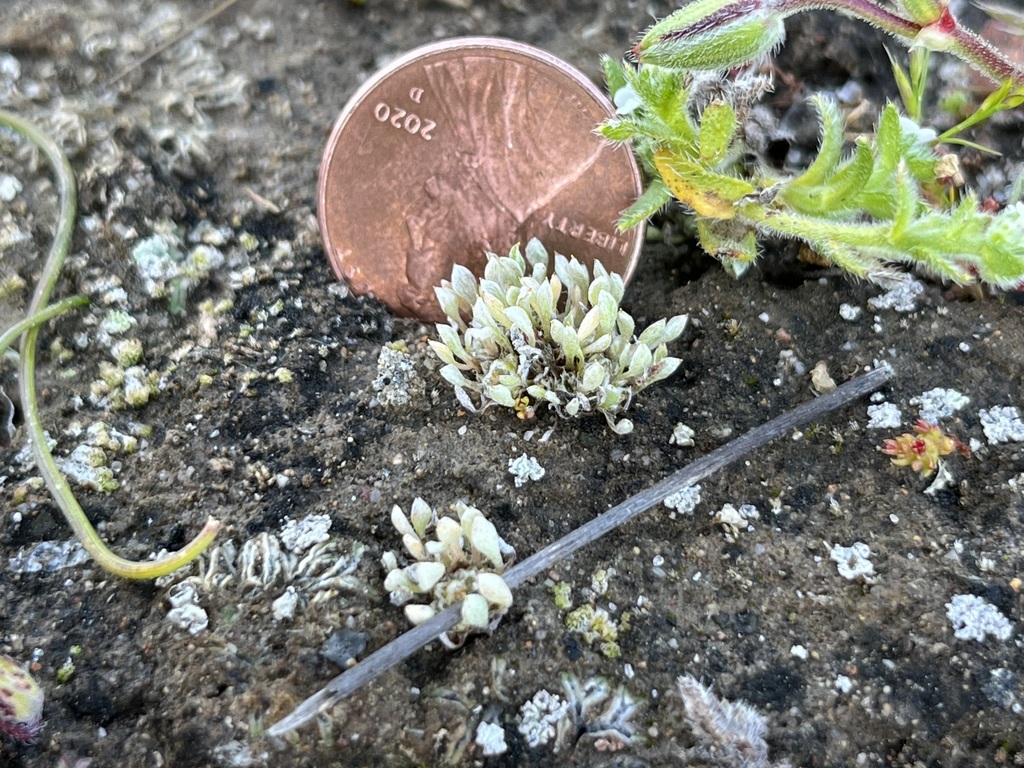
no rights reserved · CC0
Family: Asteraceae · Type: Annual · Native
Conservation status: CNPS 1B.1
Ancistrocarphus keilii (Santa ynez groundstar) is a native California annual in the Asteraceae family.
Santa ynez groundstar is a rare (CNPS 1B.1) California native annual found in southern Central Coast and southwestern Santa Barbara County in sandy chaparral bordering oak woodland at elevations of 40 to 130 meters. Flowering from March to April, this plant produces small white to tan flowers in tight clusters with delicate, nearly invisible disk. Growing with compact stems less than 10 centimeters tall, it thrives nestled under shrubs in sparse, protected environments. Its leaves are distinctive, spoon-shaped and small, measuring 8 to 10 millimeters long with a yellow to tan base that expands into a three-veined structure. The plant forms dense groupings with intricate flower heads that measure just 2.5 to 3.5 millimeters across, creating a subtle yet fascinating botanical display.
Identification and appearance
Key characters: 0 sympatric species - geographically isolated to Santa Barbara County coast, CNPS 1B.1
Habitat and range
Habitat: Sandy soils, chaparral bordering oak woodland, under shrubs
Elevation: 40-130 m
California counties: Santa Barbara
Bloom period
Ancistrocarphus keilii blooms Mar-Apr.
Conservation status
CNPS 1B.1
How to tell it apart
vs Logfia: Ancistrocarphus has distinctive inward-hooked spine tips; Logfia has mushroom-shaped heads without hooks.; vs Psilocarphus: Ancistrocarphus has hooked spine-tipped bracts; Psilocarphus has woolly heads without hooked spines.; vs Hesperevax: Ancistrocarphus has inward-hooked spine tips; Hesperevax has erect or spreading flat, blunt-tipped bracts.; vs Filago: Ancistrocarphus has prominent hooked spine-tipped bracts; Filago has cone-shaped heads without hooks.; vs Stylocline: Ancistrocarphus has distinctive fishhook-tipped bracts; Stylocline lacks hooked spines entirely.
Frequently asked questions
Is Ancistrocarphus keilii native to California?
Yes. Ancistrocarphus keilii is native to California (recorded as native).
When does Ancistrocarphus keilii bloom?
Ancistrocarphus keilii blooms Mar-Apr.
Where in California does Ancistrocarphus keilii grow?
Ancistrocarphus keilii occurs in Santa Barbara, at elevations of 40-130 m.
What plant family does Ancistrocarphus keilii belong to?
Ancistrocarphus keilii is in the Asteraceae family, genus Ancistrocarphus.
Is Ancistrocarphus keilii rare or endangered?
Ancistrocarphus keilii carries California Rare Plant Rank 1B.1, state rank S1.
Related species
Other California species in the same genus, family, or bioregion.
Sources: Jepson eFlora · CNPS Rare Plant Inventory · Index of California Plant Names · CalPhotos · CDFW CNDDB
Last updated 2026-09-30
Data from The California Species Project — 14,000+ California species with verified data from CNPS, CDFW, USFWS, Cal-IPC, and more.