Andersonglossum occidentale
Western hound's tongue, Western Hound's Tongue
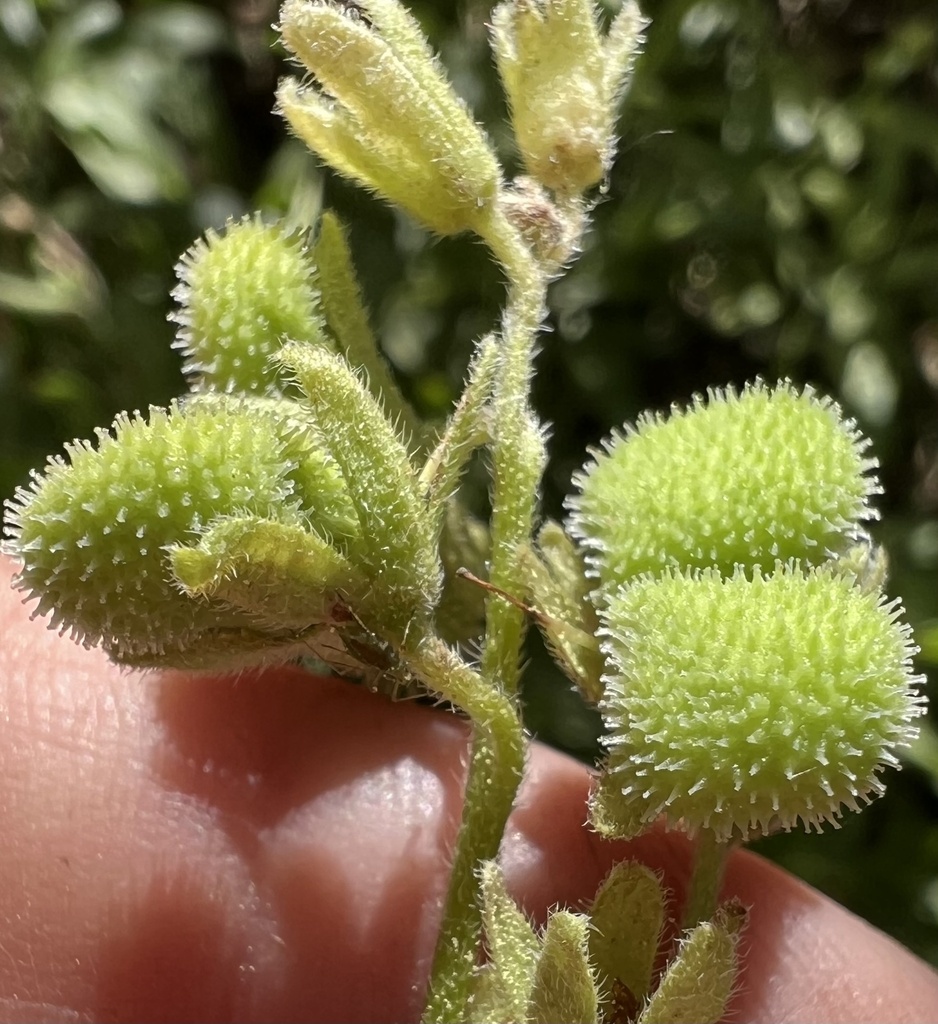
(c) Steve Matson, some rights reserved (CC BY) · licence
Family: Boraginaceae · Type: Herb · Native
Andersonglossum occidentale (Western hound's tongue) is a native California herb in the Boraginaceae family, recognized by Recently segregated from Cynoglossum, represents Pacific Northwest endemic lineage.
Western hound's tongue is a California native perennial found in the Klamath Ranges, northern Coast Ranges, California Ranges, Sierra Nevada, and North Coast Mountains in open, dry conifer forests at elevations of 900 to 2,600 meters. Flowering from May to July, this plant produces blue flowers with rose to brown tints, bell-shaped and approximately 6 to 9 millimeters long with white appendages. Growing with clustered stems 15 to 50 centimeters tall that are spread with soft hairs, it forms multiple stems from a single base. Its basal leaves are rough-hairy and oblanceolate, measuring 5 to 15 centimeters long with a tapered base and winged petiole 4 to 10 centimeters in length. The fruit consists of nearly spherical nutlets that are ascending and spread outward.
Identification and appearance
Key characters: Recently segregated from Cynoglossum, represents Pacific Northwest endemic lineage
Habitat and range
Habitat: Open, dry, conifer forest
Elevation: 900-2600 m
California counties: Fresno, Tulare, Shasta, Tehama, Trinity, Kern, Lassen, Mariposa, Tuolumne, El Dorado, Mendocino, Siskiyou, Sierra, Nevada, Placer, Modoc, Plumas, Butte, Glenn, Humboldt, Colusa, Lake, Monterey
Outside California: to central Oregon
Bloom period
Andersonglossum occidentale blooms May-Jul.
How to tell it apart
vs Adelinia: Andersonglossum is rough spreading-hairy, not glaucous, with many cauline leaves; Adelinia is glabrous and glaucous with leaves concentrated in a low basal cluster.; vs Cynoglossum: Andersonglossum is a native of dry western slopes with dull blue, reddish-tinged bell-shaped flowers and merely rough (not soft-velvety) hairs; Cynoglossum officinale is a weedy biennial with uniformly reddish-purple flowers and softer hairs.; vs Hackelia: Andersonglossum nutlets are prickly over the whole back; Hackelia (stickseed) nutlets carry a marginal fringe of barbed prickles.; vs Mertensia: Andersonglossum has flat-faced blue flowers with throat scales and 4 bur nutlets; Mertensia has nodding tubular bells and smooth nutlets.; vs Myosotis: Andersonglossum is a coarse rough-hairy perennial with bur fruit; Myosotis is a slender plant with tiny flowers in coiled cymes and smooth nutlets.
Frequently asked questions
Is Andersonglossum occidentale native to California?
Yes. Andersonglossum occidentale is native to California (recorded as native).
When does Andersonglossum occidentale bloom?
Andersonglossum occidentale blooms May-Jul.
Where in California does Andersonglossum occidentale grow?
Andersonglossum occidentale occurs in Fresno, Tulare, Shasta, Tehama, Trinity, Kern, Lassen, Mariposa and other counties, at elevations of 900-2600 m.
What plant family does Andersonglossum occidentale belong to?
Andersonglossum occidentale is in the Boraginaceae family, genus Andersonglossum.
What habitat does Andersonglossum occidentale grow in?
Andersonglossum occidentale grows in Open, dry, conifer forest.
Related species
Other California species in the same genus, family, or bioregion.
Sources: Jepson eFlora · Index of California Plant Names · CalPhotos
Last updated 2026-10-07
Data from The California Species Project — 14,000+ California species with verified data from CNPS, CDFW, USFWS, Cal-IPC, and more.