Andropogon virginicus var. virginicus
Broomsedge bluestem
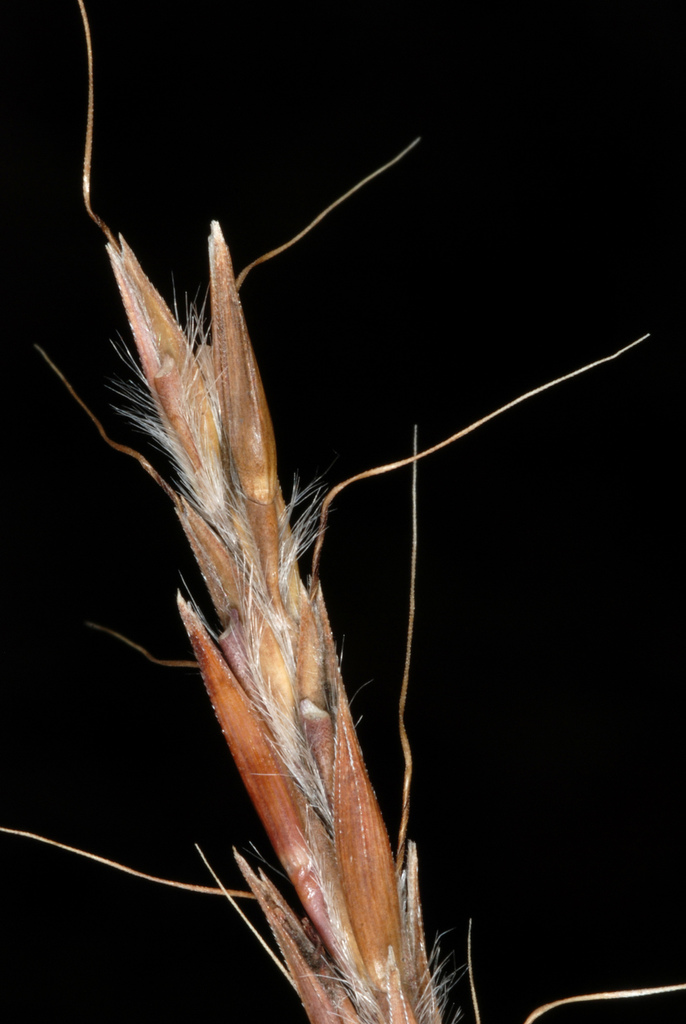
(c) Douglas Goldman, some rights reserved (CC BY-SA), uploaded by Douglas Goldman · licence
Family: Poaceae · Type: Grass · Not Native
Andropogon virginicus var. virginicus (Broomsedge bluestem) is a non-native California grass in the Poaceae family, recognized by smaller size, spikelet length, and non-native status with broader geographic range.
Broomsedge bluestem is a naturalized perennial found in northern Coast Ranges, California Reserve Forests, northern Sierra Nevada foothills, northern Sierra Nevada, Sacramento Valley, and San Francisco Bay Area in moist, open, disturbed areas and seeps at elevations below 300 meters. Flowering from September to January, this grass produces tan to golden-brown spikelets with distinctive hairy calluses. Growing with tall stems 50 to 200 centimeters high, it forms dense, compact clusters of grass blades. Its lower leaf blades are 10 to 50 centimeters long and 1.5 to 5 millimeters wide, creating a wispy, delicate appearance. The spikelets are 3.5 to 4 millimeters long, with callus hairs 1 to 2.5 millimeters in length.
Identification and appearance
Key characters: 1 sympatric species; distinguished by smaller size, spikelet length, and non-native status with broader geographic range
Habitat and range
Habitat: Moist, open, disturbed areas, seeps
Elevation: < 300 m
Outside California: native to central and eastern United States, Mexico, South America, widely naturalized, other varieties in eastern and southeastern United States
Bloom period
Andropogon virginicus var. virginicus blooms Sep-Jan.
How to tell it apart
vs Anatherum: Andropogon has fluffy, cottony seed heads from hairy bristles; check spikelet arrangement.; vs Sorghum: Andropogon has single spikelets per node; Sorghum has paired or clustered spikelets.; vs Hyparrhenia: Andropogon has one spikelet per node; Hyparrhenia has paired spikelets.; vs Bothriochloa: Andropogon has single spikelets at nodes; Bothriochloa has paired spikelets.; vs Heteropogon: Andropogon has single spikelets per node; Heteropogon has multiple spikelets per node.
Frequently asked questions
Is Andropogon virginicus var. virginicus native to California?
No. Andropogon virginicus var. virginicus is not native to California (recorded as not native).
When does Andropogon virginicus var. virginicus bloom?
Andropogon virginicus var. virginicus blooms Sep-Jan.
What plant family does Andropogon virginicus var. virginicus belong to?
Andropogon virginicus var. virginicus is in the Poaceae family, genus Andropogon.
What habitat does Andropogon virginicus var. virginicus grow in?
Andropogon virginicus var. virginicus grows in Moist, open, disturbed areas, seeps.
Related species
Other California species in the same genus, family, or bioregion.
Sources: Jepson eFlora · CalPhotos
Last updated 2026-10-07
Data from The California Species Project — 14,000+ California species with verified data from CNPS, CDFW, USFWS, Cal-IPC, and more.