Angelica tomentosa
Woolly angelica
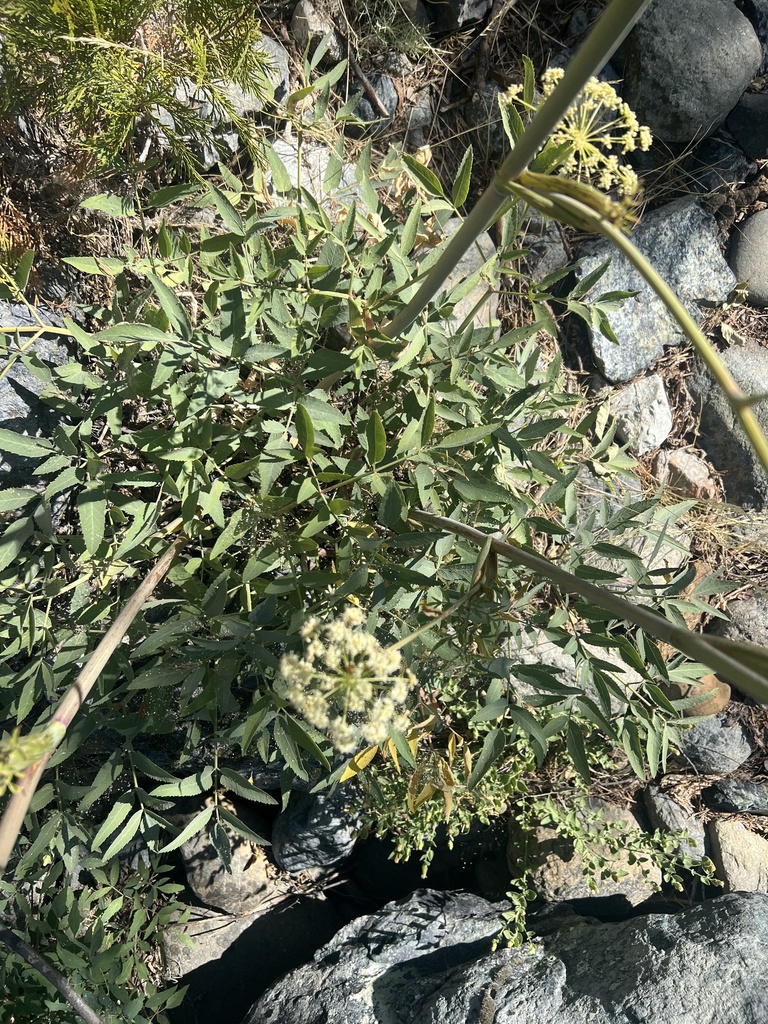
no rights reserved · CC0
Family: Apiaceae · Type: Herb · Native
Angelica tomentosa (Woolly angelica) is a native California herb in the Apiaceae family, recognized by glaucous appearance and variable pubescence.
Woolly angelica is a California native perennial found in the Klamath Ranges, northern coastal California, Channel Islands, San Gabriel Mountains, San Bernardino Mountains, and Peninsular Ranges in generally wooded areas at elevations of 30 to 2,400 meters. Flowering from June to August, this plant produces white flowers in large umbrella-like clusters with 20 to 60 rays. Growing 70 to 200 centimeters tall with glaucous, smooth to hairy stems, it develops complex, broad triangular-ovate leaves divided into multiple layers of pinnate leaflets. Its leaves are intricately structured with 2 to 3 levels of divisions, featuring leaflets 2 to 12 centimeters long that are lanceolate to ovate, with sharply pointed tips and sometimes serrated edges. The fruit is a small, oblong to ovate structure 6 to 10 millimeters long.
Identification and appearance
Key characters: 5 sympatric species; distinguished by glaucous appearance and variable pubescence
Habitat and range
Habitat: Generally wooded areas
Elevation: 30-2400 m
California counties: Humboldt, Los Angeles, Riverside, San Bernardino, San Diego, Lake, Trinity, Marin, Napa, Colusa, Sonoma, Mendocino, Siskiyou, Glenn, Santa Cruz, San Mateo, Santa Clara, Santa Barbara, Del Norte, Shasta, Tulare, Kern, Alameda
Outside California: southern Oregon
Bloom period
Angelica tomentosa blooms Jun-Aug.
How to tell it apart
vs Heracleum: Angelica has uniform petals across the flower cluster; Heracleum has dramatically enlarged outer petals.; vs Oenanthe: Angelica has coarse leaf segments; Oenanthe has finely divided, almost feathery leaflets.; vs Cicuta: Angelica has a smooth stem base; Cicuta stem base has chambered cross-sections visible when cut.; vs Sambucus: Angelica has umbrella-shaped flower clusters and divided leaves; Sambucus has flat-topped clusters and opposite leaves.; vs Ligusticum: Angelica has a smooth stem base; Ligusticum stem base is wrapped in fibrous leaf remains.
Frequently asked questions
Is Angelica tomentosa native to California?
Yes. Angelica tomentosa is native to California (recorded as native).
When does Angelica tomentosa bloom?
Angelica tomentosa blooms Jun-Aug.
Where in California does Angelica tomentosa grow?
Angelica tomentosa occurs in Humboldt, Los Angeles, Riverside, San Bernardino, San Diego, Lake, Trinity, Marin and other counties, at elevations of 30-2400 m.
What plant family does Angelica tomentosa belong to?
Angelica tomentosa is in the Apiaceae family, genus Angelica.
What habitat does Angelica tomentosa grow in?
Angelica tomentosa grows in Generally wooded areas.
Related species
Other California species in the same genus, family, or bioregion.
- Angelica arguta — Angelica
- Angelica breweri — Brewer's angelica
- Angelica californica — California angelica
- Angelica callii — Call's angelica
- Angelica capitellata — Ranger's buttons
- Angelica genuflexa — Kneeling angelica
- Anthriscus caucalis — Bur-chervil
- Anthriscus sp.
- Apiastrum angustifolium — Mock parsley
- Apiastrum sp.
Sources: Jepson eFlora · Index of California Plant Names · CalPhotos
Last updated 2026-10-07
Data from The California Species Project — 14,000+ California species with verified data from CNPS, CDFW, USFWS, Cal-IPC, and more.