Anisocarpus scabridus
Scabrid alpine tarplant, scabrid alpine tarplant, scabrid alpine tarplant
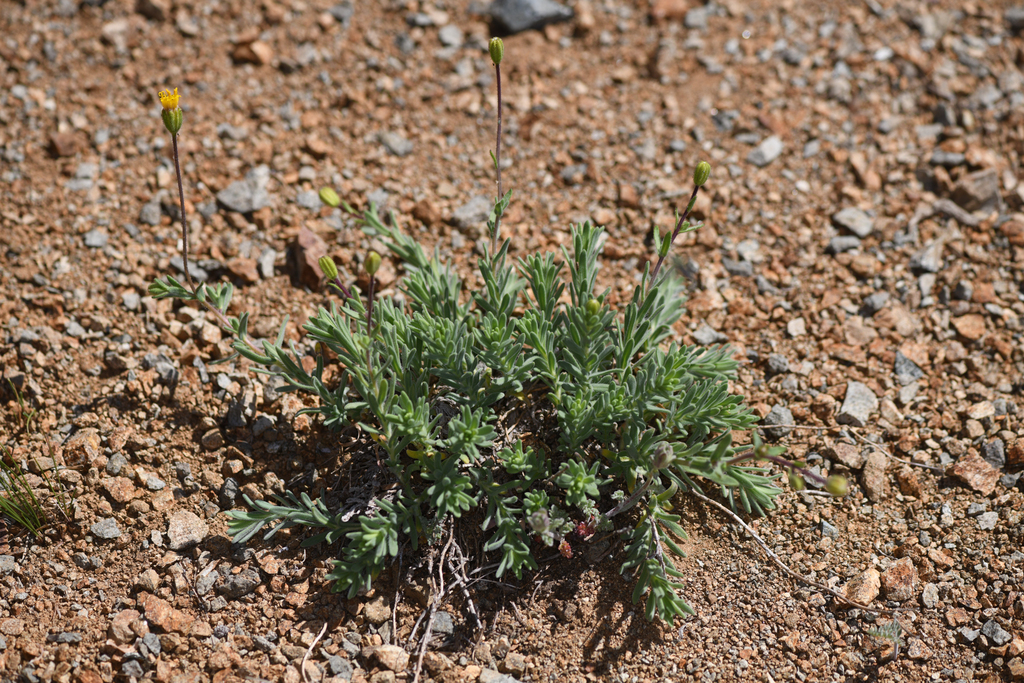
(c) Trevor Van Loon, some rights reserved (CC BY) · licence
Family: Asteraceae · Type: Herb · Native
Conservation status: CNPS 1B.3
Anisocarpus scabridus (Scabrid alpine tarplant) is a native California herb in the Asteraceae family, recognized by clear elevation and habitat separation plus distinct leaf width and fruit size.
Scabrid alpine tarplant is a rare (CNPS 1B.3) California native perennial found in the Klamath Ranges, northern Coast Ranges, and California Ranges on open ridges and slopes in metamorphic terrain at elevations of 1,600 to 2,400 meters. Flowering from June to September, this plant produces yellow ray flowers 3.5 to 11.5 millimeters long with multiple disk flowers in compact clusters. Growing 10 to 50 centimeters tall with slender, somewhat erect stems, it forms a delicate, sparse herbaceous structure. Its narrow leaves are 1 to 4 millimeters wide with acute or blunt tips, arranged along the stems with a sparse, slightly rough texture. The fruit consists of distinctive ray fruits 6 to 8 millimeters long and disk fruits 5 to 9 millimeters long, slightly cylindrical in shape.
Identification and appearance
Key characters: 1 sympatric species; clear elevation and habitat separation plus distinct leaf width and fruit size
Habitat and range
Habitat: Open ridges or slopes on metamorphics
Elevation: 1600-2400 m
California counties: Mendocino, Shasta, Lake, Tehama, Trinity, Colusa
Bloom period
Anisocarpus scabridus blooms Jun-Sep.
Conservation status
CNPS 1B.3
How to tell it apart
vs Madia: Anisocarpus ray fruits have short beaks; Madia ray fruits lack beaks.; vs Hemizonia: Anisocarpus is perennial with beaked ray fruits; Hemizonia is annual without beaked fruits.; vs Layia: Anisocarpus has short-beaked ray fruits; Layia fruits have prominent feathery bristles.; vs Deinandra: Anisocarpus is perennial in moist woods; Deinandra is annual in drier habitats.; vs Hypochaeris: Anisocarpus has bell-shaped heads; Hypochaeris has dandelion-like heads with all ray flowers.
Frequently asked questions
Is Anisocarpus scabridus native to California?
Yes. Anisocarpus scabridus is native to California (recorded as native).
When does Anisocarpus scabridus bloom?
Anisocarpus scabridus blooms Jun-Sep.
Where in California does Anisocarpus scabridus grow?
Anisocarpus scabridus occurs in Mendocino, Shasta, Lake, Tehama, Trinity, Colusa, at elevations of 1600-2400 m.
What plant family does Anisocarpus scabridus belong to?
Anisocarpus scabridus is in the Asteraceae family, genus Anisocarpus.
Is Anisocarpus scabridus rare or endangered?
Anisocarpus scabridus carries California Rare Plant Rank 1B.3, state rank S3.
Related species
Other California species in the same genus, family, or bioregion.
Sources: Jepson eFlora · CNPS Rare Plant Inventory · Index of California Plant Names · CalPhotos · CDFW CNDDB
Last updated 2026-10-07
Data from The California Species Project — 14,000+ California species with verified data from CNPS, CDFW, USFWS, Cal-IPC, and more.