Antennaria flagellaris
Stoloniferous pussy-toes, stoloniferous pussy-toes, stoloniferous pussy-toes
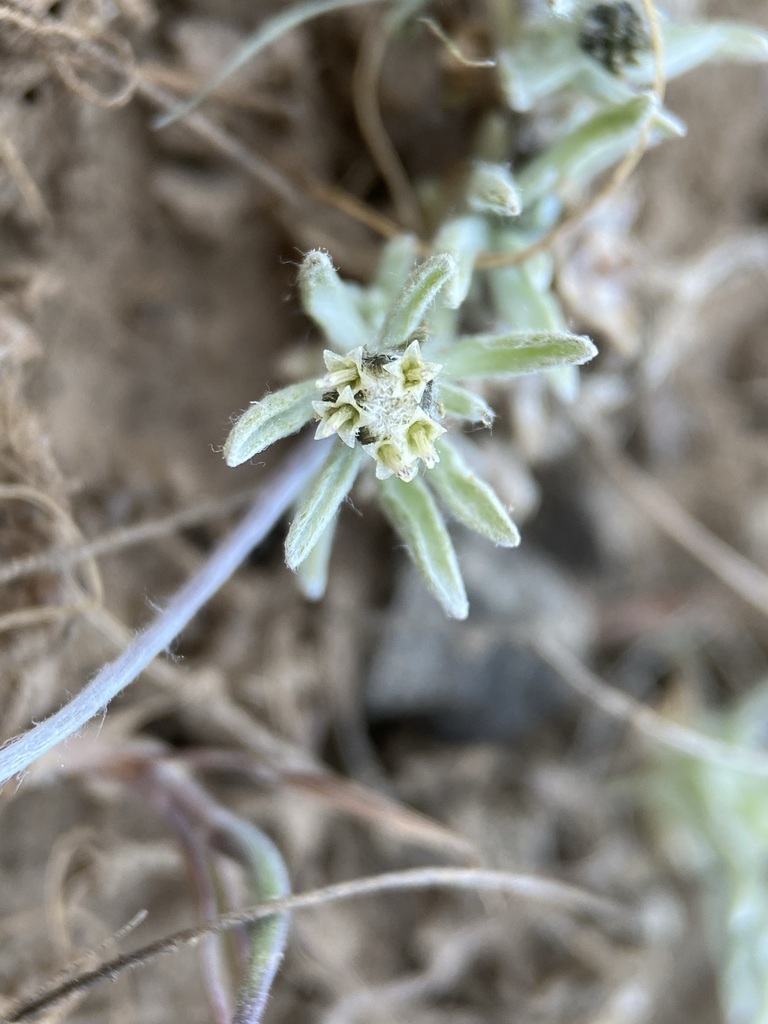
(c) Matt Berger, some rights reserved (CC BY), uploaded by Matt Berger · licence
Family: Asteraceae · Type: Herb · Native
Conservation status: CNPS 4.2
Antennaria flagellaris (Stoloniferous pussy-toes) is a native California herb in the Asteraceae family, recognized by distinctive long slender stolons and single heads on very short stems.
Stoloniferous pussy-toes is a California native perennial ranked 4.2 by CNPS, found in the Modoc Plateau in seasonally moist sagebrush scrub at elevations around 1,750 meters. Flowering from May to June, this plant produces white flowers in small heads with brown to nearly black or nearly white phyllary tips. Growing with extremely short stems less than 1.5 centimeters tall emerging from a slender caudex, it spreads through delicate stolons 3 to 10 centimeters long. Its basal leaves are linear-oblanceolate, 16 to 18 millimeters long, with a grayish woolly texture and a single prominent vein. The plant produces tiny fruits 2 to 3 millimeters long with a pappus of slender bristles 6 to 8 millimeters in length.
Identification and appearance
Key characters: 7 sympatric species - distinctive long slender stolons and single heads on very short stems
Habitat and range
Habitat: Seasonally moist sagebrush scrub
Elevation: 1750 m
Outside California: to British Columbia, Idaho, South Dakota, Nevada
Bloom period
Antennaria flagellaris blooms May-Jun.
Conservation status
CNPS 4.2
How to tell it apart
vs Pseudognaphalium: Antennaria forms low cushions with persistent basal rosettes; Pseudognaphalium grows erect to 200 cm without basal rosettes.; vs Eriogonum: Antennaria has papery-bracted flower heads in the Asteraceae; Eriogonum has showy flowers with papery bracts in the buckwheat family.; vs Anaphalis: Antennaria maintains its basal leaf rosette during flowering; Anaphalis has withered basal leaves with longer, uniform stem leaves.; vs Centaurea: Antennaria has tiny woolly heads (3-9mm) in low cushions; Centaurea has much larger flower heads (15-40mm) on tall stems.; vs Petrophytum: Antennaria has papery-bracted flower heads; Petrophytum has dense spikes of small rose-family flowers with 5 separate petals.
Frequently asked questions
Is Antennaria flagellaris native to California?
Yes. Antennaria flagellaris is native to California (recorded as native).
When does Antennaria flagellaris bloom?
Antennaria flagellaris blooms May-Jun.
What plant family does Antennaria flagellaris belong to?
Antennaria flagellaris is in the Asteraceae family, genus Antennaria.
Is Antennaria flagellaris rare or endangered?
Antennaria flagellaris carries California Rare Plant Rank 4.2, state rank S3.
What habitat does Antennaria flagellaris grow in?
Antennaria flagellaris grows in Seasonally moist sagebrush scrub.
Related species
Other California species in the same genus, family, or bioregion.
Sources: Jepson eFlora · CalPhotos · CDFW CNDDB
Last updated 2026-10-07
Data from The California Species Project — 14,000+ California species with verified data from CNPS, CDFW, USFWS, Cal-IPC, and more.