Antennaria rosea subsp. confinis
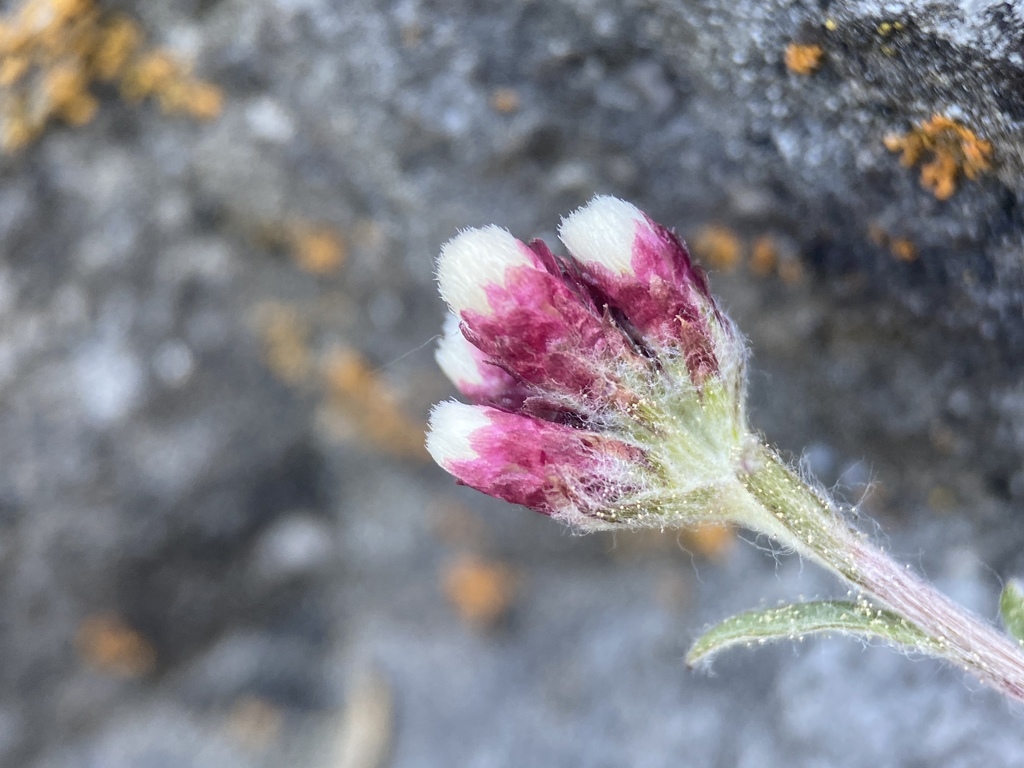
(c) Matt Berger, some rights reserved (CC BY), uploaded by Matt Berger · licence
Family: Asteraceae · Type: Herb · Native
Antennaria rosea subsp. confinis is a native California herb in the Asteraceae family, recognized by smaller size and brown phyllaries vs subsp. rosea.
Rosy pussytoes is a California native perennial found in the Klamath Ranges, northern California mountains, Sierra Nevada, southern California mountains, and Great Basin in woodland, meadow edges, and rocky areas at elevations of 1,200 to 3,700 meters. Flowering from June to August, this plant produces white to pink flowers in clusters of 4 to 11 heads approximately 4 to 6.5 millimeters long. Growing with slender stems 9 to 25 centimeters tall, it spreads through horizontal to ascending stolons that extend 15 to 45 millimeters. Its leaves form delicate rosettes with the longest flower cluster leaves measuring 8 to 20 millimeters, often with cauline leaves 6 to 20 millimeters long. The plant's distinctive brownish phyllaries and fine stolons allow it to create subtle, low-growing colonies in alpine and subalpine environments.
Identification and appearance
Key characters: 17 sympatric species - smaller size and brown phyllaries vs subsp. rosea
Habitat and range
Habitat: Woodland, meadow edges, rock barrens, dry ridges
Elevation: 1200-3700 m
Outside California: to Alaska, Greenland, Montana, Wyoming, Colorado, New Mexico
Bloom period
Antennaria rosea subsp. confinis blooms Jun-Aug.
How to tell it apart
vs Pseudognaphalium: Antennaria forms low cushions with persistent basal rosettes; Pseudognaphalium grows erect to 200 cm without basal rosettes.; vs Eriogonum: Antennaria has papery-bracted flower heads in the Asteraceae; Eriogonum has showy flowers with papery bracts in the buckwheat family.; vs Anaphalis: Antennaria maintains its basal leaf rosette during flowering; Anaphalis has withered basal leaves with longer, uniform stem leaves.; vs Centaurea: Antennaria has tiny woolly heads (3-9mm) in low cushions; Centaurea has much larger flower heads (15-40mm) on tall stems.; vs Petrophytum: Antennaria has papery-bracted flower heads; Petrophytum has dense spikes of small rose-family flowers with 5 separate petals.
Frequently asked questions
Is Antennaria rosea subsp. confinis native to California?
Yes. Antennaria rosea subsp. confinis is native to California (recorded as native).
When does Antennaria rosea subsp. confinis bloom?
Antennaria rosea subsp. confinis blooms Jun-Aug.
What plant family does Antennaria rosea subsp. confinis belong to?
Antennaria rosea subsp. confinis is in the Asteraceae family, genus Antennaria.
What habitat does Antennaria rosea subsp. confinis grow in?
Antennaria rosea subsp. confinis grows in Woodland, meadow edges, rock barrens, dry ridges.
Related species
Other California species in the same genus, family, or bioregion.
Sources: Jepson eFlora · Index of California Plant Names · CalPhotos
Last updated 2026-10-07
Data from The California Species Project — 14,000+ California species with verified data from CNPS, CDFW, USFWS, Cal-IPC, and more.