Antennaria suffrutescens
Evergreen everlasting, evergreen everlasting, evergreen everlasting
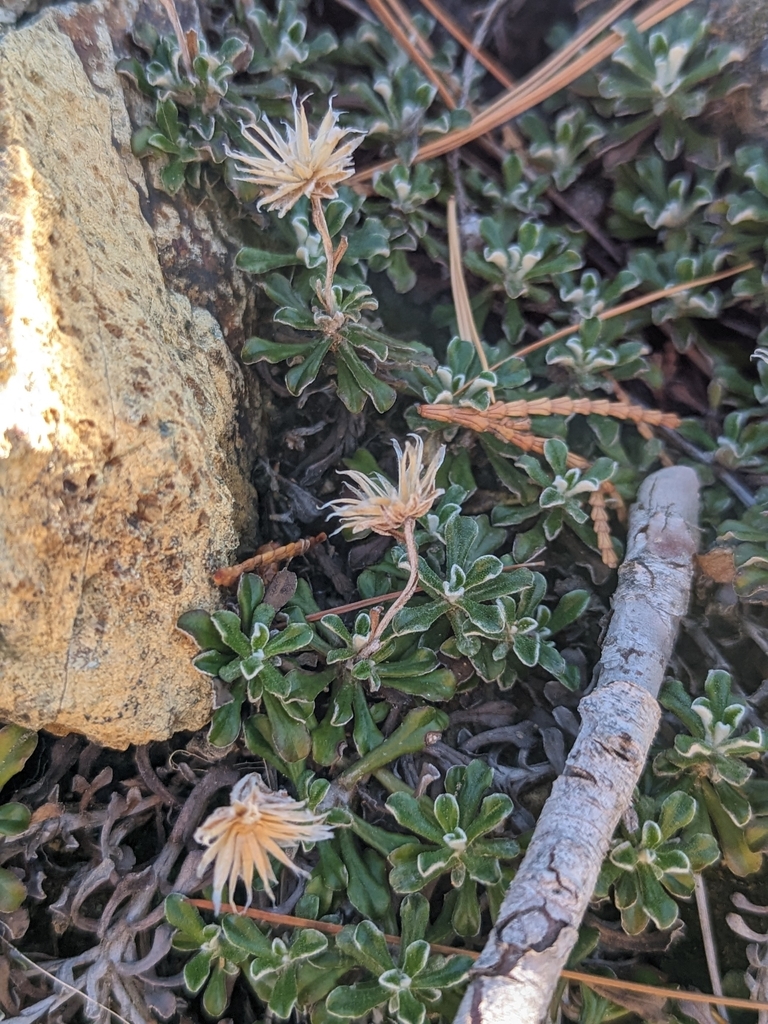
(c) Ernesto Chavez-Velasco, some rights reserved (CC BY) · licence
Family: Asteraceae · Type: Subshrub · Native
Conservation status: CNPS 4.3
Antennaria suffrutescens (Evergreen everlasting) is a native California subshrub in the Asteraceae family, recognized by notched evergreen leaves and woody tufted habit.
Evergreen everlasting is a California native perennial ranked 4.3 by CNPS, found in the Klamath Ranges and northern Coast Ranges in dry, open conifer woodland and serpentine barrens at elevations of 500 to 1,600 meters. Flowering from June to July, this plant produces white flowers in small, dense heads with green-yellow and white phyllaries. Growing with densely tufted stems 5 to 12 centimeters tall and woody at the base, it forms compact clusters. Its evergreen leaves are spoon-shaped, 5 to 12 millimeters long, thick and green on top, with a tomentose white underside and distinctively notched tips. The plant forms tight, low-growing clusters with persistent green foliage, creating a small, dense mat in its dry, rocky habitats.
Identification and appearance
Key characters: 10 sympatric species - notched evergreen leaves and woody tufted habit
Habitat and range
Habitat: Dry, open conifer woodland, serpentine barrens
Elevation: 500-1600 m
Outside California: Oregon
Bloom period
Antennaria suffrutescens blooms Jun-Jul.
Conservation status
CNPS 4.3
How to tell it apart
vs Pseudognaphalium: Antennaria forms low cushions with persistent basal rosettes; Pseudognaphalium grows erect to 200 cm without basal rosettes.; vs Eriogonum: Antennaria has papery-bracted flower heads in the Asteraceae; Eriogonum has showy flowers with papery bracts in the buckwheat family.; vs Anaphalis: Antennaria maintains its basal leaf rosette during flowering; Anaphalis has withered basal leaves with longer, uniform stem leaves.; vs Centaurea: Antennaria has tiny woolly heads (3-9mm) in low cushions; Centaurea has much larger flower heads (15-40mm) on tall stems.; vs Petrophytum: Antennaria has papery-bracted flower heads; Petrophytum has dense spikes of small rose-family flowers with 5 separate petals.
Frequently asked questions
Is Antennaria suffrutescens native to California?
Yes. Antennaria suffrutescens is native to California (recorded as native).
When does Antennaria suffrutescens bloom?
Antennaria suffrutescens blooms Jun-Jul.
What plant family does Antennaria suffrutescens belong to?
Antennaria suffrutescens is in the Asteraceae family, genus Antennaria.
Is Antennaria suffrutescens rare or endangered?
Antennaria suffrutescens carries California Rare Plant Rank 4.3, state rank S3.
What habitat does Antennaria suffrutescens grow in?
Antennaria suffrutescens grows in Dry, open conifer woodland, serpentine barrens.
Related species
Other California species in the same genus, family, or bioregion.
- Antennaria umbrinella — Brown pussytoes
- Antennaria argentea — Silver pussytoes
- Antennaria corymbosa — Flat top pussytoes
- Antennaria dimorpha — Gray cushion pussytoes
- Antennaria flagellaris — Stoloniferous pussy-toes
- Antennaria geyeri — Geyer's pussytoes
- Anthemis arvensis — Corn chamomile
- Anthemis cotula — Mayweed
- Anthemis sp. — Dog-fennel
Sources: Jepson eFlora · CNPS Rare Plant Inventory · Index of California Plant Names · CalPhotos · CDFW CNDDB
Last updated 2026-10-07
Data from The California Species Project — 14,000+ California species with verified data from CNPS, CDFW, USFWS, Cal-IPC, and more.