Anthoxanthum nitens subsp. nitens
Vanilla grass, Vanilla Grass, vanilla-grass
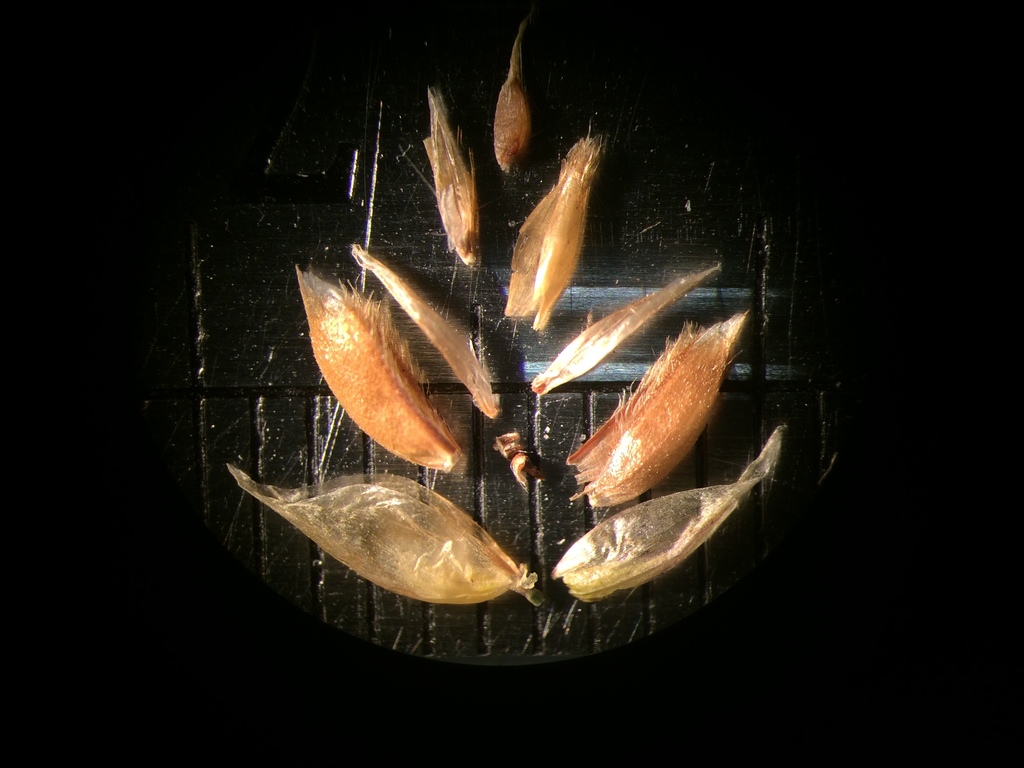
no rights reserved, uploaded by Étienne Lacroix-Carignan · CC0
Family: Poaceae · Type: Perennial · Native
Conservation status: CNPS 2B.3
Anthoxanthum nitens subsp. nitens (Vanilla grass) is a native California perennial in the Poaceae family, recognized by no sympatric species.
Vanilla grass is a rare (CNPS 2B.3) California native perennial found in northern California Ranges and Modoc Plateau in Shasta and Siskiyou counties, occurring in wet meadows at elevations of 1,500 to 1,800 meters. Flowering from April to July, this plant produces golden-brown flowers in open, drooping grass clusters 5 to 8 centimeters long. Growing with tufted or rhizomatous stems 20 to 50 centimeters tall, it forms dense grass clumps with slender, flexible stems. Its leaf blades are 10 to 30 centimeters long, 2 to 8 millimeters wide, and typically flat or slightly rolled, with glabrous to softly hairy leaf sheaths. Its distinctive spikelets are 3 to 7.5 millimeters long, with lower florets covered in tan to golden-brown hairs that are often papillate.
Identification and appearance
Key characters: Geographically isolated; no sympatric species
Habitat and range
Habitat: Wet sites, meadows
Elevation: 1500-1800 m
Outside California: to Alaska, Canada, eastern United States, Eurasia
Bloom period
Anthoxanthum nitens subsp. nitens blooms Apr-Jul.
Conservation status
CNPS 2B.3
How to tell it apart
vs Phalaris: Anthoxanthum spikelets have 2 awned sterile lemmas flanking a smaller fertile floret and smell sweet (coumarin) when dried; Phalaris (canary grass) has laterally flattened spikelets with scale-like sterile lemmas and no awns.; vs Alopecurus: Anthoxanthum's panicle is open to spike-like with 2-glumed awned spikelets; Alopecurus (foxtail) has a dense cylindric spike of 1-flowered spikelets with a single bent awn.; vs Phleum: Anthoxanthum spikelets are awned in a loose to spike-like head; Phleum (timothy) has a very dense, stiff cylindric spike of flat spikelets with short-awned glumes.; vs Holcus: Anthoxanthum is sweet-scented with awned sterile lemmas; Holcus (velvet grass) is softly velvety-hairy with a pale purple-tinged panicle and only a short hooked awn.; vs Agrostis: Anthoxanthum has conspicuous 2 sterile awned lemmas per spikelet; Agrostis (bentgrass) has tiny 1-flowered, essentially awnless spikelets in a diffuse open panicle.
Frequently asked questions
Is Anthoxanthum nitens subsp. nitens native to California?
Yes. Anthoxanthum nitens subsp. nitens is native to California (recorded as native).
When does Anthoxanthum nitens subsp. nitens bloom?
Anthoxanthum nitens subsp. nitens blooms Apr-Jul.
What plant family does Anthoxanthum nitens subsp. nitens belong to?
Anthoxanthum nitens subsp. nitens is in the Poaceae family, genus Anthoxanthum.
Is Anthoxanthum nitens subsp. nitens rare or endangered?
Anthoxanthum nitens subsp. nitens carries California Rare Plant Rank 2B.3, state rank S2.
What habitat does Anthoxanthum nitens subsp. nitens grow in?
Anthoxanthum nitens subsp. nitens grows in Wet sites, meadows.
Related species
Other California species in the same genus, family, or bioregion.
Sources: Jepson eFlora · CNPS Rare Plant Inventory · Index of California Plant Names · CalPhotos · CDFW CNDDB
Last updated 2026-09-30
Data from The California Species Project — 14,000+ California species with verified data from CNPS, CDFW, USFWS, Cal-IPC, and more.