Anthriscus caucalis
Bur-chervil
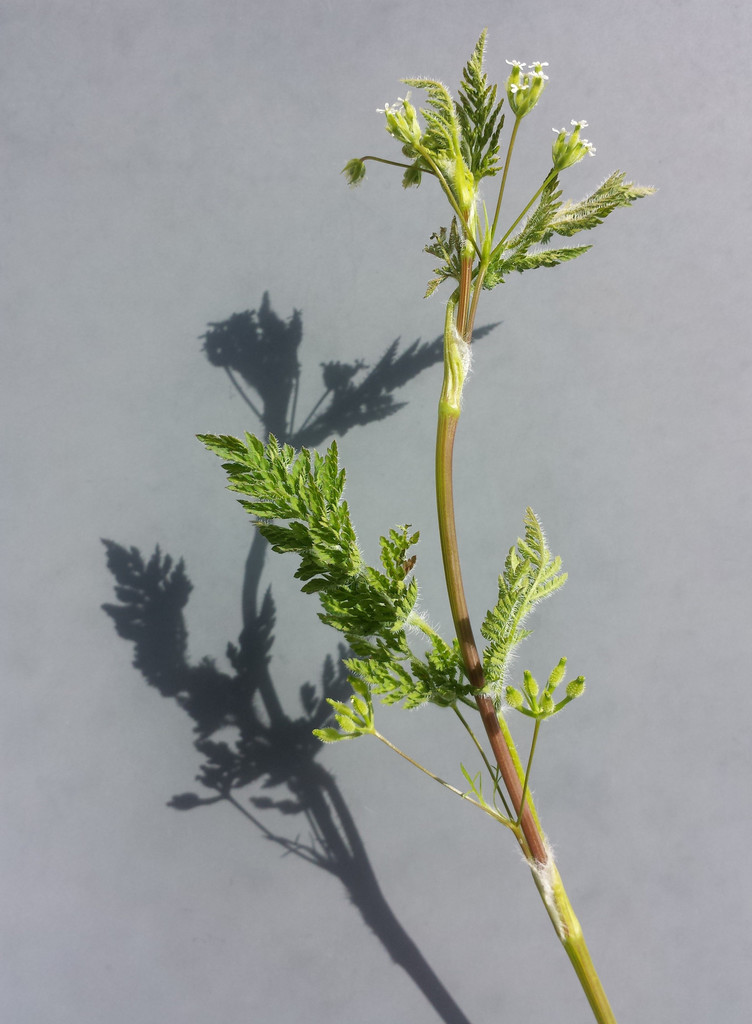
(c) Stefan.lefnaer, some rights reserved (CC BY-SA) · licence
Family: Apiaceae · Type: Herb · Not Native
Anthriscus caucalis (Bur-chervil) is a non-native California herb in the Apiaceae family, recognized by Eurasian genus with limited naturalization in California, distinguished by small bur-like fruits.
Bur-chervil is a naturalized annual found in the California Floristic Province and North Coast Ranges in generally shady places at elevations below 1,500 meters. Flowering from April to June, this plant produces small white flowers in delicate umbrella-like clusters with rays 1 to 2.5 centimeters long. Growing 45 to 100 centimeters tall with slender, branching stems, it has a spreading, open habit. Its finely dissected leaves are pinnately divided into narrow, obtuse segments 1 to 5 millimeters long, creating a delicate, lacy appearance. The fruit is a small ovoid structure approximately 4 millimeters long with a short beak.
Identification and appearance
Key characters: Eurasian genus with limited naturalization in California, distinguished by small bur-like fruits
Habitat and range
Habitat: Generally shady places
Elevation: < 1500 m
California counties: San Diego, Santa Barbara, Santa Clara, San Bernardino, Orange, Riverside, Los Angeles, San Luis Obispo, Marin, Yolo, San Mateo, Sonoma, Tulare, Napa, Mendocino, Butte, San Francisco, Fresno, Monterey, Yuba, Mariposa, Kern, San Benito, Placer, Amador, Sutter, El Dorado, Calaveras, Alameda, Solano, Sacramento, Contra Costa, Tehama, Glenn, Shasta, Colusa, Santa Cruz, Lake, Humboldt, Siskiyou, Trinity, Ventura, Alpine, Merced, San Joaquin, Stanislaus
Outside California: native to Eurasia
Bloom period
Anthriscus caucalis blooms Apr-Jun.
How to tell it apart
vs Conium: Anthriscus has smooth fruits with short beaks; poison hemlock has wavy-ridged fruits and purple-spotted stems.; vs Torilis: Anthriscus fruits are smooth with short beaks; Torilis fruits are densely covered in hooked prickles.; vs Chaerophyllum: Anthriscus has nearly smooth fruits; Chaerophyllum fruits have prominent narrow ribs running lengthwise.; vs Heracleum: Anthriscus is a small annual with tiny fruits; cow parsnip is a giant perennial with large flat fruits.; vs Daucus: Anthriscus fruits are smooth with short beaks; carrot fruits are densely bristly without beaks.
Frequently asked questions
Is Anthriscus caucalis native to California?
No. Anthriscus caucalis is not native to California (recorded as not native).
When does Anthriscus caucalis bloom?
Anthriscus caucalis blooms Apr-Jun.
Where in California does Anthriscus caucalis grow?
Anthriscus caucalis occurs in San Diego, Santa Barbara, Santa Clara, San Bernardino, Orange, Riverside, Los Angeles, San Luis Obispo and other counties, at elevations of < 1500 m.
What plant family does Anthriscus caucalis belong to?
Anthriscus caucalis is in the Apiaceae family, genus Anthriscus.
What habitat does Anthriscus caucalis grow in?
Anthriscus caucalis grows in Generally shady places.
Related species
Other California species in the same genus, family, or bioregion.
Sources: Jepson eFlora · Index of California Plant Names · CalPhotos
Last updated 2026-10-07
Data from The California Species Project — 14,000+ California species with verified data from CNPS, CDFW, USFWS, Cal-IPC, and more.