Antirrhinum mohavea
Golden desert snapdragon
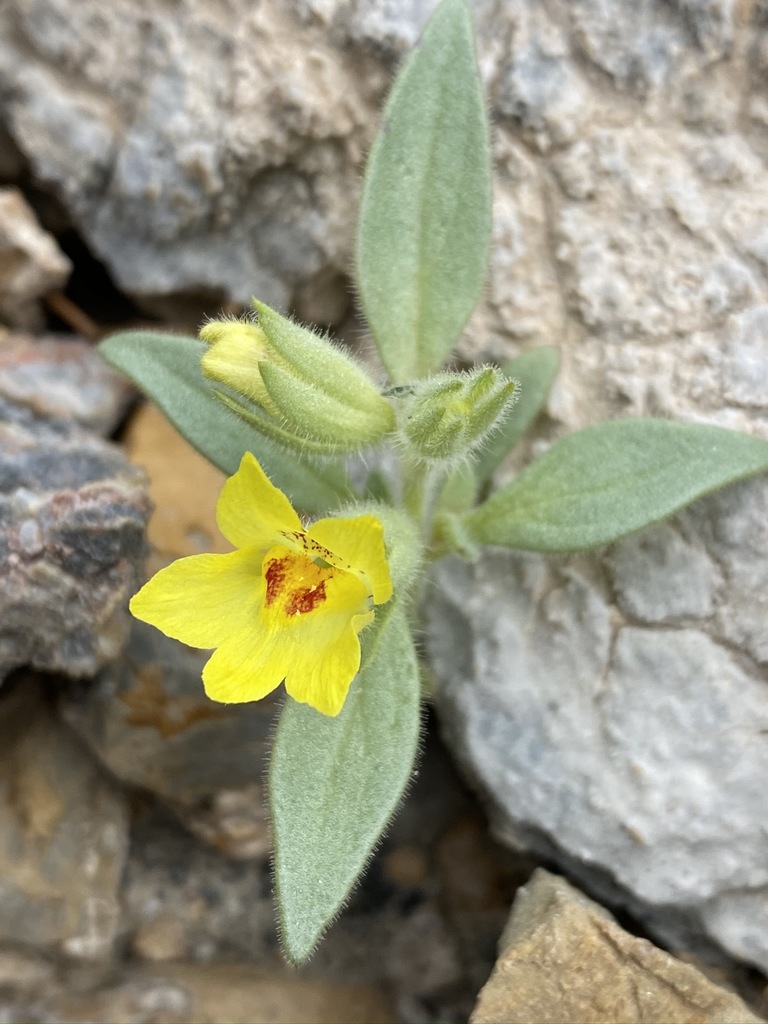
(c) Matt Berger, some rights reserved (CC BY) · licence
Family: Plantaginaceae · Type: Herb · Native
Antirrhinum mohavea (Golden desert snapdragon) is a native California herb in the Plantaginaceae family, recognized by bright yellow color and maroon blotch pattern.
Golden desert snapdragon is a California native annual found in the Mojave Desert in gravelly desert slopes and washes at elevations below 1,850 meters. Flowering from February to May, this plant produces bright yellow flowers 15 to 20 millimeters long with a distinctive maroon blotch on the lower lip and finely purple-dotted upper lip. Growing with erect, self-supporting stems 5 to 20 centimeters tall and covered in glandular hairs throughout, the plant has a delicate desert adaptation. Its leaves range from 15 to 40 millimeters long, varying from linear to lanceolate or ovate with acute tips. The fragile fruit is obliquely ovoid and 8 to 10 millimeters long, containing flat, smooth seeds with an incurved wing.
Identification and appearance
Key characters: 3 sympatric species; key features are bright yellow color and maroon blotch pattern
Habitat and range
Habitat: Gravelly desert slopes, washes
Elevation: < 1850 m
California counties: San Bernardino, Inyo, Kern, Los Angeles
Outside California: southern Nevada, northwestern Arizona
Bloom period
Antirrhinum mohavea blooms Feb-May.
How to tell it apart
vs Linaria: Antirrhinum has a bulging sac at flower base; Linaria has a long backward-pointing spur.; vs Sairocarpus: Antirrhinum has hairy plants with twining flower stalks; Sairocarpus is glabrous with straight stalks.; vs Penstemon: Antirrhinum has closed snapdragon mouth with 4 stamens; Penstemon has open throat with 5 stamens (one sterile).; vs Salvia: Antirrhinum has 4 stamens hidden inside; Salvia has 2 stamens arching out of hooded upper lip.; vs Rosa: Antirrhinum has tubular two-lipped flowers; Rosa has flat open flowers with 5 separate petals and thorny stems.
Frequently asked questions
Is Antirrhinum mohavea native to California?
Yes. Antirrhinum mohavea is native to California (recorded as native).
When does Antirrhinum mohavea bloom?
Antirrhinum mohavea blooms Feb-May.
Where in California does Antirrhinum mohavea grow?
Antirrhinum mohavea occurs in San Bernardino, Inyo, Kern, Los Angeles, at elevations of < 1850 m.
What plant family does Antirrhinum mohavea belong to?
Antirrhinum mohavea is in the Plantaginaceae family, genus Antirrhinum.
What habitat does Antirrhinum mohavea grow in?
Antirrhinum mohavea grows in Gravelly desert slopes, washes.
Related species
Other California species in the same genus, family, or bioregion.
Sources: Jepson eFlora · Index of California Plant Names · CalPhotos
Last updated 2026-10-07
Data from The California Species Project — 14,000+ California species with verified data from CNPS, CDFW, USFWS, Cal-IPC, and more.