Aphanes occidentalis
Western lady's mantle
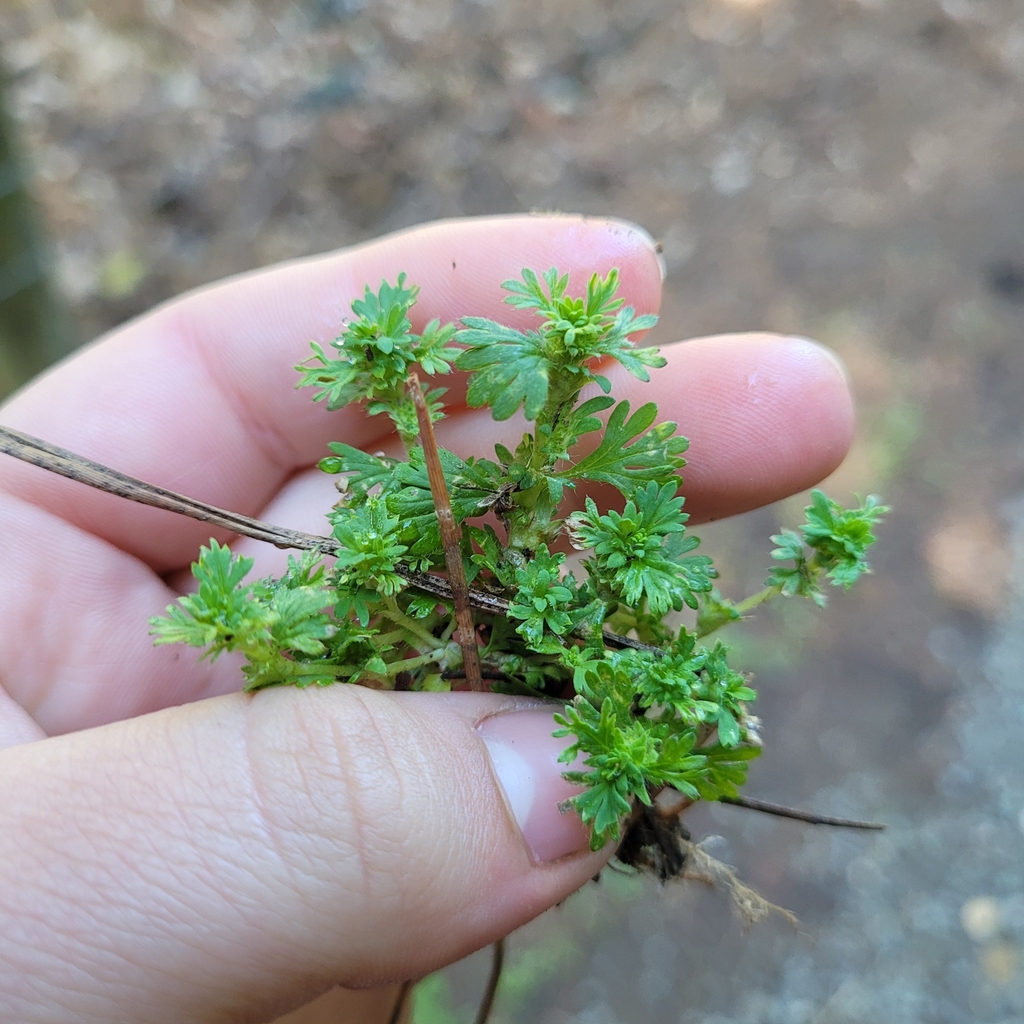
(c) Julia Palmer, some rights reserved (CC BY-SA) · licence
Family: Rosaceae · Type: Annual · Native
Aphanes occidentalis (Western lady's mantle) is a native California annual in the Rosaceae family, recognized by Only representative of Aphanes in CA - a specialized genus of minute annual herbs distinct from other rose family genera by lack of….
Western lady's mantle is a California native annual found in northwestern California, the Cascade Range foothills, Sierra Nevada foothills, Sacramento Valley, central western, and southwestern California in seasonally moist grasslands, chaparral, and woodland areas at elevations of 30 to 1,200 meters. Flowering from March to May, this plant produces tiny greenish flowers less than 2 millimeters long. Growing with delicate stems 2 to 10 centimeters tall, it forms low, compact clusters. Its leaves are distinctive with widely ovate stipules, deeply lobed blades about 2 to 5 millimeters across, featuring three main lobes that extend more than two-thirds to the base and are further toothed or subdivided. The fruit is a small, ovoid achene approximately 1 millimeter long.
Identification and appearance
Key characters: Only representative of Aphanes in CA - a specialized genus of minute annual herbs distinct from other rose family genera by lack of petals and extremely reduced flower size
Habitat and range
Habitat: Seasonally moist grassland, chaparral, woodland
Elevation: 30-1200 m
California counties: Santa Barbara, Tulare, San Luis Obispo, Plumas, Butte, Nevada, Kern, Monterey, Sonoma, Los Angeles, Lake, Riverside, Napa, San Benito, Orange, San Bernardino, San Mateo, San Diego, Santa Clara, Mendocino, Yuba, Fresno, Marin, Mariposa, El Dorado, San Francisco, Santa Cruz, Amador, Calaveras, Sutter, Tuolumne, Placer, Solano, Tehama, Glenn, Colusa, Humboldt, Contra Costa, Stanislaus, San Joaquin, Alameda, Del Norte, Ventura
Outside California: to Washington, Baja California
Bloom period
Aphanes occidentalis blooms Mar-May.
How to tell it apart
vs Acaena: Acaena has pinnately compound leaves with many leaflets; Aphanes has single palmately lobed leaves.; vs Poteridium: Poteridium is a perennial with pinnate leaves; Aphanes is an annual with palmate leaves.; vs Poterium: Poterium has pinnately compound leaves; Aphanes has palmately lobed simple leaves.; vs Sanguisorba: Sanguisorba has pinnately compound leaves and conspicuous flower spikes; Aphanes has palmate leaves and hidden flowers.
Frequently asked questions
Is Aphanes occidentalis native to California?
Yes. Aphanes occidentalis is native to California (recorded as native).
When does Aphanes occidentalis bloom?
Aphanes occidentalis blooms Mar-May.
Where in California does Aphanes occidentalis grow?
Aphanes occidentalis occurs in Santa Barbara, Tulare, San Luis Obispo, Plumas, Butte, Nevada, Kern, Monterey and other counties, at elevations of 30-1200 m.
What plant family does Aphanes occidentalis belong to?
Aphanes occidentalis is in the Rosaceae family, genus Aphanes.
What habitat does Aphanes occidentalis grow in?
Aphanes occidentalis grows in Seasonally moist grassland, chaparral, woodland.
Related species
Other California species in the same genus, family, or bioregion.
Sources: Jepson eFlora · Index of California Plant Names · CalPhotos
Last updated 2026-10-06
Data from The California Species Project — 14,000+ California species with verified data from CNPS, CDFW, USFWS, Cal-IPC, and more.