Aphyllon epigalium subsp. notocalifornicum
Galium broomrape, Galium Broomrape, Southern California galium broomrape
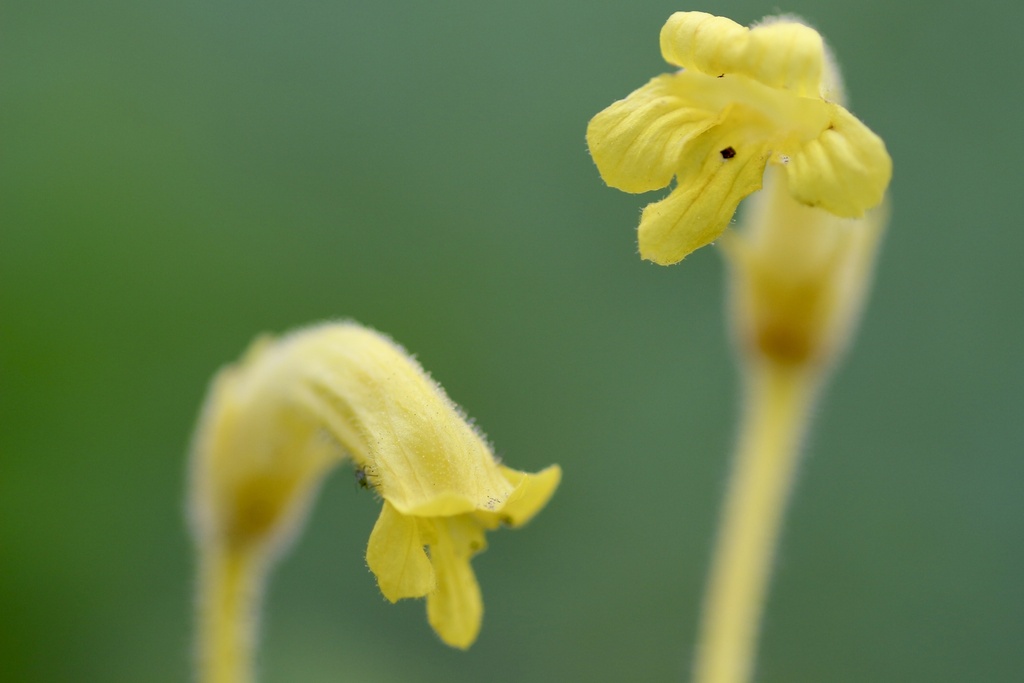
Photo: parent species Aphyllon epigalium · no rights reserved · CC0
Family: Orobanchaceae · Type: Annual · Native
Conservation status: CNPS 1B.3
Aphyllon epigalium subsp. notocalifornicum (Galium broomrape) is a native California annual in the Orobanchaceae family, recognized by rare subspecies with prominently arched corolla tube, straw-colored flowers.
Galium broomrape is a rare (CNPS 1B.3) California native annual found in open forest understories at elevations of 1,200 to 1,500 meters. Flowering from June to July, this plant produces delicate straw-colored flowers occasionally tinged with pink, with a prominently arched corolla tube and erect lobes. Growing as a parasitic plant with no true leaves, it attaches to host plants in forest understories. Its distinctive corolla is 13 to 20 millimeters long, with lobes twice as long as they are wide, presenting a unique horizontal orientation. This specialized annual represents an intriguing example of parasitic plant adaptation in California's forest ecosystems.
Identification and appearance
Key characters: Geographically isolated; rare subspecies with prominently arched corolla tube, straw-colored flowers
Habitat and range
Habitat: Open forest understory, on
Elevation: 1200-1500 m
Bloom period
Aphyllon epigalium subsp. notocalifornicum blooms Jun-Jul.
Conservation status
CNPS 1B.3
How to tell it apart
vs Orobanche: Aphyllon and Orobanche are now considered the same genus; check current taxonomy.; vs Oenothera: Aphyllon is parasitic without green leaves; Oenothera has normal green leaves and grows independently.; vs Kopsiopsis: Aphyllon is hairy with separated bracts; Kopsiopsis is hairless with tightly overlapping bracts.; vs Pholisma: Aphyllon has upright purple flower spikes; Pholisma has round white flower heads at ground level.; vs Diplacus: Aphyllon is parasitic without green leaves; Diplacus has normal green leaves and colorful snapdragon flowers.
Frequently asked questions
Is Aphyllon epigalium subsp. notocalifornicum native to California?
Yes. Aphyllon epigalium subsp. notocalifornicum is native to California (recorded as native).
When does Aphyllon epigalium subsp. notocalifornicum bloom?
Aphyllon epigalium subsp. notocalifornicum blooms Jun-Jul.
What plant family does Aphyllon epigalium subsp. notocalifornicum belong to?
Aphyllon epigalium subsp. notocalifornicum is in the Orobanchaceae family, genus Aphyllon.
Is Aphyllon epigalium subsp. notocalifornicum rare or endangered?
Aphyllon epigalium subsp. notocalifornicum carries California Rare Plant Rank 1B.3, state rank S2.
What habitat does Aphyllon epigalium subsp. notocalifornicum grow in?
Aphyllon epigalium subsp. notocalifornicum grows in Open forest understory, on.
Related species
Other California species in the same genus, family, or bioregion.
Sources: Jepson eFlora · CNPS Rare Plant Inventory · Index of California Plant Names · CalPhotos · CDFW CNDDB
Last updated 2026-09-30
Data from The California Species Project — 14,000+ California species with verified data from CNPS, CDFW, USFWS, Cal-IPC, and more.