Aphyllon franciscanum
Franciscan broomrape
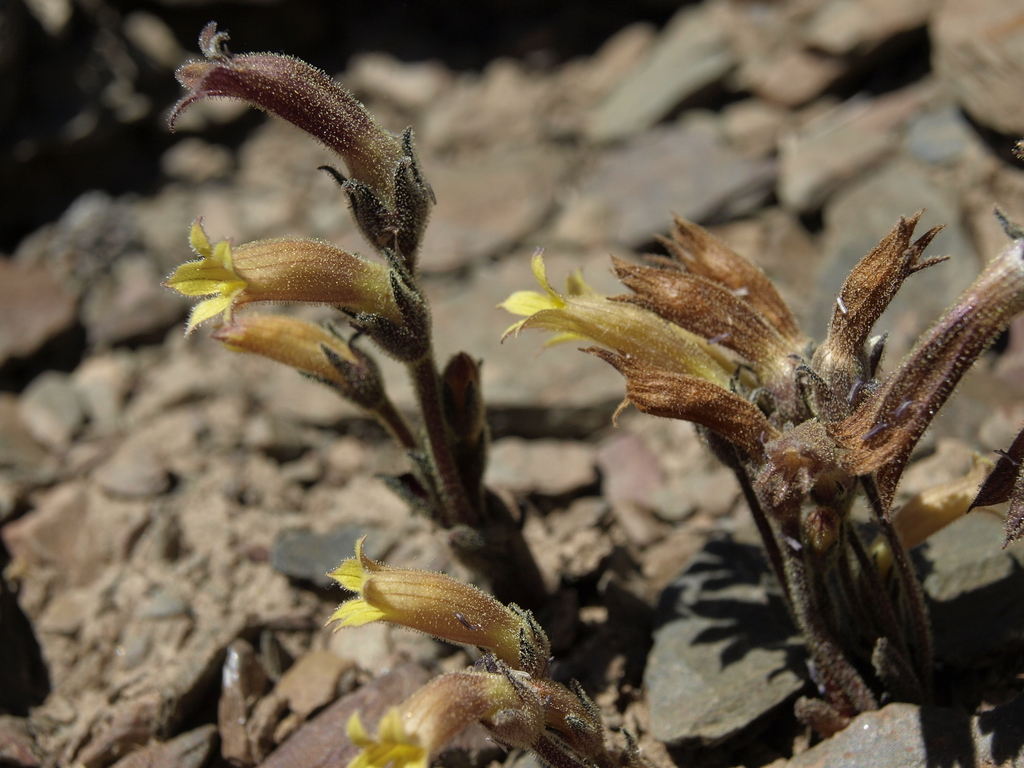
(c) Jim Morefield, some rights reserved (CC BY), uploaded by Jim Morefield · licence
Family: Orobanchaceae · Type: Perennial · Native
Aphyllon franciscanum (Franciscan broomrape) is a native California perennial in the Orobanchaceae family, recognized by pale yellow flowers slightly curved forward, acute petal tips.
Franciscan broomrape is a native perennial parasitic plant found in California's widespread serpentine habitats at elevations below 2,300 meters. Flowering from February to July, this plant produces pale to lemon yellow flowers with occasional orange or purple tints, sometimes up to 32 millimeters long with acute or soft-pointed lobe tips. Growing in clusters or individually with stems 3 to 20 centimeters tall, it develops branched or unbranched stems that form raceme-like inflorescences with 4 to 15 flowers. Its flowers feature distinctive triangular calyx lobes 2 to 5 millimeters long with darker tips and include hairy anthers and a two-lobed recurved stigma. The plant includes an orange nectary gland at the base of its ovary, highlighting its unique parasitic botanical characteristics.
Identification and appearance
Key characters: Geographically isolated; pale yellow flowers slightly curved forward, acute petal tips
Habitat and range
Habitat: Widespread where hosts present, including serpentine; most commonly on
Elevation: < 2300 m
Outside California: to southern British Columbia, Montana, Wyoming, Colorado, New Mexico, Texas, northwestern Mexico
Bloom period
Aphyllon franciscanum blooms Feb-July.
How to tell it apart
vs Orobanche: Aphyllon and Orobanche are now considered the same genus; check current taxonomy.; vs Oenothera: Aphyllon is parasitic without green leaves; Oenothera has normal green leaves and grows independently.; vs Kopsiopsis: Aphyllon is hairy with separated bracts; Kopsiopsis is hairless with tightly overlapping bracts.; vs Pholisma: Aphyllon has upright purple flower spikes; Pholisma has round white flower heads at ground level.; vs Diplacus: Aphyllon is parasitic without green leaves; Diplacus has normal green leaves and colorful snapdragon flowers.
Frequently asked questions
Is Aphyllon franciscanum native to California?
Yes. Aphyllon franciscanum is native to California (recorded as native).
When does Aphyllon franciscanum bloom?
Aphyllon franciscanum blooms Feb-July.
What plant family does Aphyllon franciscanum belong to?
Aphyllon franciscanum is in the Orobanchaceae family, genus Aphyllon.
What habitat does Aphyllon franciscanum grow in?
Aphyllon franciscanum grows in Widespread where hosts present, including serpentine; most commonly on.
Related species
Other California species in the same genus, family, or bioregion.
Sources: Jepson eFlora · Index of California Plant Names · CalPhotos
Last updated 2026-09-30
Data from The California Species Project — 14,000+ California species with verified data from CNPS, CDFW, USFWS, Cal-IPC, and more.