Apocynum androsaemifolium
Bitter dogbane
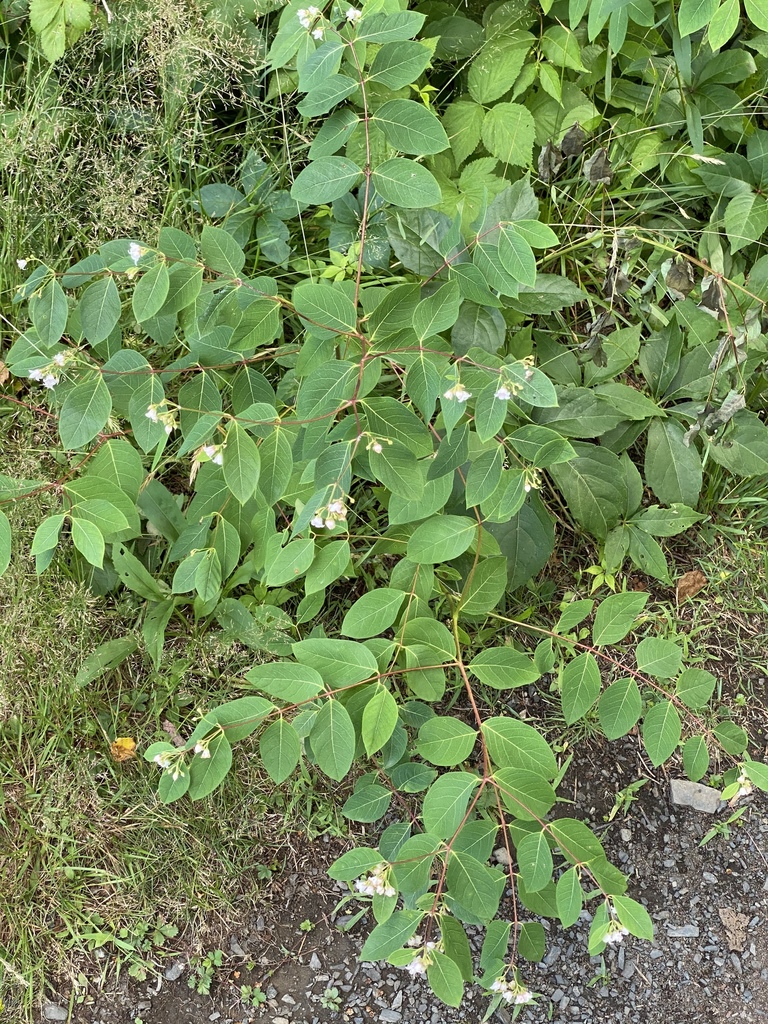
(c) gwt2102, some rights reserved (CC BY) · licence
Family: Apocynaceae · Type: Herb · Native
Apocynum androsaemifolium (Bitter dogbane) is a native California herb in the Apocynaceae family, recognized by key differences in flower size/shape and branching pattern.
Bitter dogbane is a California native perennial found in northwestern California, the high Cascade Range, northern Sierra Nevada Forests, Sierra Nevada, central western California, San Gabriel Mountains, San Bernardino Mountains, Peninsular Ranges, Modoc Plateau, and White and Inyo Mountains in open slopes and rocky places with conifers and chaparral at elevations of 200 to 2,500 meters. Flowering from May to October, this plant produces pale pink to white bell-shaped flowers in terminal clusters 4 to 8 millimeters long. Growing with diffuse-branched stems that spread widely, it reaches heights of 30 to 100 centimeters with a distinctive sprawling habit. Its leaves are broadly oval, 4 to 6 centimeters long, with rounded or heart-shaped bases and rounded to slightly pointed tips, arranged oppositely along the stems. The plant produces long, pendulous fruits 7 to 11 centimeters in length that hang from the branch tips.
Identification and appearance
Key characters: 1 sympatric species; key differences in flower size/shape and branching pattern
Habitat and range
Habitat: Open slopes, rocky places, with conifers, chaparral
Elevation: 200-2500 m
California counties: Humboldt, Nevada, Plumas, Tehama, San Bernardino, Fresno, Inyo, Los Angeles, Kern, Mariposa, Mono, Riverside, Tulare, Trinity, Yuba, Modoc, Butte, Tuolumne, Siskiyou, Alpine, Placer, El Dorado, Shasta, San Diego, Amador, Lake, Santa Barbara, Sierra, Del Norte, Sacramento, Lassen, San Joaquin, Orange, Napa, Monterey, San Francisco, Glenn, Santa Cruz, Mendocino, Alameda, Sonoma, Santa Clara, Madera, San Luis Obispo, Calaveras, Ventura, Colusa
Outside California: to Canada, eastern North America
Bloom period
Apocynum androsaemifolium blooms May-Oct.
How to tell it apart
vs Symphoricarpos: Apocynum has milky sap and five-petaled bell flowers; Symphoricarpos has clear sap and white berry-like fruits.; vs Asclepias: Apocynum has tiny bell flowers in branched sprays; Asclepias has large showy flowers with reflexed petals and raised hoods.; vs Frangula: Apocynum is an herb with opposite leaves and milky sap; Frangula is a woody shrub with alternate leaves.; vs Heteromeles: Apocynum has opposite simple leaves and milky sap; Heteromeles has alternate toothed leaves and woody stems.; vs Eucalyptus: Apocynum is a small herb with bell flowers; Eucalyptus is a tree with distinctive cap-like flower buds.
Frequently asked questions
Is Apocynum androsaemifolium native to California?
Yes. Apocynum androsaemifolium is native to California (recorded as native).
When does Apocynum androsaemifolium bloom?
Apocynum androsaemifolium blooms May-Oct.
Where in California does Apocynum androsaemifolium grow?
Apocynum androsaemifolium occurs in Humboldt, Nevada, Plumas, Tehama, San Bernardino, Fresno, Inyo, Los Angeles and other counties, at elevations of 200-2500 m.
What plant family does Apocynum androsaemifolium belong to?
Apocynum androsaemifolium is in the Apocynaceae family, genus Apocynum.
What habitat does Apocynum androsaemifolium grow in?
Apocynum androsaemifolium grows in Open slopes, rocky places, with conifers, chaparral.
Related species
Other California species in the same genus, family, or bioregion.
Sources: Jepson eFlora · Index of California Plant Names · CalPhotos
Last updated 2026-10-07
Data from The California Species Project — 14,000+ California species with verified data from CNPS, CDFW, USFWS, Cal-IPC, and more.