Aptenia cordifolia
Baby sun-rose
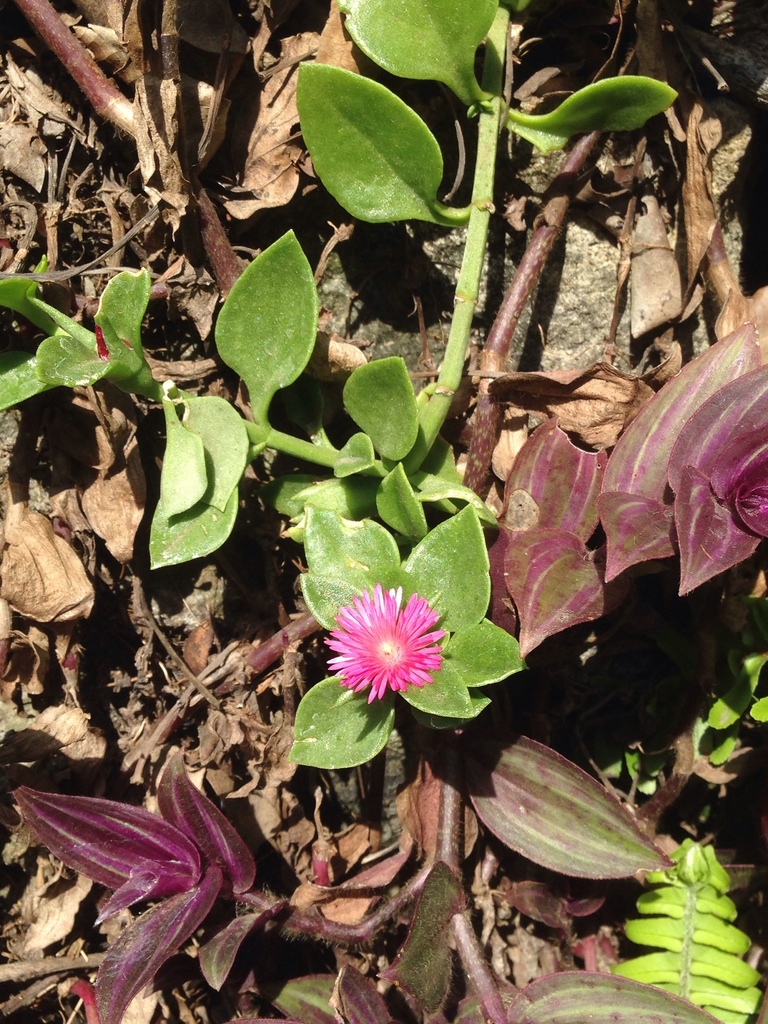
no rights reserved · CC0
Family: Aizoaceae · Type: Subshrub · Not Native
Aptenia cordifolia (Baby sun-rose) is a non-native California subshrub in the Aizoaceae family, recognized by Only Aptenia species naturalized in CA - differs from other Aizoaceae by cordate leaves and upright growth habit rather than the….
Baby sun-rose is a naturalized perennial found in the central and southern California Coast and southern Channel Islands in disturbed places and margins of coastal wetlands at elevations below 100 meters. Flowering from April to May, this plant produces vibrant purple flowers (occasionally red in cultivated varieties) with delicate petals up to 10 millimeters long. Growing with sprawling stems 30 to 60 centimeters long and widely spaced nodes, it spreads across the ground with a distinctive trailing habit. Its heart-shaped leaves are 1 to 3 centimeters long, minutely textured with tiny papillate surface features. The fruit develops to 13 to 15 millimeters long, with sepals reaching up to 20 millimeters in mature stages.
Identification and appearance
Key characters: Only Aptenia species naturalized in CA - differs from other Aizoaceae by cordate leaves and upright growth habit rather than the prostrate linear-leaved forms typical of the family
Habitat and range
Habitat: Uncommon. Disturbed places, margins of coastal wetlands
Elevation: < 100 m
California counties: Los Angeles, San Diego, San Francisco, Monterey, Orange, Ventura, Riverside, San Mateo, Santa Barbara, Marin, San Luis Obispo, Yolo
Outside California: native to southern Africa
Bloom period
Aptenia cordifolia blooms Apr-May.
How to tell it apart
vs Malephora: Aptenia has heart-shaped leaves and 4 sepals; Malephora has triangular leaves and copper flowers with 8+ chambers.; vs Delosperma: Aptenia has 4 equal sepals and heart-shaped leaves; Delosperma has 5 unequal sepals.; vs Drosanthemum: Aptenia has small heart-shaped leaves and 4 sepals; Drosanthemum has cylindrical leaves and 5 sepals.; vs Conicosia: Aptenia trails with opposite heart-shaped leaves; Conicosia forms upright rosettes with alternate dagger leaves.; vs Carpobrotus: Aptenia has tiny heart-shaped leaves and small flowers; Carpobrotus has huge triangular leaves and massive flowers.
Frequently asked questions
Is Aptenia cordifolia native to California?
No. Aptenia cordifolia is not native to California (recorded as not native).
When does Aptenia cordifolia bloom?
Aptenia cordifolia blooms Apr-May.
Where in California does Aptenia cordifolia grow?
Aptenia cordifolia occurs in Los Angeles, San Diego, San Francisco, Monterey, Orange, Ventura, Riverside, San Mateo and other counties, at elevations of < 100 m.
What plant family does Aptenia cordifolia belong to?
Aptenia cordifolia is in the Aizoaceae family, genus Aptenia.
What habitat does Aptenia cordifolia grow in?
Aptenia cordifolia grows in Uncommon. Disturbed places, margins of coastal wetlands.
Related species
Other California species in the same genus, family, or bioregion.
Sources: Jepson eFlora · Index of California Plant Names · CalPhotos
Last updated 2026-10-07
Data from The California Species Project — 14,000+ California species with verified data from CNPS, CDFW, USFWS, Cal-IPC, and more.