Aquilegia formosa
Crimson columbine
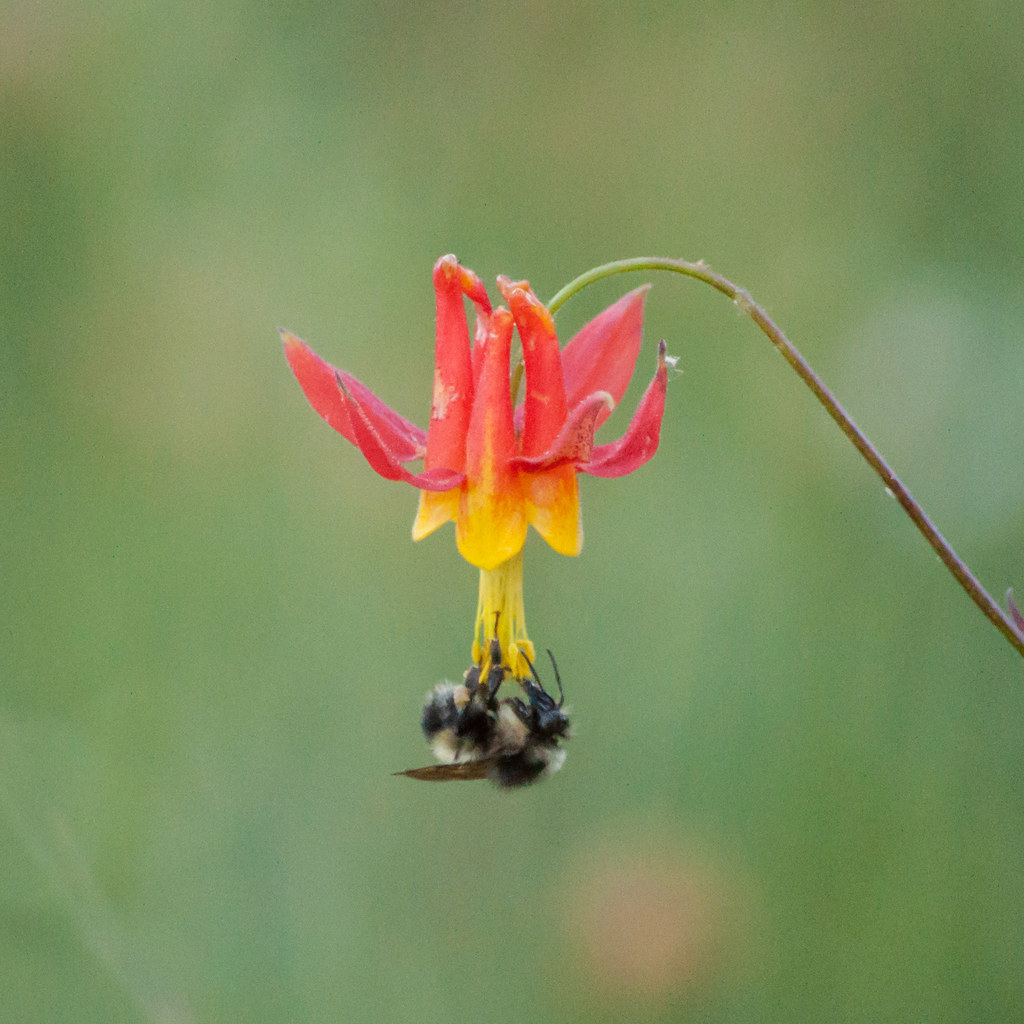
(c) Ryan Elliott, some rights reserved (CC BY) · licence
Family: Ranunculaceae · Type: Herb · Native
Aquilegia formosa (Crimson columbine) is a native California herb in the Ranunculaceae family, recognized by (A. eximia, A. pubescens). Key differences: glabrous/glaucous habit, red sepals, broad elevation range.
Crimson columbine is a California native perennial found in the Coast Ranges, Cascade Range, and Great Basin in streambanks, seeps, moist places, chaparral, oak woodland, and conifer forests at elevations up to 3,300 meters. Flowering from April to September, this plant produces red and yellow flowers with distinctive spurs 12 to 23 millimeters long, creating an elegant hanging bloom. Growing 20 to 80 centimeters tall with glaucous stems, it develops glabrous, delicate foliage with complex leaf structures. Its basal and lower cauline leaves are typically 2-ternate, featuring leaflets 7 to 45 millimeters long, with upper leaves often simply lobed. The fruit develops into elongated capsules 15 to 28 millimeters long with a distinctive beak 9 to 12 millimeters in length.
Identification and appearance
Key characters: 2 sympatric species (A. eximia, A. pubescens). Key differences: glabrous/glaucous habit, red sepals, broad elevation range
Habitat and range
Habitat: Streambanks, seeps, moist places, chaparral, oak woodland, mixed-evergreen or conifer forests
Elevation: < 3300 m
California counties: Mendocino, Mono, San Bernardino, Kern, Los Angeles, Tulare, Siskiyou, Tehama, Plumas, Inyo, Lake, Shasta, Fresno, Madera, San Diego, Lassen, Riverside, Contra Costa, Monterey, El Dorado, Placer, Humboldt, Butte, Trinity, Mariposa, Modoc, Orange, Santa Clara, Del Norte, San Mateo, Nevada, Amador, Tuolumne, Sonoma, Sierra, Alpine, Calaveras, Glenn, Marin, Santa Barbara, Yuba, Alameda, Napa, Santa Cruz, San Francisco, San Luis Obispo, Ventura, Colusa, San Benito, Solano, Sacramento
Outside California: to Alaska, Montana, Baja California
Bloom period
Aquilegia formosa blooms Apr-Sep.
How to tell it apart
vs Delphinium: Aquilegia has spurs on petals with nodding flowers; Delphinium has a single spur on the upper sepal with upright flower spikes.; vs Thalictrum: Aquilegia has large showy spurred flowers; Thalictrum has tiny flowers without petals in airy clusters.; vs Ribes: Aquilegia is an herb with spurred flowers; Ribes is a shrub with flowers in hanging clusters and berries.; vs Lomatium: Aquilegia has spurred flowers with separate petals; Lomatium has tiny flowers in compound umbels with divided leaves.; vs Clematis: Aquilegia has spurred petals on an upright herb; Clematis is a woody vine with four flat sepals and no spurs.
Frequently asked questions
Is Aquilegia formosa native to California?
Yes. Aquilegia formosa is native to California (recorded as native).
When does Aquilegia formosa bloom?
Aquilegia formosa blooms Apr-Sep.
Where in California does Aquilegia formosa grow?
Aquilegia formosa occurs in Mendocino, Mono, San Bernardino, Kern, Los Angeles, Tulare, Siskiyou, Tehama and other counties, at elevations of < 3300 m.
What plant family does Aquilegia formosa belong to?
Aquilegia formosa is in the Ranunculaceae family, genus Aquilegia.
What habitat does Aquilegia formosa grow in?
Aquilegia formosa grows in Streambanks, seeps, moist places, chaparral, oak woodland, mixed-evergreen or conifer forests.
Related species
Other California species in the same genus, family, or bioregion.
Sources: Jepson eFlora · Index of California Plant Names · CalPhotos
Last updated 2026-10-07
Data from The California Species Project — 14,000+ California species with verified data from CNPS, CDFW, USFWS, Cal-IPC, and more.