Arabidopsis thaliana
Mouse-ear cress, thale cress, Thale Cress
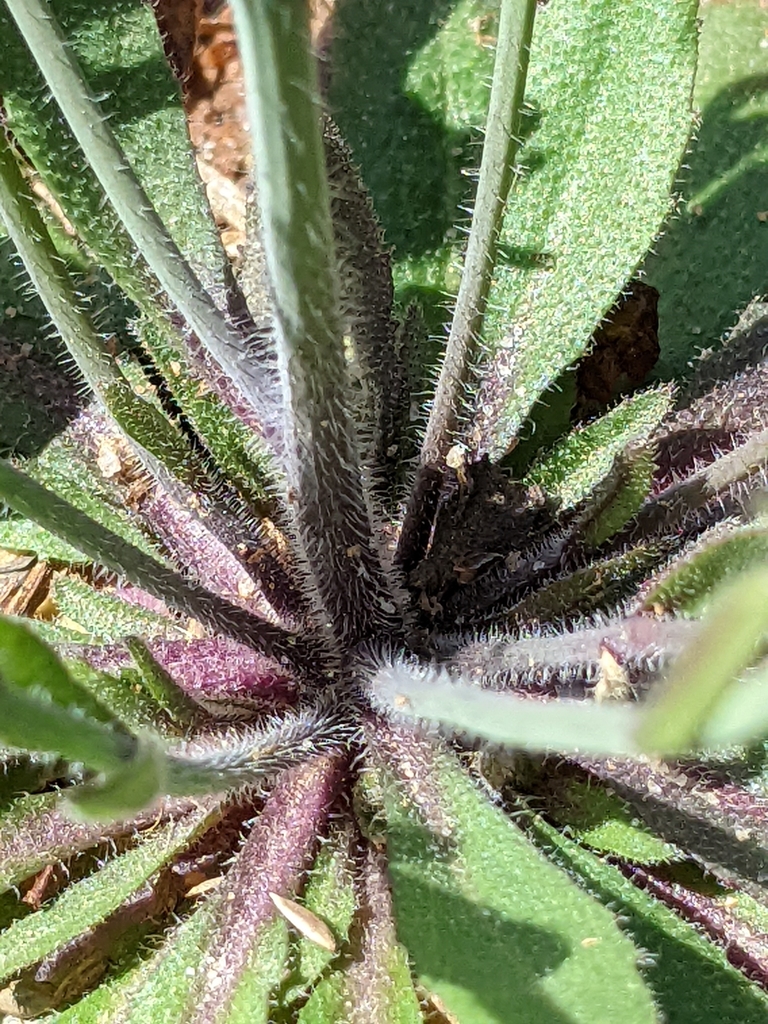
(c) Alison Northup, some rights reserved (CC BY), uploaded by Alison Northup · licence
Family: Brassicaceae · Type: Herb · Not Native
Arabidopsis thaliana (Mouse-ear cress) is a non-native California herb in the Brassicaceae family, recognized by Only Arabidopsis in CA - distinguished from other Brassicaceae by distinctive 2-4-rayed stellate hairs and erect narrow siliques.
Mouse-ear cress is a naturalized annual herb found in northwestern California, southern Sacramento Valley, Cascade Range, northern Sierra Nevada, San Francisco Bay Area, southern California Coast, and Warner Range in disturbed ground, sandy areas, flats, and fields at elevations below 1,600 meters. Flowering from February to May, this plant produces small white flowers about 2 to 3.5 millimeters long. Growing with erect, branched stems 5 to 30 centimeters tall, it has spreading simple and forked hairs on lower stems. Its basal leaves are oblanceolate, 0.8 to 3.5 centimeters long, with entire or minutely toothed edges and two- to four-rayed hairs. The slender fruit is 1 to 1.5 centimeters long, with 40 to 70 small oblong seeds.
Identification and appearance
Key characters: Only Arabidopsis in CA - distinguished from other Brassicaceae by distinctive 2-4-rayed stellate hairs and erect narrow siliques
Habitat and range
Habitat: Disturbed ground, sandy areas, flats, fields
Elevation: < 1600 m
California counties: Calaveras, Los Angeles, Placer, El Dorado, Fresno, Kern, Trinity, Shasta, Mariposa, Riverside, Alameda, Amador, Butte, San Luis Obispo, Mendocino, Marin, Humboldt, Stanislaus, Tulare, Tehama, Lake, Modoc, Siskiyou, Del Norte, San Diego, Sacramento, Yolo, Monterey
Outside California: to eastern United States where abundant, native to Eurasia
Bloom period
Arabidopsis thaliana blooms Feb-May.
How to tell it apart
vs Cardamine: Arabidopsis has cylindrical pods and simple undivided leaves; Cardamine often has divided leaflets and flattened pods.; vs Boechera: Arabidopsis has tiny flowers (2-4mm petals) and cylindrical pods; Boechera has larger flowers and flattened pods.; vs Sibara: Arabidopsis has simple smooth-edged leaves; Sibara has deeply divided feathery leaves.; vs Polyctenium: Arabidopsis has simple smooth leaves; Polyctenium has rigid comb-like divided leaves.; vs Descurainia: Arabidopsis has simple undivided leaves; Descurainia has finely divided feathery leaves.
Frequently asked questions
Is Arabidopsis thaliana native to California?
No. Arabidopsis thaliana is not native to California (recorded as not native).
When does Arabidopsis thaliana bloom?
Arabidopsis thaliana blooms Feb-May.
Where in California does Arabidopsis thaliana grow?
Arabidopsis thaliana occurs in Calaveras, Los Angeles, Placer, El Dorado, Fresno, Kern, Trinity, Shasta and other counties, at elevations of < 1600 m.
What plant family does Arabidopsis thaliana belong to?
Arabidopsis thaliana is in the Brassicaceae family, genus Arabidopsis.
What habitat does Arabidopsis thaliana grow in?
Arabidopsis thaliana grows in Disturbed ground, sandy areas, flats, fields.
Related species
Other California species in the same genus, family, or bioregion.
Sources: Jepson eFlora · Index of California Plant Names · CalPhotos
Last updated 2026-10-07
Data from The California Species Project — 14,000+ California species with verified data from CNPS, CDFW, USFWS, Cal-IPC, and more.