Arbutus menziesii
Pacific madrone, Pacific Madrone
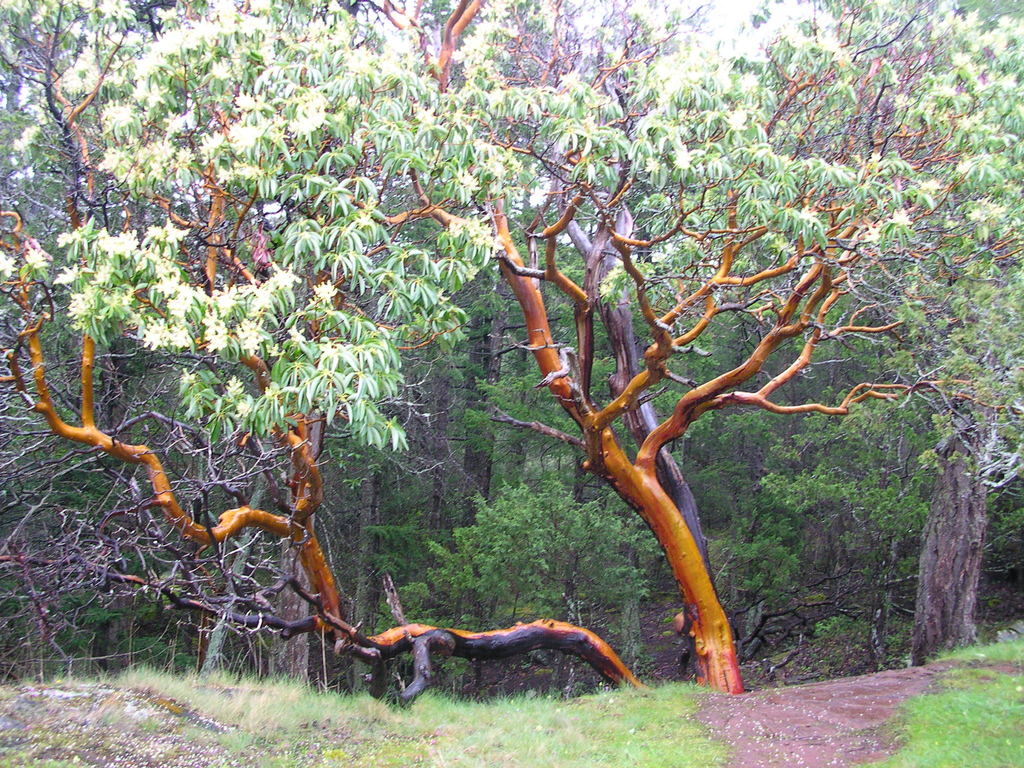
(c) J Brew, some rights reserved (CC BY-SA), uploaded by J Brew · licence
Family: Ericaceae · Type: Tree · Native
Arbutus menziesii (Pacific madrone) is a native California tree in the Ericaceae family, recognized by Only Arbutus in CA - represents the tree form within Ericaceae, distinguished by size, bark characteristics, and large evergreen leaves.
Pacific madrone is a California native shrub found in northwestern California, Cascade Range, northern Sierra Nevada Foothills, northern Sierra Nevada, Sacramento Valley, central western California, northern Channel Islands, western Transverse Ranges, San Gabriel Mountains, and Peninsular Ranges in conifer and oak forests at elevations of 100 to 1,500 meters. Flowering from March to May, this plant produces yellow-white to pink flowers less than 8 millimeters long. Growing as a tree or large shrub up to 40 meters tall with distinctive reddish bark and stout twigs, it develops a striking architectural form. Its leathery leaves are bright green on top, whitish underneath, ovate to oblong, reaching up to 12 centimeters long with entire or minutely serrated edges. The fruit is a small spherical, orange-red, slightly bumpy berry less than 12 millimeters in diameter.
Identification and appearance
Key characters: Only Arbutus in CA - represents the tree form within Ericaceae, distinguished by size, bark characteristics, and large evergreen leaves
Habitat and range
Habitat: Conifer, oak forests
Elevation: 100-1500 m
California counties: Santa Barbara, Humboldt, San Luis Obispo, San Mateo, Monterey, Mendocino, Santa Clara, Santa Cruz, Nevada, Trinity, San Diego, Los Angeles, Sonoma, Alameda, Ventura, Yuba, Marin, Napa, Shasta, Butte, San Francisco, Orange, Siskiyou, Solano, Amador, Calaveras, Del Norte, El Dorado, Placer, Tuolumne, Contra Costa, Lake, San Benito, Sierra, Riverside
Outside California: to British Columbia, Baja California
Bloom period
Arbutus menziesii blooms Mar-May.
How to tell it apart
vs Arctostaphylos: Arbutus fruits are bumpy and juicy; Arctostaphylos fruits are smooth and mealy.; vs Heteromeles: Arbutus has bumpy berries and urn-shaped flowers; Heteromeles has smooth pomes and flat flower clusters.; vs Comarostaphylis: Arbutus is a tree with multi-seeded berries; Comarostaphylis is a shrub with single-stoned drupes.; vs Quercus: Arbutus has urn-shaped flowers and berries; Quercus has catkins and acorns.; vs Umbellularia: Arbutus has bumpy red berries; Umbellularia has smooth purple drupes and aromatic leaves.
Frequently asked questions
Is Arbutus menziesii native to California?
Yes. Arbutus menziesii is native to California (recorded as native).
When does Arbutus menziesii bloom?
Arbutus menziesii blooms Mar-May.
Where in California does Arbutus menziesii grow?
Arbutus menziesii occurs in Santa Barbara, Humboldt, San Luis Obispo, San Mateo, Monterey, Mendocino, Santa Clara, Santa Cruz and other counties, at elevations of 100-1500 m.
What plant family does Arbutus menziesii belong to?
Arbutus menziesii is in the Ericaceae family, genus Arbutus.
What habitat does Arbutus menziesii grow in?
Arbutus menziesii grows in Conifer, oak forests.
Related species
Other California species in the same genus, family, or bioregion.
Sources: Jepson eFlora · Index of California Plant Names · CalPhotos
Last updated 2026-10-07
Data from The California Species Project — 14,000+ California species with verified data from CNPS, CDFW, USFWS, Cal-IPC, and more.