Arceuthobium campylopodum
Western dwarf mistletoe, Western Dwarf Mistletoe
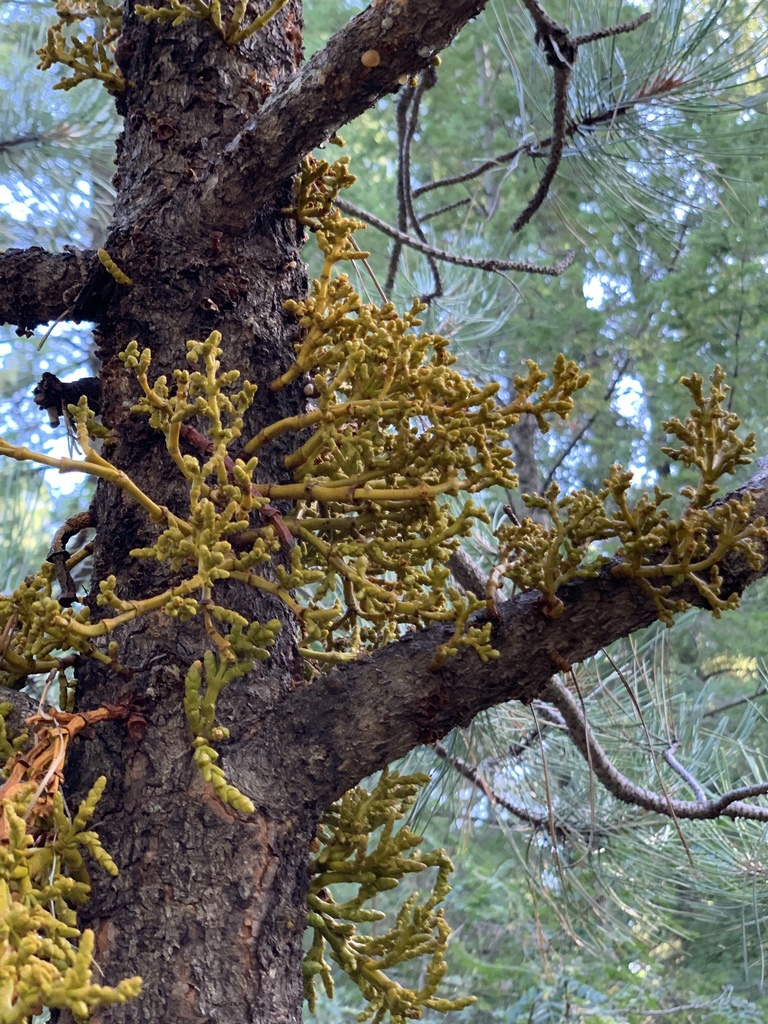
(c) CK2AZ, some rights reserved (CC BY) · licence
Family: Viscaceae · Type: Shrub · Native
Arceuthobium campylopodum (Western dwarf mistletoe) is a native California shrub in the Viscaceae family, recognized by intermediate size and stem width.
Western dwarf mistletoe is a native perennial found in northwestern California, California Ranges, Sierra Nevada, central western California, Transverse Ranges, Peninsular Ranges, Great Basin, and Desert Mountains in conifer forest at elevations up to 2,800 meters. Flowering from July to November, this parasitic plant produces small, inconspicuous yellowish-green flowers. Growing with slender stems 3 to 14 centimeters long that range from yellow to olive-green or brown, it attaches directly to host conifer trees. Its reduced leaves are scale-like, adapted for its specialized parasitic lifestyle on pine and other conifer species. Seeds mature from August to December, allowing the mistletoe to spread and establish on new host trees.
Identification and appearance
Key characters: 2 sympatric species; distinguished by intermediate size and stem width
Habitat and range
Habitat: Common. Conifer forest, on
Elevation: < 2800 m
California counties: San Bernardino, Kern, Los Angeles, Tulare, Merced, Lake, Siskiyou, Fresno, Riverside, Monterey, Tuolumne, Butte, Ventura, San Diego, San Benito, Placer, Mariposa, Santa Barbara, El Dorado, Trinity, Shasta, Plumas, Alpine, Napa, Inyo, San Luis Obispo, Madera, Contra Costa, Santa Clara, Del Norte, Mendocino, Calaveras, Lassen, Nevada, Sierra, Sonoma, Tehama, San Mateo, Colusa, Glenn, Modoc, Humboldt, Amador, Marin, Mono, Sacramento, Yolo, Santa Cruz
Outside California: to southeastern Alaska, Montana, Colorado, New Mexico, northern Baja California
Bloom period
Arceuthobium campylopodum blooms Generally Jul-Nov.
How to tell it apart
vs Phoradendron: Arceuthobium is tiny (<8 inches) with scale-leaves on conifers; Phoradendron has obvious oval leaves >8 inches on oaks/shrubs.; vs Pseudotsuga: Arceuthobium grows as yellowish parasite clusters on branches; Pseudotsuga is the green-needled host tree itself.; vs Pinus: Arceuthobium is the yellowish parasitic clump on the pine; Pinus is the host tree with needles in bundles.; vs Viscum: Arceuthobium is scale-leaved dwarf mistletoe on conifers; Viscum has thick fleshy leaves on broadleaf trees.
Frequently asked questions
Is Arceuthobium campylopodum native to California?
Yes. Arceuthobium campylopodum is native to California (recorded as native).
When does Arceuthobium campylopodum bloom?
Arceuthobium campylopodum blooms Generally Jul-Nov.
Where in California does Arceuthobium campylopodum grow?
Arceuthobium campylopodum occurs in San Bernardino, Kern, Los Angeles, Tulare, Merced, Lake, Siskiyou, Fresno and other counties, at elevations of < 2800 m.
What plant family does Arceuthobium campylopodum belong to?
Arceuthobium campylopodum is in the Viscaceae family, genus Arceuthobium.
What habitat does Arceuthobium campylopodum grow in?
Arceuthobium campylopodum grows in Common. Conifer forest, on.
Related species
Other California species in the same genus, family, or bioregion.
Sources: Jepson eFlora · Index of California Plant Names · CalPhotos
Last updated 2026-10-07
Data from The California Species Project — 14,000+ California species with verified data from CNPS, CDFW, USFWS, Cal-IPC, and more.