Arctostaphylos glandulosa subsp. adamsii
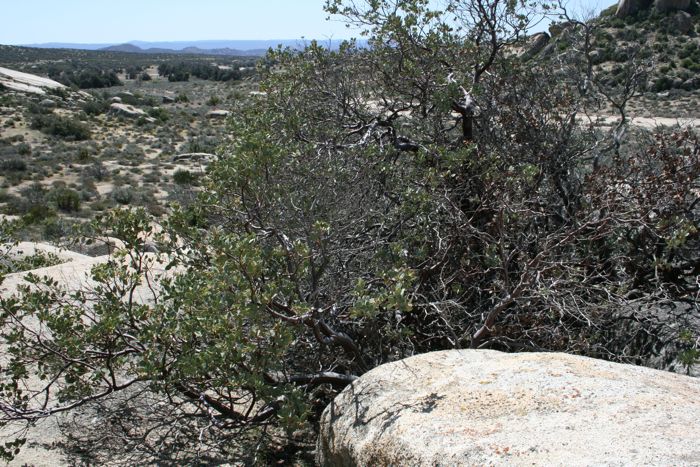
Photo: parent species Arctostaphylos glandulosa · Photo by Chez Brungraber
Family: Ericaceae · Type: Shrub · Native
Arctostaphylos glandulosa subsp. adamsii is a native California shrub in the Ericaceae family, recognized by strongly glaucous glabrous leaves and white-hairy reproductive parts.
Adams manzanita is a California native shrub found in the southwestern California mountains excluding the Channel Islands in chaparral and conifer forest at elevations of 1,500 to 2,200 meters. Flowering from January to April, this plant produces white to pink urn-shaped flowers in clusters. Growing with erect branches 1 to 2 meters tall, it has distinctively smooth, reddish bark and twigs sparsely covered in short, non-glandular hairs. Its leaves are glabrous with a striking white-glaucous appearance, featuring rounded to occasionally lobed bases that give the foliage a distinctive bluish-white coloration. The plant's dense, white-hairy inflorescence and bracts contribute to its unique botanical character.
Identification and appearance
Key characters: 25 sympatric species; distinguished by strongly glaucous glabrous leaves and white-hairy reproductive parts
Habitat and range
Habitat: Chaparral, conifer forest
Elevation: 1500-2200 m
California counties: San Bernardino, San Diego, Riverside, Los Angeles, San Francisco
Outside California: northern Baja California
Bloom period
Arctostaphylos glandulosa subsp. adamsii blooms Jan-Apr.
How to tell it apart
vs Arbutus: Arctostaphylos fruits are smooth and mealy; Arbutus fruits are bumpy and juicy.; vs Rhus: Arctostaphylos has simple evergreen leaves; Rhus has compound deciduous leaves.; vs Quercus: Arctostaphylos has urn-shaped flowers and berry-like fruits; Quercus has catkins and acorns.; vs Xylococcus: Arctostaphylos leaves are flat; Xylococcus leaves have margins rolled tightly under.; vs Heteromeles: Arctostaphylos has urn-shaped flowers; Heteromeles has flat white flower clusters.
Frequently asked questions
Is Arctostaphylos glandulosa subsp. adamsii native to California?
Yes. Arctostaphylos glandulosa subsp. adamsii is native to California (recorded as native).
When does Arctostaphylos glandulosa subsp. adamsii bloom?
Arctostaphylos glandulosa subsp. adamsii blooms Jan-Apr.
Where in California does Arctostaphylos glandulosa subsp. adamsii grow?
Arctostaphylos glandulosa subsp. adamsii occurs in San Bernardino, San Diego, Riverside, Los Angeles, San Francisco, at elevations of 1500-2200 m.
What plant family does Arctostaphylos glandulosa subsp. adamsii belong to?
Arctostaphylos glandulosa subsp. adamsii is in the Ericaceae family, genus Arctostaphylos.
What habitat does Arctostaphylos glandulosa subsp. adamsii grow in?
Arctostaphylos glandulosa subsp. adamsii grows in Chaparral, conifer forest.
Related species
Other California species in the same genus, family, or bioregion.
- Arctostaphylos glandulosa subsp. crassifolia — Del mar manzanita
- Arctostaphylos glandulosa subsp. cushingiana — Cushing manzanita
- Arctostaphylos glandulosa subsp. gabrielensis — San gabriel manzanita
- Arctostaphylos glandulosa subsp. glandulosa
- Arctostaphylos glandulosa subsp. howellii
- Arctostaphylos glandulosa subsp. leucophylla
Sources: Jepson eFlora · Index of California Plant Names · CalPhotos
Last updated 2026-10-07
Data from The California Species Project — 14,000+ California species with verified data from CNPS, CDFW, USFWS, Cal-IPC, and more.