Arctostaphylos pallida
Pallid manzanita, Pallid Manzanita, pallid manzanita, pallid manzanita
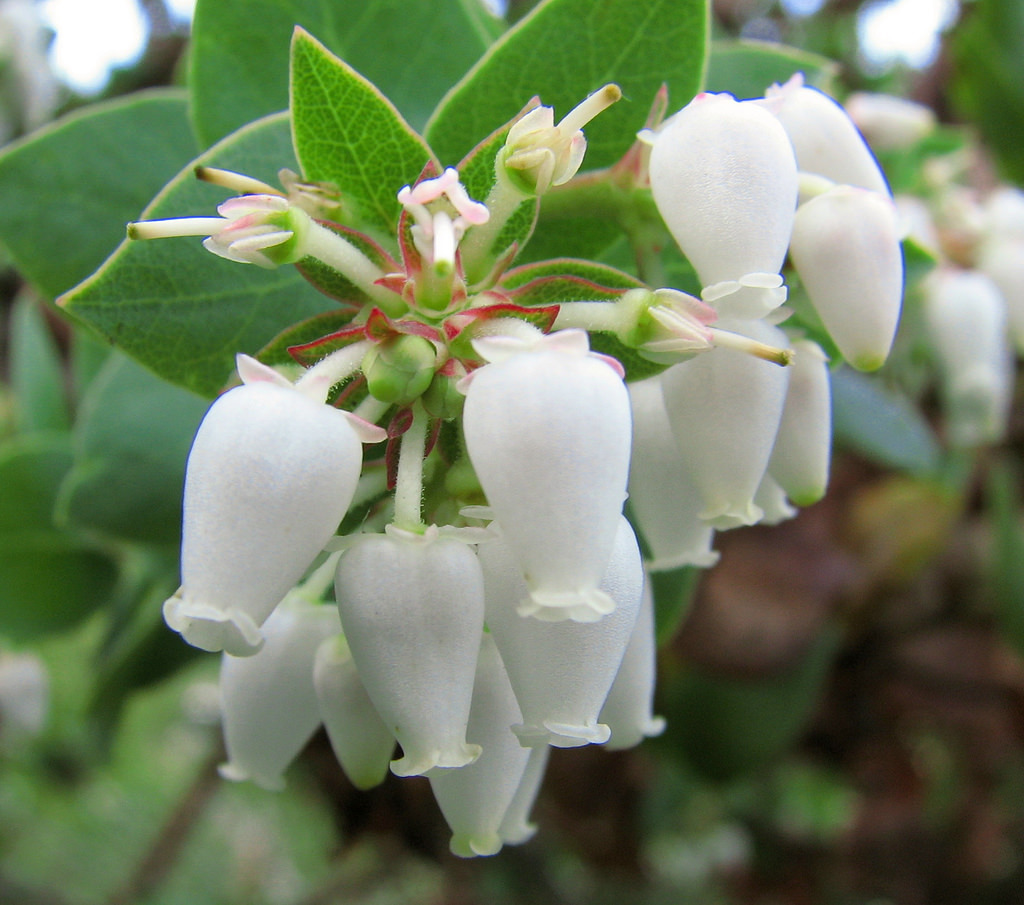
(c) Pete Klosterman, some rights reserved (CC BY) · licence
Family: Ericaceae · Type: Shrub · Native
Conservation status: CNPS 1B.1 · Threatened
Arctostaphylos pallida (Pallid manzanita) is a native California shrub in the Ericaceae family, recognized by glaucous clasping leaves and sticky fruits.
Pallid manzanita is a rare (CNPS 1B.1) California native shrub found in eastern San Francisco Bay bioregion, specifically on Sobrante and Huckleberry ridges in Alameda and Contra Costa counties, growing in chaparral and siliceous shale slopes at elevations of 200 to 460 meters. Flowering from January to March, this plant produces pale pink to white urn-shaped flowers in delicate, drooping clusters with 3 to 5 branches. Growing as an erect shrub 2 to 4 meters tall with densely hairy twigs, it develops a distinctive branching structure with multiple stems. Its leaves are glaucous-green, generally ovate, 2.5 to 4.5 centimeters long, with a lobed base that clasps the stem and an entire, flat margin. The fruit is a sticky, depressed-spheric berry approximately 8 to 10 millimeters wide, with stones that can be variably fused or free.
Identification and appearance
Key characters: 19 sympatric species; key features are glaucous clasping leaves and sticky fruits
Habitat and range
Habitat: Siliceous shales, slopes, ridges, chaparral
Elevation: 200-460 m
California counties: Alameda, Contra Costa, Fresno
Bloom period
Arctostaphylos pallida blooms Jan-Mar.
Conservation status
CNPS 1B.1 · Threatened
How to tell it apart
vs Arbutus: Arctostaphylos fruits are smooth and mealy; Arbutus fruits are bumpy and juicy.; vs Rhus: Arctostaphylos has simple evergreen leaves; Rhus has compound deciduous leaves.; vs Quercus: Arctostaphylos has urn-shaped flowers and berry-like fruits; Quercus has catkins and acorns.; vs Xylococcus: Arctostaphylos leaves are flat; Xylococcus leaves have margins rolled tightly under.; vs Heteromeles: Arctostaphylos has urn-shaped flowers; Heteromeles has flat white flower clusters.
Frequently asked questions
Is Arctostaphylos pallida native to California?
Yes. Arctostaphylos pallida is native to California (recorded as native).
When does Arctostaphylos pallida bloom?
Arctostaphylos pallida blooms Jan-Mar.
Where in California does Arctostaphylos pallida grow?
Arctostaphylos pallida occurs in Alameda, Contra Costa, Fresno, at elevations of 200-460 m.
What plant family does Arctostaphylos pallida belong to?
Arctostaphylos pallida is in the Ericaceae family, genus Arctostaphylos.
Is Arctostaphylos pallida rare or endangered?
Arctostaphylos pallida carries California Rare Plant Rank 1B.1, state rank S1.
Related species
Other California species in the same genus, family, or bioregion.
- Arctostaphylos parryana — Parry manzanita
- Arctostaphylos parryana subsp. desertica — Desert manzanita
- Arctostaphylos parryana subsp. parryana — Parry manzanita
- Arctostaphylos parryana subsp. tumescens — Interior manzanita
- Arctostaphylos patula — Greenleaf manzanita
- Arctostaphylos patula subsp. gankinii — Gankin's greenleaf manzanita
Sources: Jepson eFlora · CNPS Rare Plant Inventory · Index of California Plant Names · CalPhotos · CDFW CNDDB
Last updated 2026-10-07
Data from The California Species Project — 14,000+ California species with verified data from CNPS, CDFW, USFWS, Cal-IPC, and more.