Arctotis venusta
Blue-eyed african daisy
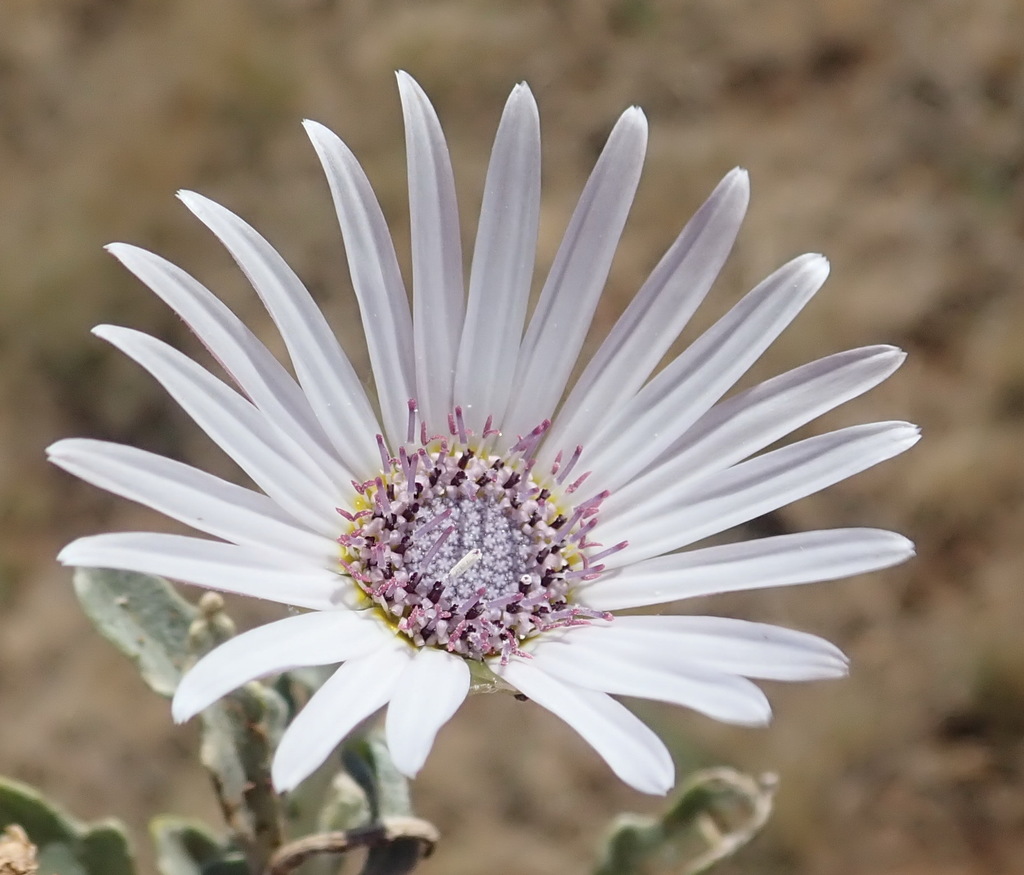
(c) Nicola van Berkel, some rights reserved (CC BY-SA), uploaded by Nicola van Berkel · licence
Family: Asteraceae · Type: Subshrub · Not Native
Arctotis venusta (Blue-eyed african daisy) is a non-native California subshrub in the Asteraceae family, recognized by Only Arctotis naturalized in CA - South African genus with distinctive winged fruits and bi-colored ray flowers unlike native Asteraceae.
Blue-eyed african daisy is a naturalized perennial found in southern California coastal areas at elevations below 300 meters. Flowering from April to November, this plant produces white ray flowers with a narrow yellow base and violet reverse, surrounded by gray-violet disk flowers in heads up to 8 centimeters wide. Growing with stout stems 40 to 70 centimeters tall that are cobwebby to woolly, it develops from a robust taproot. Its oblong to obovate leaves range from 5 to 20 centimeters long, covered evenly in gray tomentose, with margins entire to wavy and occasionally featuring irregular lobes. The distinctive fruit is 2 to 3 millimeters long with three wings and multiple cavities, topped by a delicate series of translucent pappus scales.
Identification and appearance
Key characters: Only Arctotis naturalized in CA - South African genus with distinctive winged fruits and bi-colored ray flowers unlike native Asteraceae
Habitat and range
Habitat: Uncommon. Escape from cultivation in coastal areas, roadsides
Elevation: < 300 m
Outside California: native to southern Africa
Bloom period
Arctotis venusta blooms Apr-Nov.
How to tell it apart
vs Dimorphotheca: Arctotis has multiple overlapping bract rows; Dimorphotheca has bracts in 1-2 rows.; vs Gazania: Arctotis is silvery-woolly throughout; Gazania is greener with dark-spotted rays.; vs Bellis: Arctotis has large 20-30mm rays; Bellis has tiny rays under 10mm.; vs Malephora: Arctotis is in Asteraceae with daisy flowers; Malephora is in Aizoaceae with succulent leaves.; vs Calendula: Arctotis has both ray and disk flowers; Calendula has only ray-like flowers throughout.
Frequently asked questions
Is Arctotis venusta native to California?
No. Arctotis venusta is not native to California (recorded as not native).
When does Arctotis venusta bloom?
Arctotis venusta blooms Apr-Nov.
What plant family does Arctotis venusta belong to?
Arctotis venusta is in the Asteraceae family, genus Arctotis.
What habitat does Arctotis venusta grow in?
Arctotis venusta grows in Uncommon. Escape from cultivation in coastal areas, roadsides.
Related species
Other California species in the same genus, family, or bioregion.
Sources: Jepson eFlora · CalPhotos
Last updated 2026-10-07
Data from The California Species Project — 14,000+ California species with verified data from CNPS, CDFW, USFWS, Cal-IPC, and more.