Arenaria serpyllifolia var. serpyllifolia
Thymeleaf sandwort
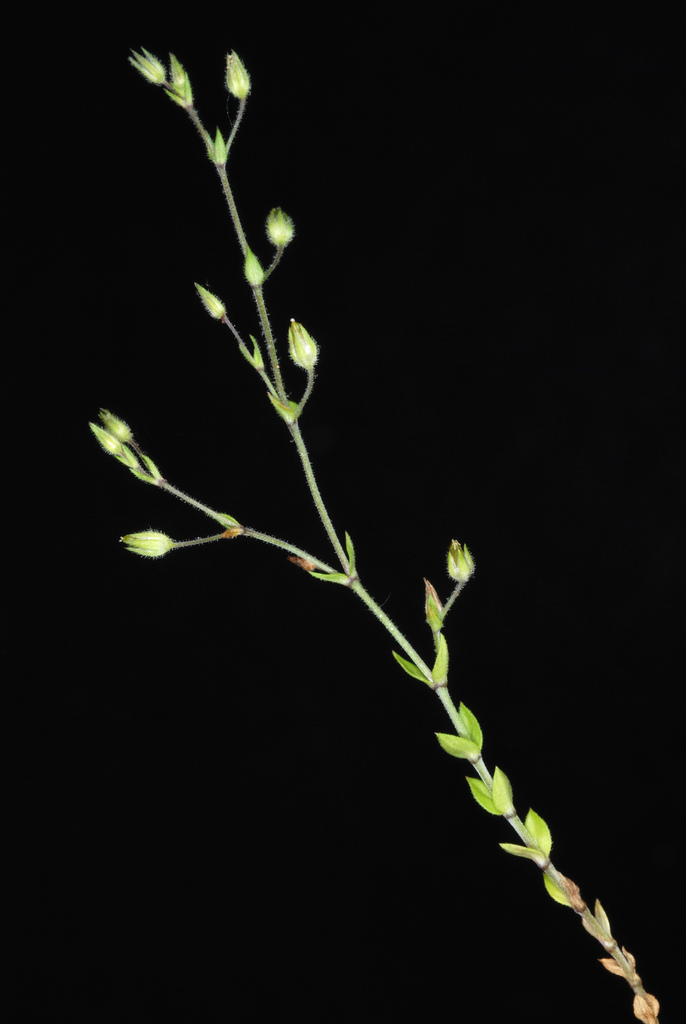
(c) Douglas Goldman, some rights reserved (CC BY-SA), uploaded by Douglas Goldman · licence
Family: Caryophyllaceae · Type: Annual · Not Native
Arenaria serpyllifolia var. serpyllifolia (Thymeleaf sandwort) is a non-native California annual in the Caryophyllaceae family, recognized by . Clear morphological and habitat differences from co-occurring perennial species.
Thymeleaf sandwort is a naturalized annual found in northwestern California, northern Sierra Nevada foothills, southern California, and the Modoc Plateau in disturbed areas, sandy environments, and dry woodlands at elevations of 150 to 1,800 meters. Flowering from spring to summer, this plant produces small white flowers in terminal clusters with delicate pedicels 1 to 12 millimeters long. Growing with tufted or trailing green stems 3 to 25 centimeters tall, covered in minute down-curved hairs. Its leaves are small, approximately 2 to 7 millimeters long and 1 to 4 millimeters wide, with ovate shapes and typically 3 to 5 visible veins. The plant produces 10 to 15 plump, widely reniform seeds approximately 0.5 to 0.6 millimeters long, with low, elongate tubercles and a grayish appearance.
Identification and appearance
Key characters: 1 sympatric species. Clear morphological and habitat differences from co-occurring perennial species.
Habitat and range
Habitat: Disturbed areas, sand, gravel bars, dry woodland
Elevation: 150-1800 m
California counties: Humboldt, Los Angeles, Siskiyou, Trinity, Sierra, Tehama, Lake, Sonoma, Stanislaus, Tuolumne
Outside California: +- North America; native to Europe.
Bloom period
Arenaria serpyllifolia var. serpyllifolia blooms Spring-summer.
How to tell it apart
vs Calidris: Arenaria is a small flowering plant; Calidris is a shorebird (sandpiper).; vs Actitis: Arenaria is a small flowering plant; Actitis is a shorebird (sandpiper).; vs Larus: Arenaria is a small flowering plant; Larus is a gull.; vs Pluvialis: Arenaria is a small flowering plant; Pluvialis is a shorebird (plover).; vs Charadrius: Arenaria is a small flowering plant; Charadrius is a shorebird (plover).
Frequently asked questions
Is Arenaria serpyllifolia var. serpyllifolia native to California?
No. Arenaria serpyllifolia var. serpyllifolia is not native to California (recorded as not native).
When does Arenaria serpyllifolia var. serpyllifolia bloom?
Arenaria serpyllifolia var. serpyllifolia blooms Spring-summer.
Where in California does Arenaria serpyllifolia var. serpyllifolia grow?
Arenaria serpyllifolia var. serpyllifolia occurs in Humboldt, Los Angeles, Siskiyou, Trinity, Sierra, Tehama, Lake, Sonoma and other counties, at elevations of 150-1800 m.
What plant family does Arenaria serpyllifolia var. serpyllifolia belong to?
Arenaria serpyllifolia var. serpyllifolia is in the Caryophyllaceae family, genus Arenaria.
What habitat does Arenaria serpyllifolia var. serpyllifolia grow in?
Arenaria serpyllifolia var. serpyllifolia grows in Disturbed areas, sand, gravel bars, dry woodland.
Related species
Other California species in the same genus, family, or bioregion.
Sources: Jepson eFlora · Index of California Plant Names · CalPhotos
Last updated 2026-09-30
Data from The California Species Project — 14,000+ California species with verified data from CNPS, CDFW, USFWS, Cal-IPC, and more.