Aristida divaricata
Poverty three-awn, Poverty Three-Awn
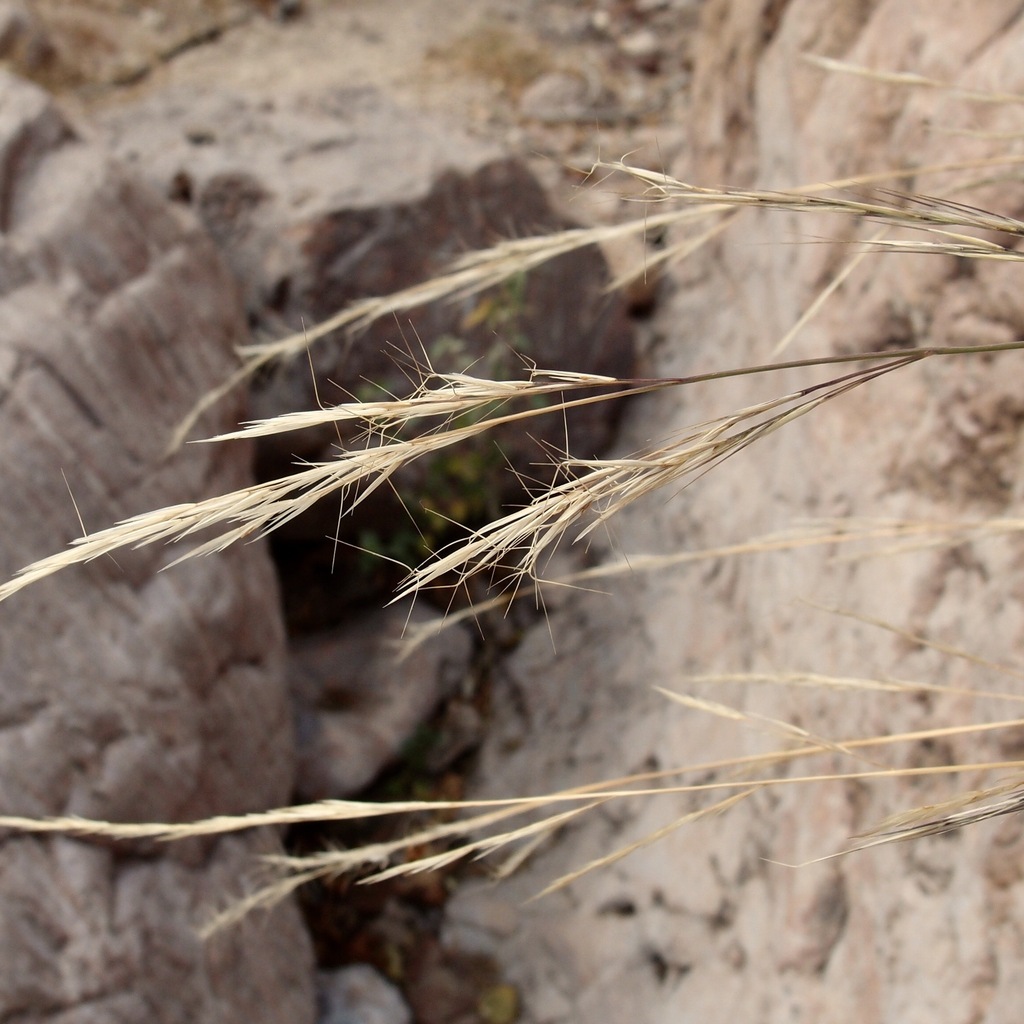
(c) Sue Carnahan, some rights reserved (CC BY), uploaded by Sue Carnahan · licence
Family: Poaceae · Type: Grass · Native
Aristida divaricata (Poverty three-awn) is a native California grass in the Poaceae family, recognized by tall stature and wide, umbrella-like inflorescence.
Poverty three-awn is a native perennial grass found in southern San Joaquin Valley, southern California Coastal, and southern peninsular regions of California on dry slopes, shrublands, and grasslands at elevations below 1,500 meters. Flowering from March to October, this grass produces pale green to tan spikelets with distinctive twisted awns that extend 10 to 20 millimeters long. Growing in dense tufts with erect stems 30 to 120 centimeters tall, the plant forms loose, open branching clusters. Its leaf blades are 5 to 20 centimeters long, loosely inrolled with a glabrous base, creating a fine, wispy appearance characteristic of three-awn grasses. The mature fruit is 8 to 10 millimeters long with intricate, multiple-twisted awns that distinguish this species from other grassland grasses.
Identification and appearance
Key characters: 9 sympatric species; distinguished by tall stature and wide, umbrella-like inflorescence
Habitat and range
Habitat: Uncommon. Dry slopes, shrubland, grassland
Elevation: < 1500 m
California counties: Los Angeles, Riverside, San Bernardino, Santa Barbara, Orange, Kern, Tulare, San Diego
Outside California: to Great Plains, Central America
Bloom period
Aristida divaricata blooms Mar-Oct.
How to tell it apart
vs Muhlenbergia: Aristida always has three awns per seed; Muhlenbergia has one awn or none.; vs Hilaria: Aristida has three awns on each spikelet; Hilaria has spikelets grouped in threes with single awns.; vs Bromus: Aristida's three thin straight awns are unmistakable; Bromus has single awns and papery seed coverings.; vs Schismus: Aristida has three long awns per seed; Schismus is a tiny annual with no awns at all.; vs Stipa: Aristida has three straight awns; Stipa has one twisted, bent awn.
Frequently asked questions
Is Aristida divaricata native to California?
Yes. Aristida divaricata is native to California (recorded as native).
When does Aristida divaricata bloom?
Aristida divaricata blooms Mar-Oct.
Where in California does Aristida divaricata grow?
Aristida divaricata occurs in Los Angeles, Riverside, San Bernardino, Santa Barbara, Orange, Kern, Tulare, San Diego, at elevations of < 1500 m.
What plant family does Aristida divaricata belong to?
Aristida divaricata is in the Poaceae family, genus Aristida.
What habitat does Aristida divaricata grow in?
Aristida divaricata grows in Uncommon. Dry slopes, shrubland, grassland.
Related species
Other California species in the same genus, family, or bioregion.
Sources: Jepson eFlora · Index of California Plant Names · CalPhotos
Last updated 2026-10-07
Data from The California Species Project — 14,000+ California species with verified data from CNPS, CDFW, USFWS, Cal-IPC, and more.