Armoracia rusticana
Horse radish
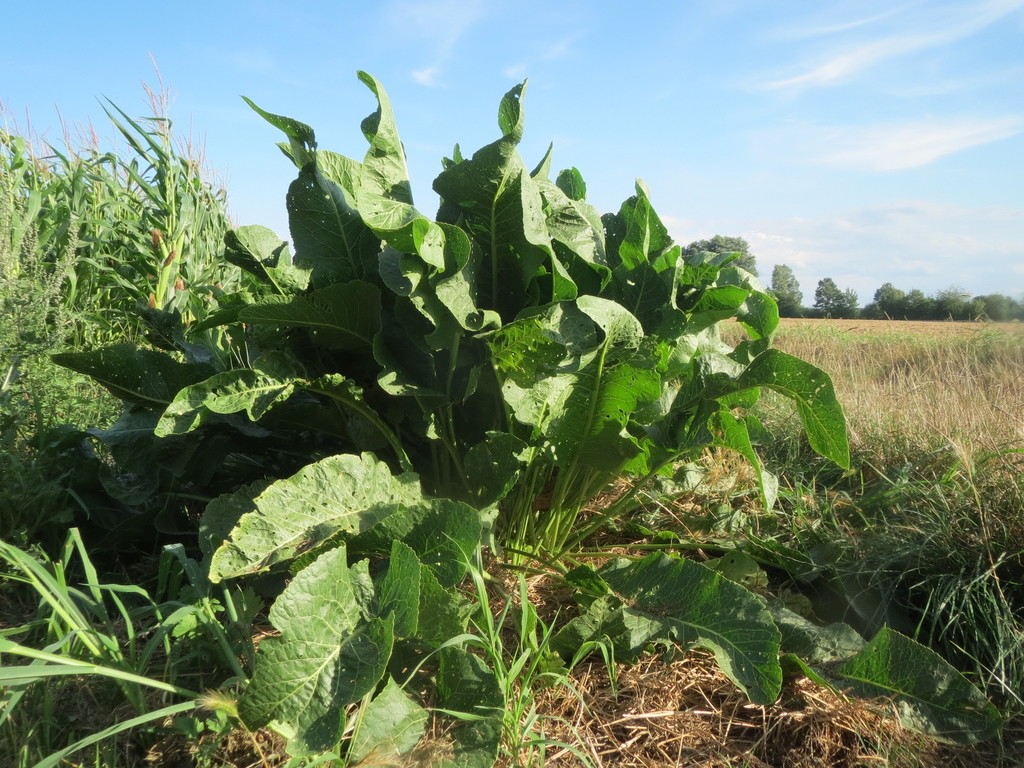
(c) Andreas Rockstein, some rights reserved (CC BY-SA) · licence
Family: Brassicaceae · Type: Herb · Not Native
Armoracia rusticana (Horse radish) is a non-native California herb in the Brassicaceae family, recognized by Only Armoracia in CA - distinguished from other Brassicaceae by massive size, deep taproot, and predominantly vegetative reproduction….
Horse radish is a naturalized perennial found in the Central Valley, central Coast, and San Francisco Bay regions in ditches, roadsides, moist places, and fields at elevations below 1,100 meters. Flowering from March to July, this plant produces white flowers 5 to 7 millimeters long with obovate petals. Growing with generally erect, branched stems 5 to 12 decimeters tall, it develops deep roots that spread vigorously. Its basal leaves are wide-oblong to ovate, 1.5 to 12 decimeters long with crenate edges, while stem leaves are pinnately lobed and become progressively smaller toward the stem tip. The fruit is small, typically 4 to 6 millimeters long, and rarely produces viable seeds.
Identification and appearance
Key characters: Only Armoracia in CA - distinguished from other Brassicaceae by massive size, deep taproot, and predominantly vegetative reproduction via root fragments
Habitat and range
Habitat: Ditches, roadsides, moist places, fields
Elevation: < 1100 m
Outside California: temperate North America, native to Eurasia
Bloom period
Armoracia rusticana blooms Mar-Jul.
How to tell it apart
vs Rapistrum: Armoracia is a huge perennial 5-12 feet tall with fleshy roots, Rapistrum is a hairy annual under 3 feet.; vs Cakile: Armoracia grows 5-12 feet in moist inland areas, Cakile is a low coastal plant on sandy beaches.; vs Carrichtera: Armoracia is a massive 5-12 foot perennial, Carrichtera is a small annual under 2 feet.; vs Cochlearia: Armoracia reaches 5-12 feet with thick fleshy roots, Cochlearia stays under 16 inches with thin roots.; vs Lepidium: Armoracia is a giant perennial with fleshy roots and huge leaves, Lepidium is much smaller without fleshy roots.
Frequently asked questions
Is Armoracia rusticana native to California?
No. Armoracia rusticana is not native to California (recorded as not native).
When does Armoracia rusticana bloom?
Armoracia rusticana blooms Mar-Jul.
What plant family does Armoracia rusticana belong to?
Armoracia rusticana is in the Brassicaceae family, genus Armoracia.
What habitat does Armoracia rusticana grow in?
Armoracia rusticana grows in Ditches, roadsides, moist places, fields.
Related species
Other California species in the same genus, family, or bioregion.
Sources: Jepson eFlora · CalPhotos
Last updated 2026-10-07
Data from The California Species Project — 14,000+ California species with verified data from CNPS, CDFW, USFWS, Cal-IPC, and more.