Arrhenatherum elatius
Tall oat grass
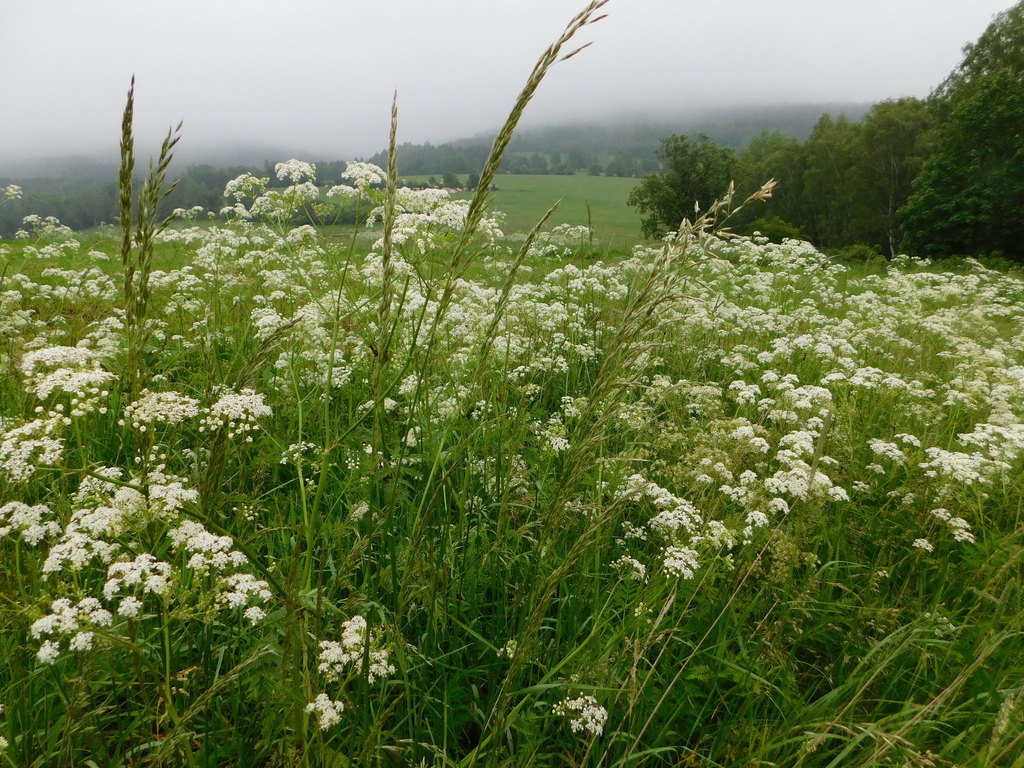
(c) Pavel Kacl, some rights reserved (CC BY), uploaded by Pavel Kacl · licence
Family: Poaceae · Type: Grass · Not Native
Arrhenatherum elatius (Tall oat grass) is a non-native California grass in the Poaceae family, recognized by Only Arrhenatherum in CA - characterized by dimorphic flowers within spikelets (lower staminate with long awn, upper bisexual with….
Tall oat grass is a naturalized perennial grass found in northwestern California, the Cascade Range, northern and central Sierra Nevada Foothills, central Sierra Nevada, Central Coast, San Francisco Bay Area, Western Transverse Ranges, and Modoc Plateau in disturbed, open sites at elevations of 30 to 1,800 meters. Flowering from May to July, this grass produces pale, translucent spikelets with soft-hairy keels in loose clusters 7 to 30 centimeters long. Growing with ascending to erect stems 50 to 180 centimeters tall, it forms dense tufts and sometimes develops rhizomes with distinctively bulbous basal internodes. Its leaves are flat, 5 to 30 centimeters long and 3 to 8 millimeters wide, with obtuse ligules that are minutely ciliate and glabrous to slightly rough blades. The distinctive lower lemma features an awn 10 to 17 millimeters long, creating a characteristic wispy appearance in disturbed grassland areas.
Identification and appearance
Key characters: Only Arrhenatherum in CA - characterized by dimorphic flowers within spikelets (lower staminate with long awn, upper bisexual with short/no awn) and often bulbous stem bases
Habitat and range
Habitat: Disturbed, open sites
Elevation: 30-1800 m
Outside California: to Alaska, southern Canada, most of United States, native to temperate Europe
Bloom period
Arrhenatherum elatius blooms May-Jul.
How to tell it apart
vs Avena: Arrhenatherum has small spikelets (~7--10 mm) with the lower floret staminate and awned; Avena (oats) has much larger, drooping spikelets (>15 mm) with a strongly bent, twisted awn.; vs Holcus: Arrhenatherum is taller with an open shiny panicle and a bent awn on the lower floret; Holcus (velvet grass) is softly velvety with a compact pale panicle and a short hooked awn.; vs Trisetum: Arrhenatherum spikelets are 2-flowered with a long geniculate awn from the staminate lower floret; Trisetum has smaller spikelets with awns arising from all florets.; vs Dactylis: Arrhenatherum has a loose open panicle of awned spikelets; Dactylis (orchardgrass) crowds spikelets into dense one-sided clumps at the branch tips.; vs Bromus: Arrhenatherum bears a dorsal bent awn low on a 2-flowered spikelet and may have bulbous stem bases; Bromus has larger many-flowered spikelets with straight terminal awns and closed sheaths.
Frequently asked questions
Is Arrhenatherum elatius native to California?
No. Arrhenatherum elatius is not native to California (recorded as not native).
When does Arrhenatherum elatius bloom?
Arrhenatherum elatius blooms May-Jul.
What plant family does Arrhenatherum elatius belong to?
Arrhenatherum elatius is in the Poaceae family, genus Arrhenatherum.
What habitat does Arrhenatherum elatius grow in?
Arrhenatherum elatius grows in Disturbed, open sites.
Related species
Other California species in the same genus, family, or bioregion.
Sources: Jepson eFlora · CalPhotos
Last updated 2026-10-07
Data from The California Species Project — 14,000+ California species with verified data from CNPS, CDFW, USFWS, Cal-IPC, and more.