Arum italicum
Italian arum, Italian Arum
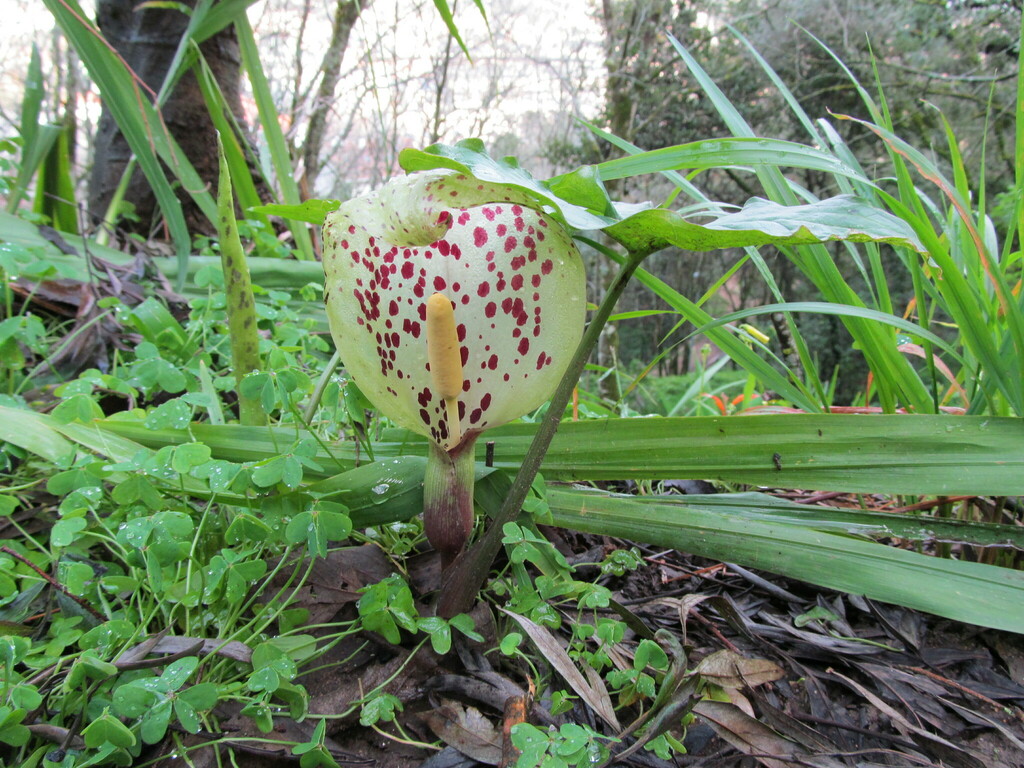
(c) zebedeugalinha, some rights reserved (CC BY) · licence
Family: Araceae · Type: Herb · Not Native
Conservation status: Cal-IPC Yes
Arum italicum (Italian arum) is a non-native California herb in the Araceae family, recognized by key differences are appendage color, tuber orientation, and habitat preferences.
Italian arum is a naturalized perennial found in northern coastal California, San Francisco Bay Area, Sacramento Valley, and southern coastal regions in disturbed, shaded areas at elevations below 500 meters. Flowering from March to June, this plant produces a distinctive yellow-tipped inflorescence arising from a large bract up to 32 centimeters long. Growing with a horizontal tuber and broad leaves less than 35 centimeters wide, it develops striking orange-red fruits that emerge after flowering. Its large green leaves are supported by petioles up to 42 centimeters tall, creating a dramatic presence in shaded woodland environments. As an introduced species, it thrives in disturbed habitats, forming dense patches in sheltered locations.
Identification and appearance
Key characters: 1 sympatric species; key differences are appendage color, tuber orientation, and habitat preferences
Habitat and range
Habitat: Uncommon. Disturbed, generally shaded areas
Elevation: < 500 m
California counties: Mendocino, Santa Cruz, Sonoma, Marin, Napa, Sacramento, Butte, Contra Costa, Santa Clara, Mariposa
Outside California: native to Europe, western Asia, northern Africa
Bloom period
Arum italicum blooms Mar-Jun.
Conservation status
Cal-IPC Yes
How to tell it apart
vs Zantedeschia: Arum has pale yellow-green on the bract outside; Zantedeschia is pure white on both surfaces.; vs Dracunculus: Arum has arrow-shaped leaves and a pale hood; Dracunculus has deeply divided leaves and dark purple hood.; vs Arisaema: Arum has arrow-shaped leaves and flowers on spike; Arisaema has compound leaves divided into leaflets.; vs Silybum: Arum has smooth arrow-shaped leaves with a hooded flower; Silybum has spiny white-veined thistle leaves.; vs Peltandra: Arum has pale yellow-green bract outside; Peltandra has a narrow green bract tightly wrapped around spike.
Frequently asked questions
Is Arum italicum native to California?
No. Arum italicum is not native to California (recorded as not native).
When does Arum italicum bloom?
Arum italicum blooms Mar-Jun.
Where in California does Arum italicum grow?
Arum italicum occurs in Mendocino, Santa Cruz, Sonoma, Marin, Napa, Sacramento, Butte, Contra Costa and other counties, at elevations of < 500 m.
What plant family does Arum italicum belong to?
Arum italicum is in the Araceae family, genus Arum.
Is Arum italicum invasive in California?
Arum italicum is listed by Cal-IPC with an invasiveness rating of Yes.
Related species
Other California species in the same genus, family, or bioregion.
Sources: Jepson eFlora · Index of California Plant Names · CalPhotos
Last updated 2026-10-07
Data from The California Species Project — 14,000+ California species with verified data from CNPS, CDFW, USFWS, Cal-IPC, and more.