Aruncus dioicus var. acuminatus
Bride's feathers
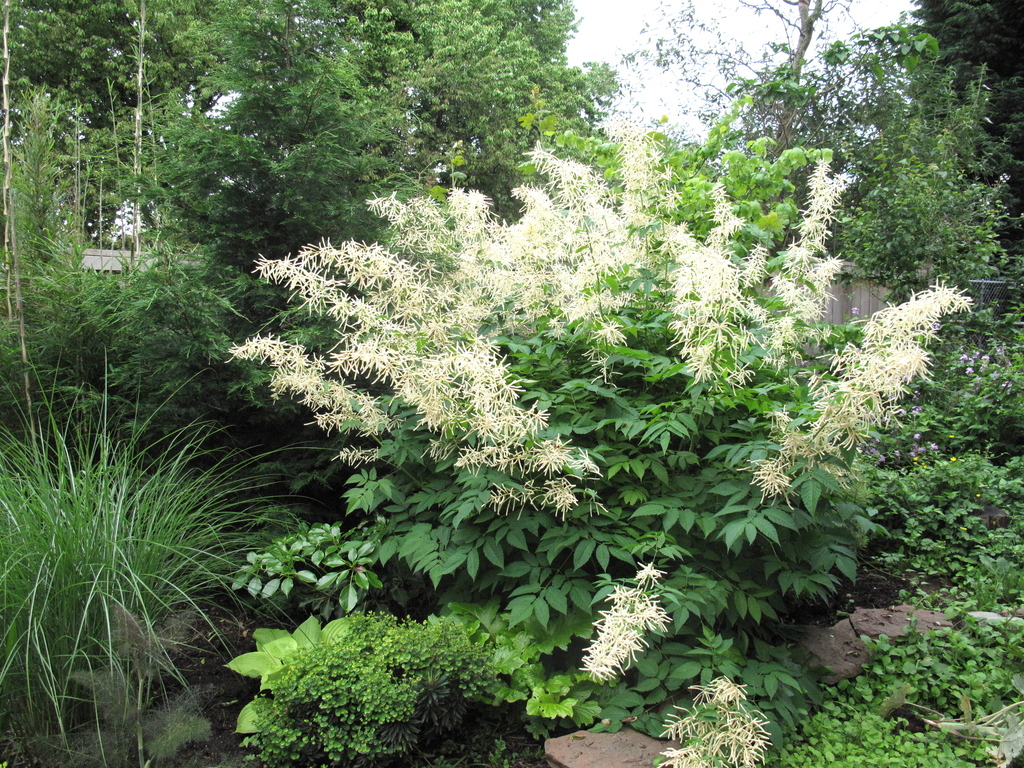
(c) Megan Hansen, some rights reserved (CC BY-SA) · licence
Family: Rosaceae · Type: Herb · Native
Aruncus dioicus var. acuminatus (Bride's feathers) is a native California herb in the Rosaceae family, recognized by Only Aruncus in CA - dioecious habit and follicle fruits distinguish it from other Rosaceae genera, representing a specialized lineage….
Bride's feathers is a California native perennial found in northern coastal California, Klamath Ranges, northern Coast Ranges, and Cascade Ranges in moist streambanks and conifer or mixed-evergreen forests at elevations below 1,900 meters. Flowering from June to September, this plant produces delicate white to pale yellow flowers in feathery panicles up to 50 centimeters long. Growing with robust stems 1 to 2 meters tall and a stout rhizome, it forms impressive clumps in woodland understories. Its large leaves are intricately compound, with 2 to 3 levels of pinnate leaflets, each ovate and sharply toothed, measuring 3 to 16 centimeters long. The fruit consists of 3 to 5 small cylindrical follicles that reflexively curve outward when mature.
Identification and appearance
Key characters: Only Aruncus in CA - dioecious habit and follicle fruits distinguish it from other Rosaceae genera, representing a specialized lineage within the family
Habitat and range
Habitat: Moist streambanks, conifer or mixed-evergreen forest
Elevation: < 1900 m
California counties: Humboldt, Del Norte, Siskiyou, Trinity
Outside California: to Alaska
Bloom period
Aruncus dioicus var. acuminatus blooms Jun-Sep.
How to tell it apart
vs Croton: Aruncus has white flower plumes and compound leaves; Croton has inconspicuous flowers and simple alternate leaves.; vs Atriplex: Aruncus has showy white flower plumes; Atriplex has inconspicuous greenish flowers and often scaly leaves.; vs Amaranthus: Aruncus has creamy flower plumes and compound leaves; Amaranthus has dense greenish spikes and simple leaves.; vs Soleirolia: Aruncus is 3-6 feet tall with large plumes; Soleirolia is a tiny mat-forming plant with minute leaves.; vs Cannabis: Aruncus has white flower plumes and double-toothed leaflets; Cannabis has greenish flowers and palmate leaves with single-toothed edges.
Frequently asked questions
Is Aruncus dioicus var. acuminatus native to California?
Yes. Aruncus dioicus var. acuminatus is native to California (recorded as native).
When does Aruncus dioicus var. acuminatus bloom?
Aruncus dioicus var. acuminatus blooms Jun-Sep.
Where in California does Aruncus dioicus var. acuminatus grow?
Aruncus dioicus var. acuminatus occurs in Humboldt, Del Norte, Siskiyou, Trinity, at elevations of < 1900 m.
What plant family does Aruncus dioicus var. acuminatus belong to?
Aruncus dioicus var. acuminatus is in the Rosaceae family, genus Aruncus.
What habitat does Aruncus dioicus var. acuminatus grow in?
Aruncus dioicus var. acuminatus grows in Moist streambanks, conifer or mixed-evergreen forest.
Related species
Other California species in the same genus, family, or bioregion.
Sources: Jepson eFlora · Index of California Plant Names · CalPhotos
Last updated 2026-10-07
Data from The California Species Project — 14,000+ California species with verified data from CNPS, CDFW, USFWS, Cal-IPC, and more.