Arundo donax
Giant reed
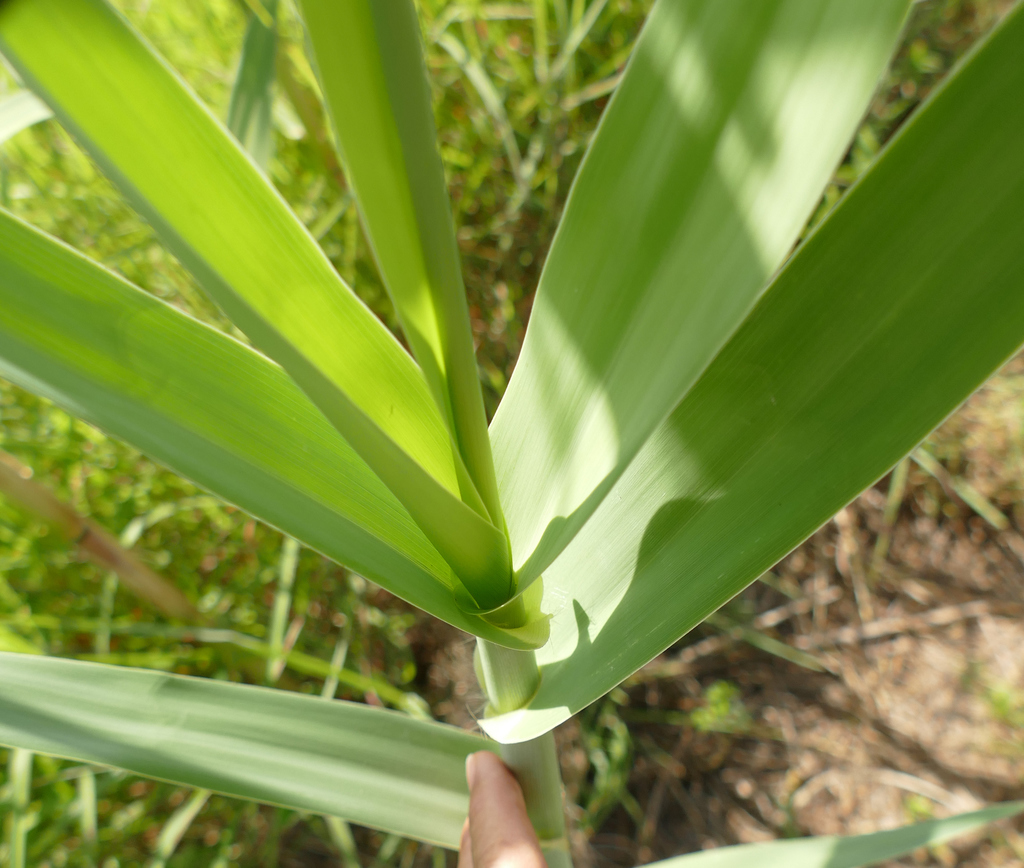
(c) Wendy McCrady, some rights reserved (CC BY), uploaded by Wendy McCrady · licence
Family: Poaceae · Type: Shrub · Not Native
Conservation status: Cal-IPC Yes
Arundo donax (Giant reed) is a non-native California shrub in the Poaceae family, recognized by Mediterranean introduction - this genus is not native to North America.
Giant reed is a naturalized perennial grass found in northern California Coast, Klamath Ranges, central Sierra Nevada Forest, Central Valley, Central Coast, southern coastal regions, southern California, San Gabriel Mountains, and desert areas in moist places, seeps, and ditchbanks at elevations below 1,500 meters. Flowering from March to September, this robust grass produces silvery to brownish-purple flowers in dense, ascending plume-like clusters up to 70 centimeters long. Growing to impressive heights of 2 to 10 meters with thick, woody stems and smooth nodes, it forms dense, towering stands in wet environments. Its elongated leaves are broad, measuring 2 to 6 centimeters wide and up to 1 meter in length, creating a dense, dramatic green backdrop. The plant's intricate flower clusters feature thin, silvery spikelets with silky-haired lemmas, contributing to its distinctive and dramatic appearance.
Identification and appearance
Key characters: Mediterranean introduction - this genus is not native to North America
Habitat and range
Habitat: Moist places, seeps, ditchbanks
Elevation: < 1500 m
California counties: Kings, Orange, Riverside, San Bernardino, San Diego, Ventura, Kern, Los Angeles, Madera, San Mateo, Santa Barbara, Sonoma, Solano, Santa Clara, Lake, Contra Costa, Fresno, Marin, Monterey, Sacramento, Napa, Imperial, Inyo, Glenn, Butte, Stanislaus, Mariposa, Humboldt, Yolo, Tehama, Shasta, Mendocino, San Luis Obispo, Merced, San Joaquin, Amador, Colusa, San Benito, Placer
Outside California: southern United States, native to Europe
Bloom period
Arundo donax blooms Mar-Sep.
Conservation status
Cal-IPC Yes
How to tell it apart
vs Leymus: Arundo reaches 12-20 feet with bamboo-like stems; Leymus is much shorter with wheat-like spikes.; vs Phragmites: Arundo has densely hairy lemma on smooth spikelet axis; Phragmites has smooth lemma on silky-hairy axis.; vs Phyllostachys: Arundo has unbranched hollow stems with single plume; Phyllostachys has woody branching bamboo structure.; vs Zea: Arundo has plumy flower clusters; Zea (corn) has distinctive ears and tassels.; vs Bambusa: Arundo has unbranched stems with grass flowers; Bambusa has woody branching bamboo structure.
Frequently asked questions
Is Arundo donax native to California?
No. Arundo donax is not native to California (recorded as not native).
When does Arundo donax bloom?
Arundo donax blooms Mar-Sep.
Where in California does Arundo donax grow?
Arundo donax occurs in Kings, Orange, Riverside, San Bernardino, San Diego, Ventura, Kern, Los Angeles and other counties, at elevations of < 1500 m.
What plant family does Arundo donax belong to?
Arundo donax is in the Poaceae family, genus Arundo.
Is Arundo donax invasive in California?
Arundo donax is listed by Cal-IPC with an invasiveness rating of Yes.
Related species
Other California species in the same genus, family, or bioregion.
Sources: Jepson eFlora · Index of California Plant Names · CalPhotos
Last updated 2026-10-07
Data from The California Species Project — 14,000+ California species with verified data from CNPS, CDFW, USFWS, Cal-IPC, and more.