Asclepias cordifolia
Purple milkweed, Purple Milkweed
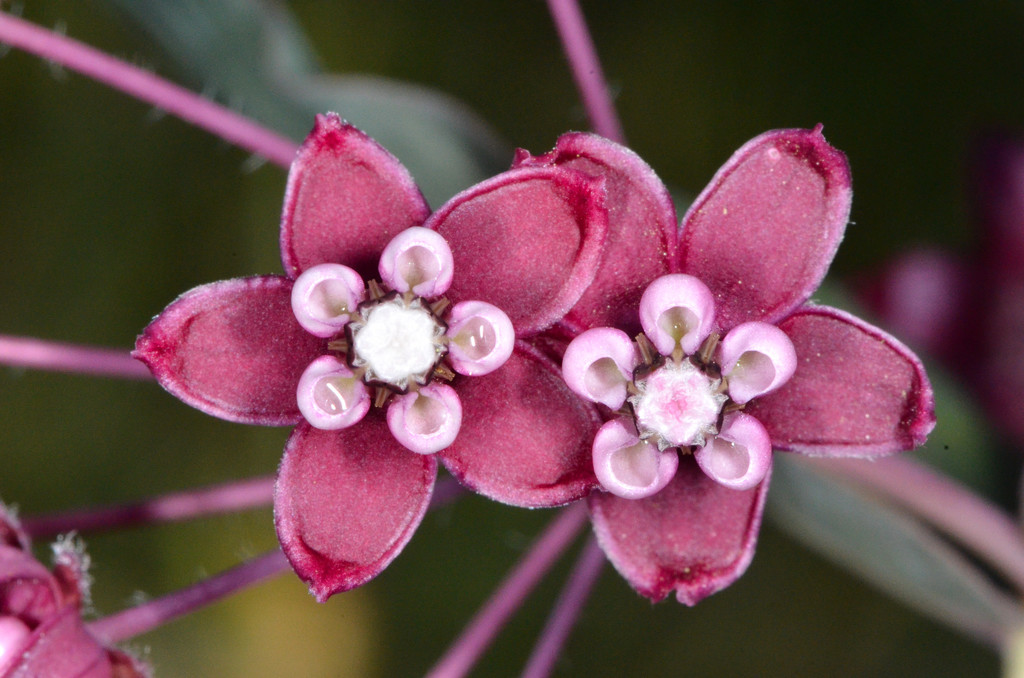
(c) Don Loarie, some rights reserved (CC BY) · licence
Family: Apocynaceae · Type: Herb · Native
Asclepias cordifolia (Purple milkweed) is a native California herb in the Apocynaceae family, recognized by distinctive cordate clasping leaves and glabrous stems.
Purple milkweed is a California native perennial found in northwestern California, the Cascade Range, Sierra Nevada, Sutter Buttes, central coastal California, northern San Francisco Bay, and the North Coast Ranges in rocky slopes, talus, woodlands, chaparral, and lava flows at elevations of 50 to 2,000 meters. Flowering from May to July, this plant produces striking dark red-purple flowers with spreading to reflexed corollas and elevated purple hoods. Growing with ascending stems reaching moderate heights, it develops opposite leaves with distinctive heart-shaped blades that clasp the stem at their base. Its leaves are cordate with no distinct petiole, creating a unique architectural profile along the stem. The plant produces erect fruits carried on slightly reflexed pedicels, with seeds approximately 7 to 8 millimeters long.
Identification and appearance
Key characters: 9 sympatric species; distinctive cordate clasping leaves and glabrous stems
Habitat and range
Habitat: Rocky slopes, talus, woodland, chaparral, lava flows
Elevation: 50-2000 m
California counties: Lake, Fresno, Calaveras, Plumas, Shasta, Madera, Humboldt, Amador, Sacramento, Butte, Kern, Tuolumne, Mariposa, Tulare, Siskiyou, Colusa, Yuba, Modoc, Sutter, Tehama, El Dorado, Nevada, San Mateo, Placer, Orange, Lassen, Trinity, Yolo, San Luis Obispo, Sierra, Contra Costa, Solano, Alpine, Sonoma, Napa, Mendocino, Del Norte, Glenn, Mono, Stanislaus
Outside California: Oregon, Nevada
Bloom period
Asclepias cordifolia blooms May-Jul.
How to tell it apart
vs Gomphocarpus: Asclepias has hoods that touch or nearly touch at their edges; Gomphocarpus has gaps between hood edges.; vs Erigeron: Asclepias has rounded umbel clusters with large individual flowers; Erigeron has daisy-like flowers with many thin ray petals.; vs Lantana: Asclepias has reflexed petals with a raised hood crown; Lantana has flat-faced tubular flowers in dense rounded heads.; vs Apocynum: Asclepias has large showy flowers in dome-shaped clusters; Apocynum has tiny bell-shaped flowers in branched sprays.; vs Baccharis: Asclepias has milky sap and large distinctive flowers; Baccharis has clear sap and tiny fuzzy composite flowers.
Frequently asked questions
Is Asclepias cordifolia native to California?
Yes. Asclepias cordifolia is native to California (recorded as native).
When does Asclepias cordifolia bloom?
Asclepias cordifolia blooms May-Jul.
Where in California does Asclepias cordifolia grow?
Asclepias cordifolia occurs in Lake, Fresno, Calaveras, Plumas, Shasta, Madera, Humboldt, Amador and other counties, at elevations of 50-2000 m.
What plant family does Asclepias cordifolia belong to?
Asclepias cordifolia is in the Apocynaceae family, genus Asclepias.
What habitat does Asclepias cordifolia grow in?
Asclepias cordifolia grows in Rocky slopes, talus, woodland, chaparral, lava flows.
Related species
Other California species in the same genus, family, or bioregion.
Sources: Jepson eFlora · Index of California Plant Names · CalPhotos
Last updated 2026-10-07
Data from The California Species Project — 14,000+ California species with verified data from CNPS, CDFW, USFWS, Cal-IPC, and more.