Asclepias eriocarpa
Kotolo, Kotolo
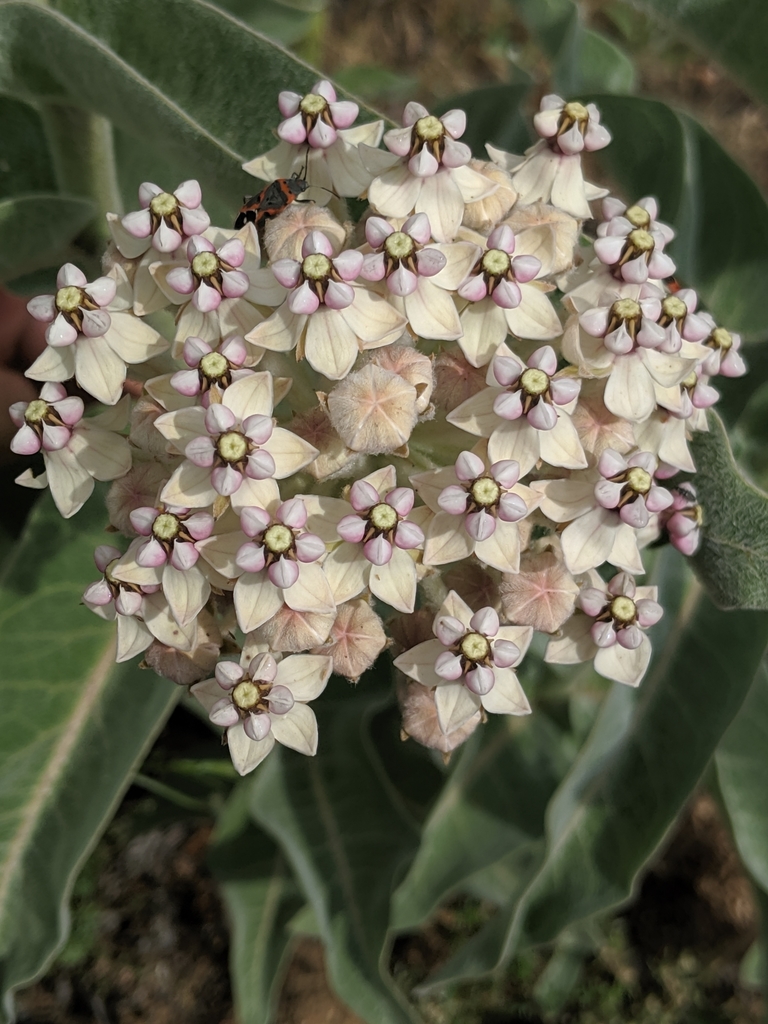
no rights reserved · CC0
Family: Apocynaceae · Type: Herb · Native
Asclepias eriocarpa (Kotolo) is a native California herb in the Apocynaceae family, recognized by erect habit with exserted horns at hood level, very hairy when young.
Kotolo is a California native perennial found in dry, barren areas across California's diverse landscapes at elevations of 200 to 1,900 meters. Flowering from May to October, this plant produces cream-colored flowers occasionally pink-tinged, with distinctive purple-tinged hoods nestled among densely hairy clusters. Growing with erect stems that can reach moderate heights, it develops opposite or whorled leaves in groups of three or four, with elliptic to lanceolate blades tapering at the base. Its leaves are characterized by smooth margins and obtuse to short-acuminate tips, creating a distinctive silhouette in arid environments. The plant produces erect fruits with seeds 8 to 9 millimeters long, reflecting its robust adaptation to challenging dry habitats.
Identification and appearance
Key characters: 14 sympatric species; erect habit with exserted horns at hood level, very hairy when young
Habitat and range
Habitat: Dry, barren areas
Elevation: 200-1900 m
California counties: Kern, Riverside, Fresno, Mariposa, Ventura, San Bernardino, San Luis Obispo, Santa Barbara, Los Angeles, Monterey, Orange, San Diego, Trinity, Mendocino, Tulare, Lake, Butte, Tehama, Merced, Yolo, Shasta, Tuolumne, Sutter, Plumas, Napa, Humboldt, Nevada, San Benito, Colusa, Glenn, Madera, Solano
Outside California: Nevada, northern Baja California
Bloom period
Asclepias eriocarpa blooms May-Oct.
How to tell it apart
vs Gomphocarpus: Asclepias has hoods that touch or nearly touch at their edges; Gomphocarpus has gaps between hood edges.; vs Erigeron: Asclepias has rounded umbel clusters with large individual flowers; Erigeron has daisy-like flowers with many thin ray petals.; vs Lantana: Asclepias has reflexed petals with a raised hood crown; Lantana has flat-faced tubular flowers in dense rounded heads.; vs Apocynum: Asclepias has large showy flowers in dome-shaped clusters; Apocynum has tiny bell-shaped flowers in branched sprays.; vs Baccharis: Asclepias has milky sap and large distinctive flowers; Baccharis has clear sap and tiny fuzzy composite flowers.
Frequently asked questions
Is Asclepias eriocarpa native to California?
Yes. Asclepias eriocarpa is native to California (recorded as native).
When does Asclepias eriocarpa bloom?
Asclepias eriocarpa blooms May-Oct.
Where in California does Asclepias eriocarpa grow?
Asclepias eriocarpa occurs in Kern, Riverside, Fresno, Mariposa, Ventura, San Bernardino, San Luis Obispo, Santa Barbara and other counties, at elevations of 200-1900 m.
What plant family does Asclepias eriocarpa belong to?
Asclepias eriocarpa is in the Apocynaceae family, genus Asclepias.
What habitat does Asclepias eriocarpa grow in?
Asclepias eriocarpa grows in Dry, barren areas.
Related species
Other California species in the same genus, family, or bioregion.
Sources: Jepson eFlora · Index of California Plant Names · CalPhotos
Last updated 2026-10-07
Data from The California Species Project — 14,000+ California species with verified data from CNPS, CDFW, USFWS, Cal-IPC, and more.