Asclepias fruticosa
African milkweed
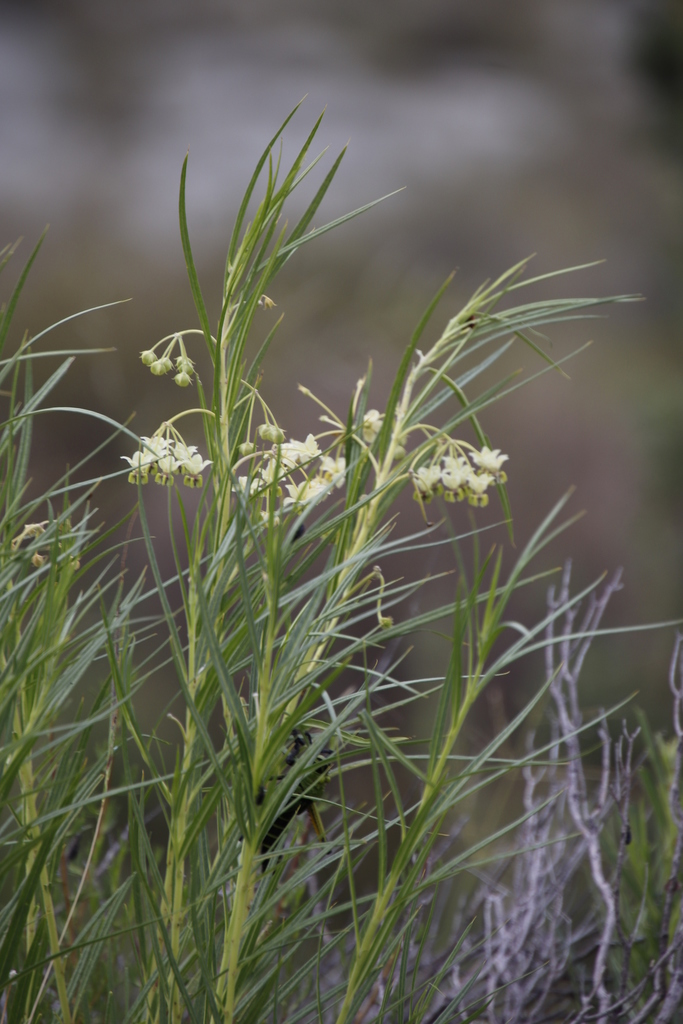
(c) Tony Rebelo, some rights reserved (CC BY-SA) · licence
Family: Apocynaceae · Type: Subshrub · Not Native
Asclepias fruticosa (African milkweed) is a non-native California subshrub in the Apocynaceae family, recognized by non-native with distinctive horns absent and spiny fruits.
African milkweed is a naturalized perennial found in Contra Costa County in disturbed sites at elevations below 100 meters. Flowering from December to July, this plant produces white flowers with subtle pink to purple tints, arranged in small clusters at the upper stem nodes. Growing with nearly erect stems that are slightly hairy, it reaches a moderate height with linear to narrow lance-shaped leaves positioned opposite each other. Its leaves have short or absent petioles, with blade shapes that are narrow and pointed, creating a delicate structural appearance. The fruit develops as an erect pod with small prickles 5 to 10 millimeters long, characteristic of milkweed species.
Identification and appearance
Key characters: 6 sympatric species; non-native with distinctive horns absent and spiny fruits
Habitat and range
Habitat: Disturbed sites
Elevation: < 100 m
Outside California: alien in Central America, South America, southern Europe, native to Africa
Bloom period
Asclepias fruticosa blooms Dec-Jul.
How to tell it apart
vs Gomphocarpus: Asclepias has hoods that touch or nearly touch at their edges; Gomphocarpus has gaps between hood edges.; vs Erigeron: Asclepias has rounded umbel clusters with large individual flowers; Erigeron has daisy-like flowers with many thin ray petals.; vs Lantana: Asclepias has reflexed petals with a raised hood crown; Lantana has flat-faced tubular flowers in dense rounded heads.; vs Apocynum: Asclepias has large showy flowers in dome-shaped clusters; Apocynum has tiny bell-shaped flowers in branched sprays.; vs Baccharis: Asclepias has milky sap and large distinctive flowers; Baccharis has clear sap and tiny fuzzy composite flowers.
Frequently asked questions
Is Asclepias fruticosa native to California?
No. Asclepias fruticosa is not native to California (recorded as not native).
When does Asclepias fruticosa bloom?
Asclepias fruticosa blooms Dec-Jul.
What plant family does Asclepias fruticosa belong to?
Asclepias fruticosa is in the Apocynaceae family, genus Asclepias.
What habitat does Asclepias fruticosa grow in?
Asclepias fruticosa grows in Disturbed sites.
Related species
Other California species in the same genus, family, or bioregion.
Sources: Jepson eFlora · CalPhotos
Last updated 2026-10-07
Data from The California Species Project — 14,000+ California species with verified data from CNPS, CDFW, USFWS, Cal-IPC, and more.