Asclepias subulata
Rush milkweed, Rush Milkweed
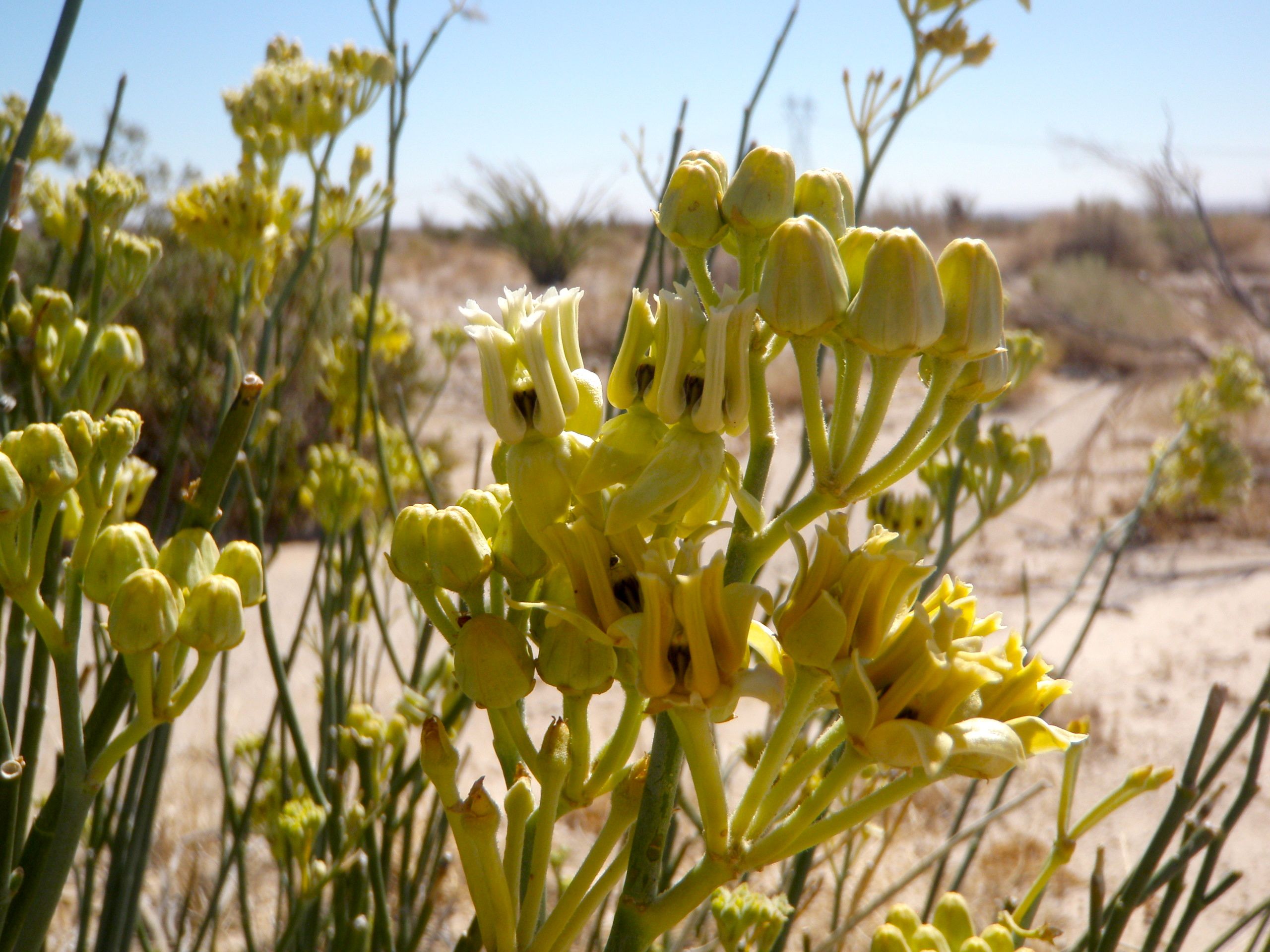
Photo by Chez Brungraber
Family: Apocynaceae · Type: Subshrub · Native
Asclepias subulata (Rush milkweed) is a native California subshrub in the Apocynaceae family, recognized by unique rush-like leafless appearance.
Rush milkweed is a California native perennial found in southern desert regions including the Mojave and Colorado Desert in arroyos and washes at elevations below 700 meters. Flowering essentially year-round, this plant produces yellow-white to green-white flowers with distinctive elevated hoods that extend well above the corolla base. Growing with erect, generally glabrous stems that reach approximately 60 to 100 centimeters tall, it develops a distinctive sparse structure with narrow-linear leaves arranged oppositely along the stem. Its ephemeral leaves are extremely narrow, blade-like, and positioned directly on the stem without distinct petioles. The plant produces pendulous fruits that hang from slightly reflexed pedicels, with seeds approximately 6 millimeters long.
Identification and appearance
Key characters: 9 sympatric species; unique rush-like leafless appearance
Habitat and range
Habitat: Arroyos, washes
Elevation: < 700 m
California counties: San Bernardino, San Diego, Riverside, Imperial
Outside California: to southern Nevada, Arizona, northwestern Mexico
Bloom period
Asclepias subulata blooms +- all year.
How to tell it apart
vs Gomphocarpus: Asclepias has hoods that touch or nearly touch at their edges; Gomphocarpus has gaps between hood edges.; vs Erigeron: Asclepias has rounded umbel clusters with large individual flowers; Erigeron has daisy-like flowers with many thin ray petals.; vs Lantana: Asclepias has reflexed petals with a raised hood crown; Lantana has flat-faced tubular flowers in dense rounded heads.; vs Apocynum: Asclepias has large showy flowers in dome-shaped clusters; Apocynum has tiny bell-shaped flowers in branched sprays.; vs Baccharis: Asclepias has milky sap and large distinctive flowers; Baccharis has clear sap and tiny fuzzy composite flowers.
Frequently asked questions
Is Asclepias subulata native to California?
Yes. Asclepias subulata is native to California (recorded as native).
When does Asclepias subulata bloom?
Asclepias subulata blooms +- all year.
Where in California does Asclepias subulata grow?
Asclepias subulata occurs in San Bernardino, San Diego, Riverside, Imperial, at elevations of < 700 m.
What plant family does Asclepias subulata belong to?
Asclepias subulata is in the Apocynaceae family, genus Asclepias.
What habitat does Asclepias subulata grow in?
Asclepias subulata grows in Arroyos, washes.
Related species
Other California species in the same genus, family, or bioregion.
- Asclepias vestita — Woolly milkweed
- Asclepias albicans — White-stemmed milkweed
- Asclepias asperula subsp. asperula — Antelope-horns
- Asclepias californica — California milkweed
- Asclepias cordifolia — Purple milkweed
- Asclepias cryptoceras — Humboldt mountains milkweed
- Catharanthus roseus — Madagascar periwinkle
- Catharanthus sp.
- Cycladenia humilis — Cycladenia
Sources: Jepson eFlora · Index of California Plant Names · CalPhotos
Last updated 2026-10-07
Data from The California Species Project — 14,000+ California species with verified data from CNPS, CDFW, USFWS, Cal-IPC, and more.