Asperugo procumbens
German madwort
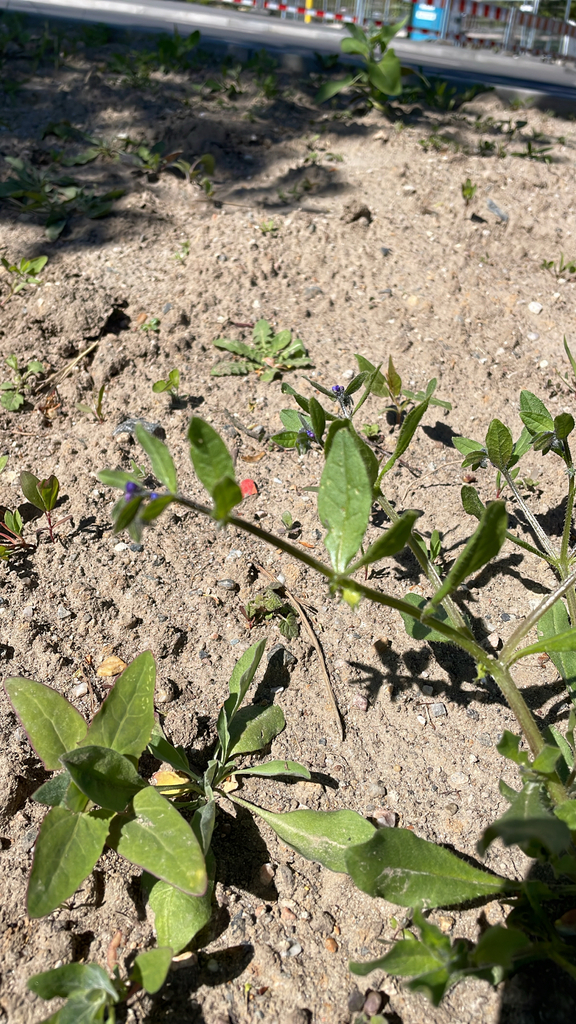
no rights reserved · CC0
Family: Boraginaceae · Type: Herb · Not Native
Asperugo procumbens (German madwort) is a non-native California herb in the Boraginaceae family, recognized by Only member of genus Asperugo naturalized in California, distinguished by unique compressed, papery fruiting calyx.
German madwort is a naturalized annual found in the Mojave Plains in disturbed areas at elevations of 1,000 to 1,500 meters. Flowering from April to July, this plant produces blue-violet flowers small and delicate with a funnel-shaped appearance. Growing with prostrate to weakly decumbent stems 30 to 80 centimeters long, it spreads across the ground with numerous branching stems that are distinctly angled. Its leaves vary from opposite at the base to alternate higher up the plant, with oblanceolate to elliptic blades 2 to 7 centimeters long that are notably rough or scabrous to the touch. The fruit consists of 2 to 4 dark, shiny nutlets that are compressed and ovate, each roughly 2 to 3 millimeters long.
Identification and appearance
Key characters: Only member of genus Asperugo naturalized in California, distinguished by unique compressed, papery fruiting calyx
Habitat and range
Habitat: Disturbed areas
Elevation: 1000-1500 m
Outside California: widespread United States, native to central and eastern Europe
Bloom period
Asperugo procumbens blooms Apr-Jul.
How to tell it apart
vs Galium: Both scramble with clinging, retrorse-barbed stems, but Asperugo has undivided leaves (opposite below, alternate above) and blue borage flowers with an enlarging toothed fruiting calyx; Galium (bedstraw) has whorled leaves and tiny white 4-petaled flowers.; vs Cynoglossum: Asperugo is a weak sprawling annual with tiny blue flowers and a flattened, toothed fruit-calyx; Cynoglossum (hound's tongue) is a stout erect biennial with larger reddish flowers and 4 bur-like nutlets.; vs Hackelia: Asperugo's nutlets are enclosed in an enlarged folded calyx; Hackelia (stickseed) nutlets carry a rim of marginal barbed prickles and are borne openly.; vs Lappula: Asperugo sprawls with hooked bristles and an accrescent toothed calyx; Lappula is erect with nutlets edged by 1--2 rows of hooked prickles.; vs Myosotis: Asperugo flowers are few and axillary with a bristly enlarging calyx; Myosotis (forget-me-not) has flowers in coiled racemes with a small, non-enlarging calyx.
Frequently asked questions
Is Asperugo procumbens native to California?
No. Asperugo procumbens is not native to California (recorded as not native).
When does Asperugo procumbens bloom?
Asperugo procumbens blooms Apr-Jul.
What plant family does Asperugo procumbens belong to?
Asperugo procumbens is in the Boraginaceae family, genus Asperugo.
What habitat does Asperugo procumbens grow in?
Asperugo procumbens grows in Disturbed areas.
Related species
Other California species in the same genus, family, or bioregion.
Sources: Jepson eFlora · CalPhotos
Last updated 2026-10-07
Data from The California Species Project — 14,000+ California species with verified data from CNPS, CDFW, USFWS, Cal-IPC, and more.