Aspidotis densa
Dense lace fern, Dense Lace Fern
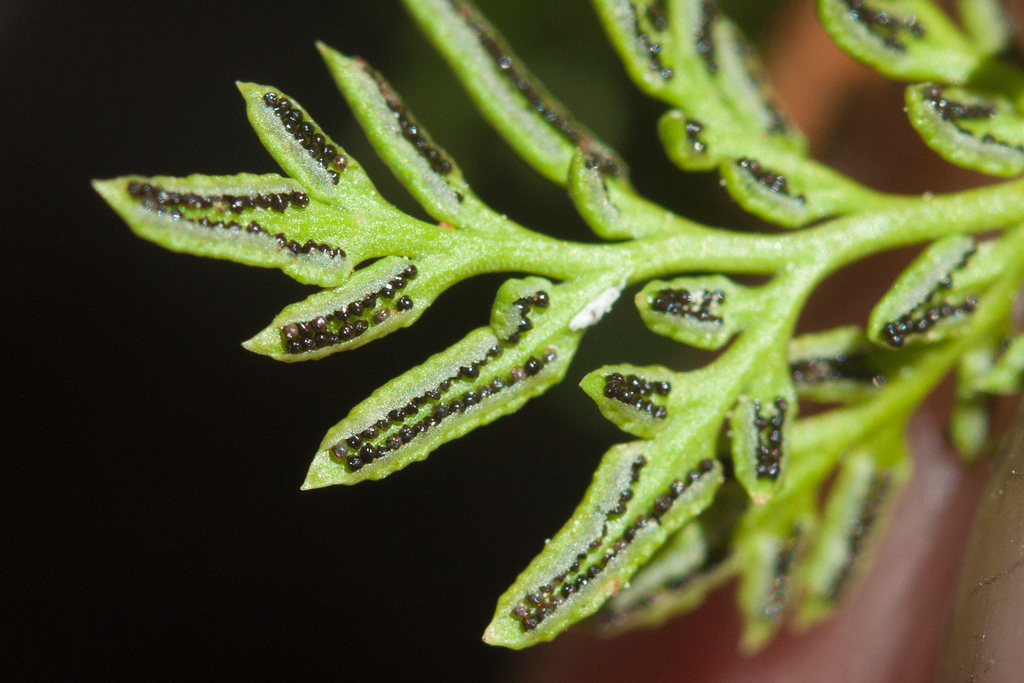
(c) Ken-ichi Ueda, some rights reserved (CC BY) · licence
Family: Pteridaceae · Type: Herb · Native
Aspidotis densa (Dense lace fern) is a native California herb in the Pteridaceae family, recognized by linear segments, continuous indusia, and dimorphic fertile/sterile fronds.
Dense lace fern is a California native perennial found in northwestern California, the California Ranges, Sierra Nevada, central western California, and Peninsular Ranges on slopes, crevices, and rocky outcrops, especially serpentine areas at elevations of 100 to 3,400 meters. This fern features deeply dissected, leathery fronds (2)3-pinnate and 15 to 20 centimeters long, with distinctive linear segments arranged in intricate lace-like patterns. Growing with complex, multi-layered fronds that have subtle differences between fertile and sterile leaves, the plant develops a compact, intricate growth form. Its pinnae are pinnately dissected with narrow, almost entire linear segments that create a delicate, textured appearance. The fern's sporangia form continuous false indusia along segment midveins with many shallow, regular teeth, giving it a unique textural quality.
Identification and appearance
Key characters: 2 sympatric species; key features are linear segments, continuous indusia, and dimorphic fertile/sterile fronds
Habitat and range
Habitat: Slopes, crevices, outcrops, especially serpentine
Elevation: 100-3400 m
California counties: Trinity, Siskiyou, Tuolumne, Sierra, Plumas, Tulare, Placer, Sonoma, Shasta, Sacramento, Butte, Del Norte, El Dorado, Fresno, Humboldt, Kern, Lake, Madera, Marin, Mariposa, Mendocino, Mono, Napa, Nevada, Tehama, Amador, Calaveras, Yuba, Glenn, Monterey, San Luis Obispo, Colusa, Alameda, Inyo, San Diego, San Benito
Outside California: to southwestern Canada, Montana, Wyoming, Utah, also southeastern Can (Gaspé Peninsula)
How to tell it apart
vs Conium: Aspidotis has spore cases under leaf margins; poison-hemlock has white flowers in umbels.; vs Pentagramma: Aspidotis has toothed sterile segments; goldback fern segments are entire without teeth.; vs Cryptogramma: Aspidotis segments are connected by thin wing tissue; rock-brake segments are completely separate.; vs Myriopteris: Check the leaf underside - Aspidotis is smooth, Myriopteris has scales, hairs, or glands.; vs Rumohra: Aspidotis segments are stalkless and connected; leather fern segments are distinctly stalked.
Frequently asked questions
Is Aspidotis densa native to California?
Yes. Aspidotis densa is native to California (recorded as native).
Where in California does Aspidotis densa grow?
Aspidotis densa occurs in Trinity, Siskiyou, Tuolumne, Sierra, Plumas, Tulare, Placer, Sonoma and other counties, at elevations of 100-3400 m.
What plant family does Aspidotis densa belong to?
Aspidotis densa is in the Pteridaceae family, genus Aspidotis.
What habitat does Aspidotis densa grow in?
Aspidotis densa grows in Slopes, crevices, outcrops, especially serpentine.
Related species
Other California species in the same genus, family, or bioregion.
Sources: Jepson eFlora · Index of California Plant Names · CalPhotos
Last updated 2026-10-07
Data from The California Species Project — 14,000+ California species with verified data from CNPS, CDFW, USFWS, Cal-IPC, and more.