Asplenium septentrionale
Northern spleenwort, northern spleenwort, northern spleenwort
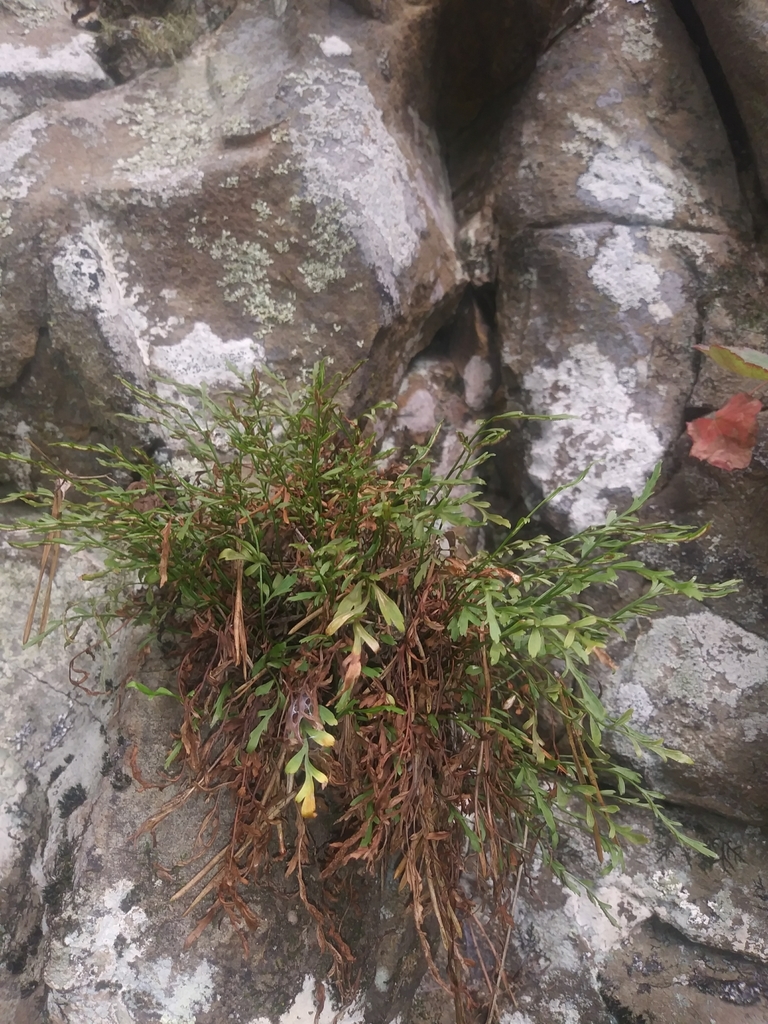
(c) Chris Hoess, some rights reserved (CC BY-SA) · licence
Family: Aspleniaceae · Type: Herb · Native
Conservation status: CNPS 2B.3
Asplenium septentrionale (Northern spleenwort) is a native California herb in the Aspleniaceae family, recognized by distinctive simple/forked fronds vs pinnate structure.
Northern spleenwort is a native fern found in the high Sierra Nevada Mountains and California-Cascade Range in granite rock crevices at elevations of 2,500 to 3,350 meters. This distinctive fern produces narrow, grass-like leaves 5 to 15 centimeters long with red-brown bases and green upper portions. Growing in dense clusters, its leaves are remarkably slender, typically 1 to 2 millimeters wide and often with small sterile teeth near the tips. Its fronds emerge from short reddish-brown stems 2.5 to 12 centimeters long, creating a delicate, tufted appearance in rocky mountain habitats. The fern develops linear sori (spore-producing structures) 5 to 15 millimeters long, typically positioned along its narrow leaf segments.
Identification and appearance
Key characters: 1 sympatric species; distinctive simple/forked fronds vs pinnate structure
Habitat and range
Habitat: Crevices of granite rocks
Elevation: 2500-3350 m
California counties: Tulare, Shasta, Tehama
Outside California: to Oregon, South Dakota, Texas, northern Baja California, also West Virginia, Europe, Asia
Conservation status
CNPS 2B.3
How to tell it apart
vs Polystichum: Asplenium has linear to J-shaped sori; Polystichum has round sori with umbrella-like covers.; vs Rumex: Asplenium has fern fronds with sori underneath; Rumex has simple flowering plant leaves with papery sheaths.; vs Nephrolepis: Asplenium has free veins ending at margins; Nephrolepis has veins that form connecting loops.; vs Marsilea: Asplenium has typical fern fronds; Marsilea has four-parted clover-like leaves on creeping stems.; vs Blechnum: Asplenium sori are scattered along veins; Blechnum sori form continuous lines parallel to the midrib.
Frequently asked questions
Is Asplenium septentrionale native to California?
Yes. Asplenium septentrionale is native to California (recorded as native).
Where in California does Asplenium septentrionale grow?
Asplenium septentrionale occurs in Tulare, Shasta, Tehama, at elevations of 2500-3350 m.
What plant family does Asplenium septentrionale belong to?
Asplenium septentrionale is in the Aspleniaceae family, genus Asplenium.
Is Asplenium septentrionale rare or endangered?
Asplenium septentrionale carries California Rare Plant Rank 2B.3, state rank S3.
What habitat does Asplenium septentrionale grow in?
Asplenium septentrionale grows in Crevices of granite rocks.
Related species
Other California species in the same genus, family, or bioregion.
Sources: Jepson eFlora · CNPS Rare Plant Inventory · Index of California Plant Names · CalPhotos · CDFW CNDDB
Last updated 2026-10-07
Data from The California Species Project — 14,000+ California species with verified data from CNPS, CDFW, USFWS, Cal-IPC, and more.