Astragalus casei
Case's milkvetch
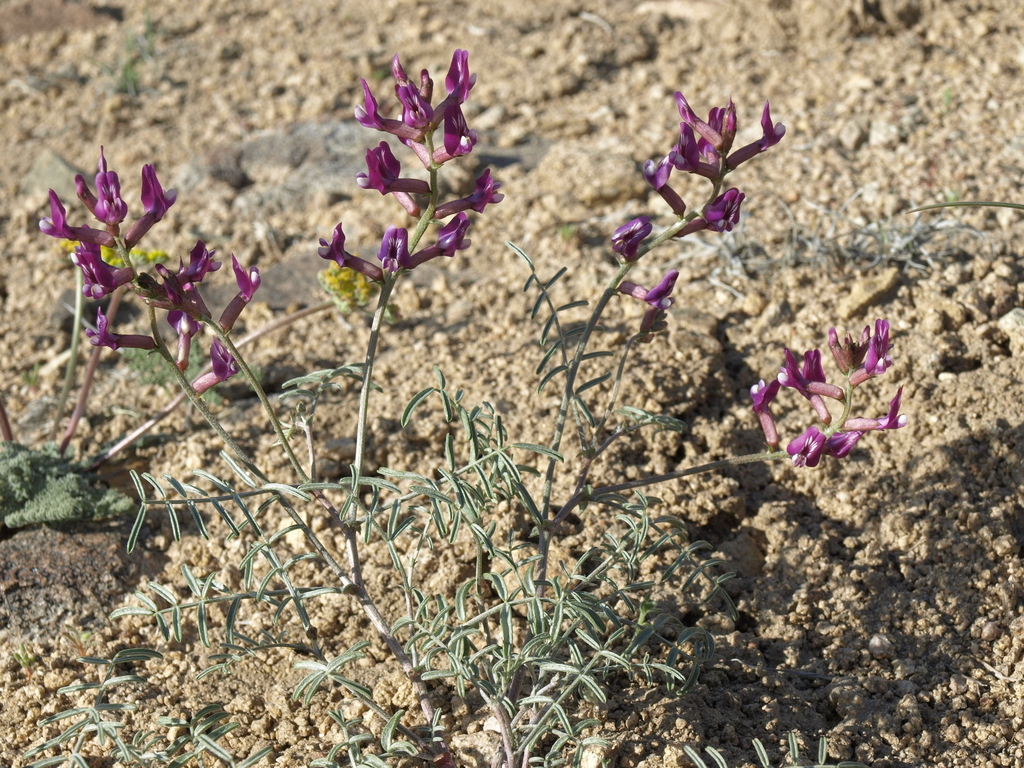
(c) Jim Morefield, some rights reserved (CC BY) · licence
Family: Fabaceae · Type: Herb · Native
Astragalus casei (Case's milkvetch) is a native California herb in the Fabaceae family, recognized by zigzag stems, sharply reflexed half-moon shaped pods.
Case's milkvetch is a California native perennial found in the southern eastern desert mountains and desert mountains of Inyo County in dry, gravelly soils with sagebrush or pinyon woodland at elevations of 1,200 to 2,400 meters. Flowering from April to June, this plant produces delicate pink-purple flowers with white wing and keel tips, with a recurved banner 12 to 18 millimeters long. Growing with slender, widely branched stems 10 to 40 centimeters tall that often zigzag and are minutely hairy, it has an open, wiry structure. Its leaves are complex, with 5 to 15 linear to oblanceolate leaflets 3 to 25 millimeters long, typically with obtuse or notched tips. The fruit is a distinctive sharply pendent pod 20 to 55 millimeters long, slightly curved and wider than deep, with a sharp rigid beak.
Identification and appearance
Key characters: 63 sympatric species; zigzag stems, sharply reflexed half-moon shaped pods
Habitat and range
Habitat: Dry, gravelly soils or dunes, with sagebrush or pinyon
Elevation: 1200-2400 m
California counties: Inyo, Mono, San Bernardino
Outside California: western Nevada
Bloom period
Astragalus casei blooms Apr-Jun.
How to tell it apart
vs Vicia: Astragalus has racemes of flowers; vetches (Vicia) have tendrils at leaf tips and climbing or sprawling habit.; vs Oxytropis: Astragalus keel tip is rounded to slightly pointed; Oxytropis keel has a pronounced pointed beak.; vs Cleomella: Astragalus has pea-shaped flowers; Cleomella has 4-petaled cruciform flowers with long stamens.; vs Lupinus: Astragalus has pinnate compound leaves; lupines have palmate leaves (leaflets radiating from one point).; vs Dalea: Astragalus has typical pea flowers; Dalea has tiny flowers with petals attached to the stamen tube.
Frequently asked questions
Is Astragalus casei native to California?
Yes. Astragalus casei is native to California (recorded as native).
When does Astragalus casei bloom?
Astragalus casei blooms Apr-Jun.
Where in California does Astragalus casei grow?
Astragalus casei occurs in Inyo, Mono, San Bernardino, at elevations of 1200-2400 m.
What plant family does Astragalus casei belong to?
Astragalus casei is in the Fabaceae family, genus Astragalus.
What habitat does Astragalus casei grow in?
Astragalus casei grows in Dry, gravelly soils or dunes, with sagebrush or pinyon.
Related species
Other California species in the same genus, family, or bioregion.
Sources: Jepson eFlora · Index of California Plant Names · CalPhotos
Last updated 2026-10-07
Data from The California Species Project — 14,000+ California species with verified data from CNPS, CDFW, USFWS, Cal-IPC, and more.