Astragalus lentiginosus var. micans
Shining milkvetch
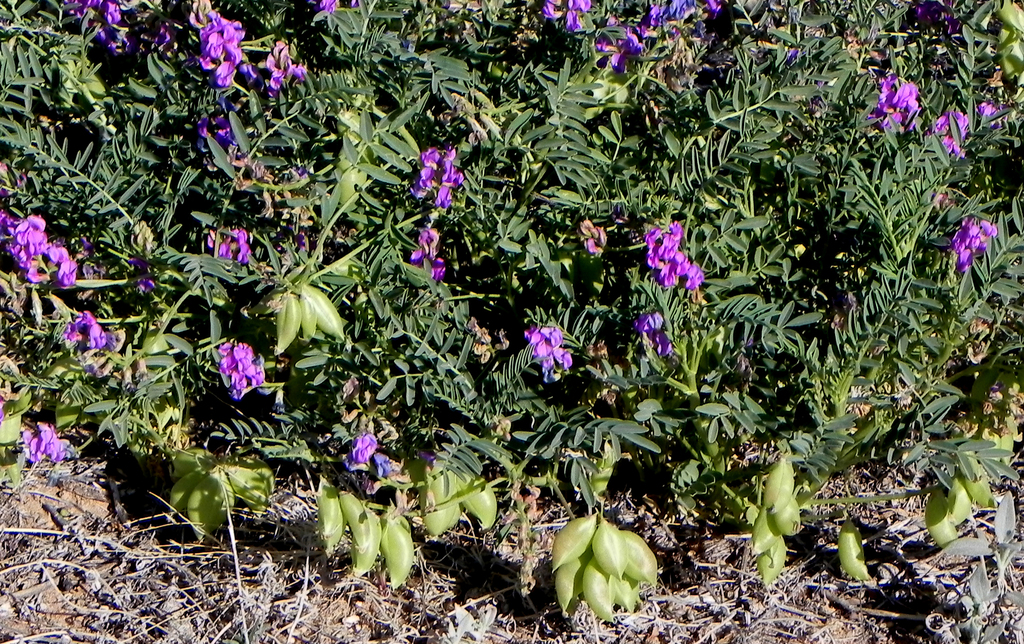
(c) Hadley Paul Garland, some rights reserved (CC BY-SA) · licence
Family: Fabaceae · Type: Herb · Native
Conservation status: CNPS 1B.2
Astragalus lentiginosus var. micans (Shining milkvetch) is a native California herb in the Fabaceae family, recognized by dense silvery hairs and dune habitat.
Shining milkvetch is a rare (CNPS 1B.2) California native perennial found in northern Death Valley's Eureka Valley in sandy dune habitats at elevations of 850 to 1,200 meters. Flowering from April to June, this plant produces white flowers with delicate pink-lavender tips, creating elegant clusters of 12 to 35 blooms. Growing in clumped, ascending stems 20 to 40 centimeters tall with dense silvery-white silky hairs, it forms compact clusters in the desert landscape. Its compound leaves feature 11 to 17 widely ovate leaflets, each 5 to 14 millimeters long, creating a soft, textured appearance. The fruit is an inflated, stiff-papery pod 15 to 20 millimeters long, densely covered in silky hairs that shimmer in the desert sunlight.
Identification and appearance
Key characters: 40 sympatric species; distinguished by dense silvery hairs and dune habitat
Habitat and range
Habitat: Dunes
Elevation: 850-1200 m
California counties: Inyo
Bloom period
Astragalus lentiginosus var. micans blooms Apr-Jun.
Conservation status
CNPS 1B.2
How to tell it apart
vs Vicia: Astragalus has racemes of flowers; vetches (Vicia) have tendrils at leaf tips and climbing or sprawling habit.; vs Oxytropis: Astragalus keel tip is rounded to slightly pointed; Oxytropis keel has a pronounced pointed beak.; vs Cleomella: Astragalus has pea-shaped flowers; Cleomella has 4-petaled cruciform flowers with long stamens.; vs Lupinus: Astragalus has pinnate compound leaves; lupines have palmate leaves (leaflets radiating from one point).; vs Dalea: Astragalus has typical pea flowers; Dalea has tiny flowers with petals attached to the stamen tube.
Frequently asked questions
Is Astragalus lentiginosus var. micans native to California?
Yes. Astragalus lentiginosus var. micans is native to California (recorded as native).
When does Astragalus lentiginosus var. micans bloom?
Astragalus lentiginosus var. micans blooms Apr-Jun.
Where in California does Astragalus lentiginosus var. micans grow?
Astragalus lentiginosus var. micans occurs in Inyo, at elevations of 850-1200 m.
What plant family does Astragalus lentiginosus var. micans belong to?
Astragalus lentiginosus var. micans is in the Fabaceae family, genus Astragalus.
Is Astragalus lentiginosus var. micans rare or endangered?
Astragalus lentiginosus var. micans carries California Rare Plant Rank 1B.2, state rank S1.
Related species
Other California species in the same genus, family, or bioregion.
- Astragalus lentiginosus var. nigricalycis — Black hair milkvetch
- Astragalus lentiginosus var. piscinensis — Fish slough milkvetch
- Astragalus lentiginosus var. salinus — Sagebrush milkvetch
- Astragalus lentiginosus var. semotus — Freckled milkvetch
- Astragalus lentiginosus var. sesquimetralis — Sodaville milkvetch
- Astragalus lentiginosus var. sierrae — Big bear valley milkvetch
Sources: Jepson eFlora · CNPS Rare Plant Inventory · Index of California Plant Names · CalPhotos · CDFW CNDDB
Last updated 2026-10-07
Data from The California Species Project — 14,000+ California species with verified data from CNPS, CDFW, USFWS, Cal-IPC, and more.