Astragalus tener var. titi
Coastal dunes milkvetch
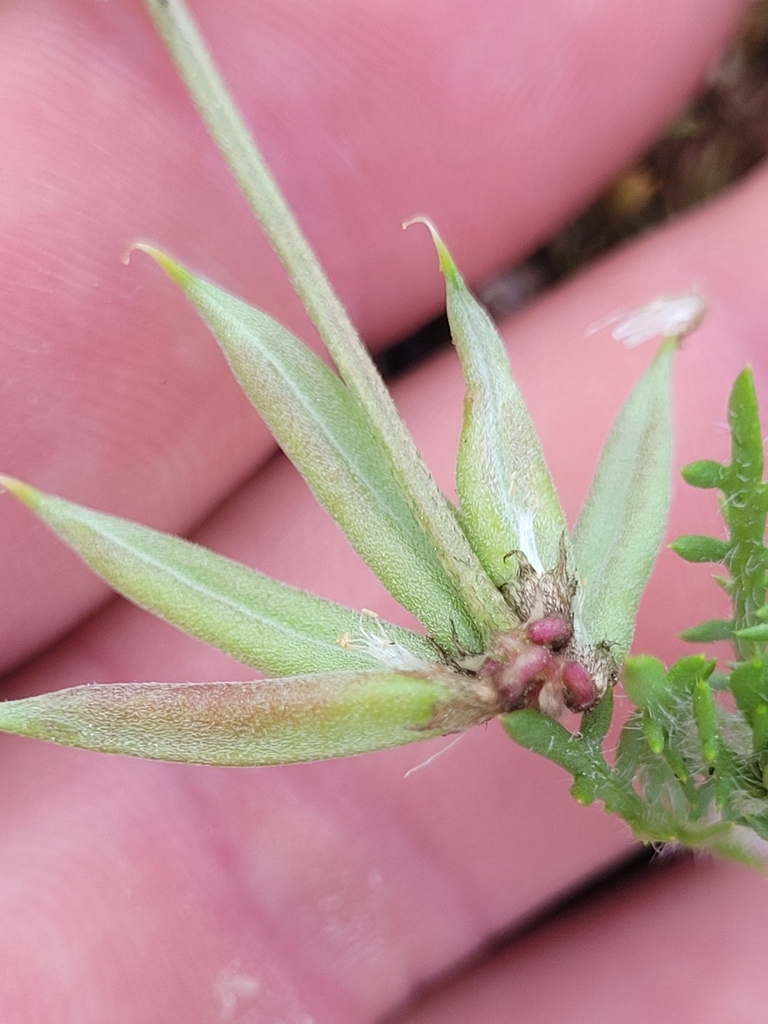
(c) Konshau Duman, some rights reserved (CC BY) · licence
Family: Fabaceae · Type: Herb · Native
Conservation status: CNPS 1B.1 · Endangered
Astragalus tener var. titi (Coastal dunes milkvetch) is a native California herb in the Fabaceae family, recognized by very small size, coastal habitat, and short straight/outcurved fruits diagnostic.
Coastal dunes milkvetch is a rare (CNPS 1B.1) California native annual found in central California coastal areas including Monterey County on coastal bluffs and dunes at elevations below 20 meters. Flowering from March to June, this plant produces delicate flowers with pale colors in small clusters of 2 to 7 blooms. Growing with low-spreading stems 2 to 12 centimeters long, it forms compact plants in moist sandy coastal depressions. Its compound leaves span 2 to 7 centimeters and feature 7 to 13 small leaflets, creating a fine, intricate foliage pattern. The fruit develops 6 to 14 millimeters long, either straight or slightly curved.
Identification and appearance
Key characters: 24 sympatric species; very small size, coastal habitat, and short straight/outcurved fruits diagnostic
Habitat and range
Habitat: Moist sandy depressions (vernal pool) near coast, coastal bluffs, dunes
Elevation: < 20 m
Bloom period
Astragalus tener var. titi blooms Mar-Jun.
Conservation status
CNPS 1B.1 · Endangered
How to tell it apart
vs Vicia: Astragalus has racemes of flowers; vetches (Vicia) have tendrils at leaf tips and climbing or sprawling habit.; vs Oxytropis: Astragalus keel tip is rounded to slightly pointed; Oxytropis keel has a pronounced pointed beak.; vs Cleomella: Astragalus has pea-shaped flowers; Cleomella has 4-petaled cruciform flowers with long stamens.; vs Lupinus: Astragalus has pinnate compound leaves; lupines have palmate leaves (leaflets radiating from one point).; vs Dalea: Astragalus has typical pea flowers; Dalea has tiny flowers with petals attached to the stamen tube.
Frequently asked questions
Is Astragalus tener var. titi native to California?
Yes. Astragalus tener var. titi is native to California (recorded as native).
When does Astragalus tener var. titi bloom?
Astragalus tener var. titi blooms Mar-Jun.
What plant family does Astragalus tener var. titi belong to?
Astragalus tener var. titi is in the Fabaceae family, genus Astragalus.
Is Astragalus tener var. titi rare or endangered?
Astragalus tener var. titi carries California Rare Plant Rank 1B.1, state rank S1.
What habitat does Astragalus tener var. titi grow in?
Astragalus tener var. titi grows in Moist sandy depressions (vernal pool) near coast, coastal bluffs, dunes.
Related species
Other California species in the same genus, family, or bioregion.
Sources: Jepson eFlora · CalPhotos · CDFW CNDDB
Last updated 2026-10-07
Data from The California Species Project — 14,000+ California species with verified data from CNPS, CDFW, USFWS, Cal-IPC, and more.