Astragalus whitneyi var. lenophyllus
Woolly-leaved milkvetch, Woolly-Leaved Milkvetch
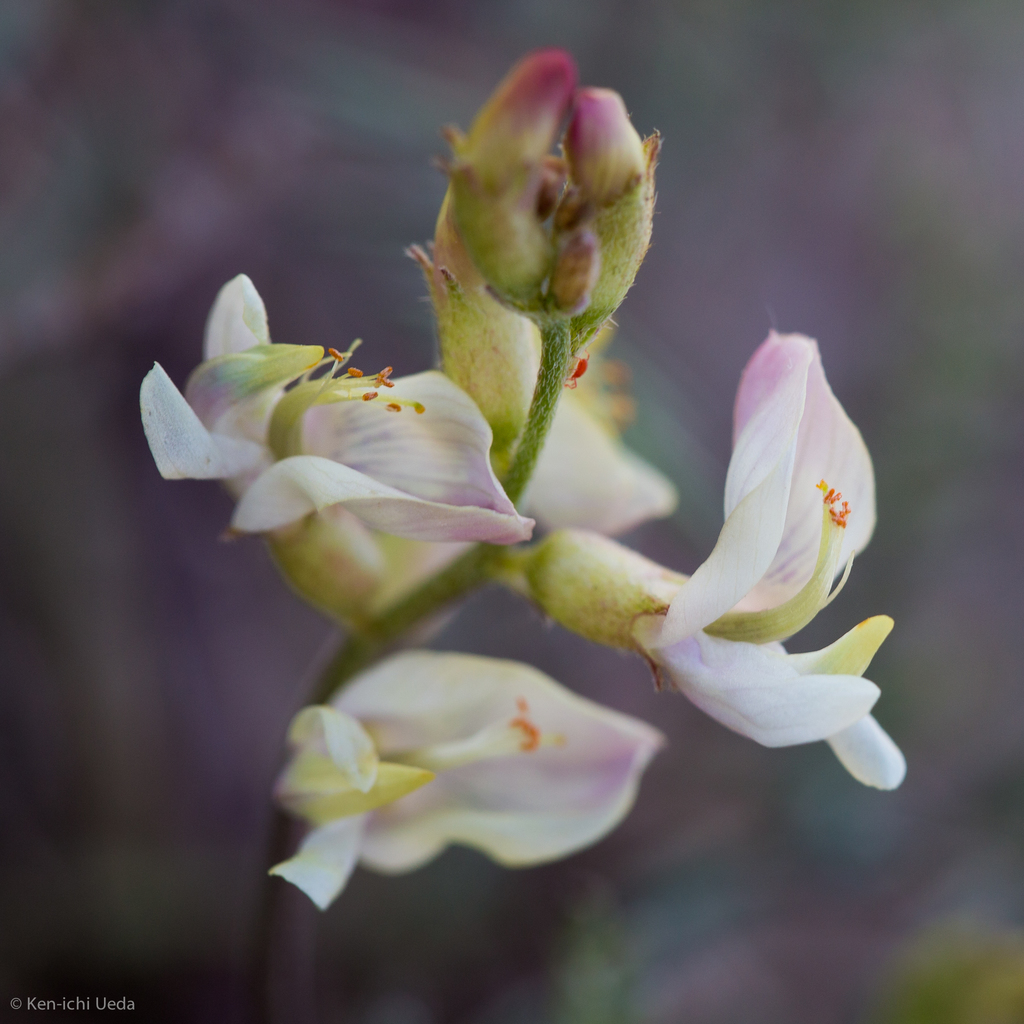
(c) Ken-ichi Ueda, some rights reserved (CC BY), uploaded by Ken-ichi Ueda · licence
Family: Fabaceae · Type: Herb · Native
Conservation status: CNPS 4.3
Astragalus whitneyi var. lenophyllus (Woolly-leaved milkvetch) is a native California herb in the Fabaceae family, recognized by crowded leaflets and glabrous pods are distinctive.
Woolly-leaved milkvetch is a California native perennial ranked 4.3 by CNPS, found in the Klamath Ranges and northern Sierra Nevada Mountains in open, rocky places at elevations of 1,500 to 2,750 meters. Flowering from July to August, this plant produces cream-colored flowers with a banner 8.3 to 16.5 millimeters long, with 5 to 9 flowers in its inflorescence. Growing with a distinctive gray-green appearance and spreading to ascending herbage hairs, it forms compact clusters with stems covered in soft, pale indumentum. Its leaves are 2 to 4 centimeters long, densely packed with leaflets positioned closely together without visible spaces between them. The plant produces elongated fruit bodies 1.5 to 4.2 centimeters long with a short stalk-like base, emerging from its delicate, woolly foliage.
Identification and appearance
Key characters: 28 sympatric species; crowded leaflets and glabrous pods are distinctive
Habitat and range
Habitat: Open, rocky places
Elevation: 1500-2750 m
California counties: Nevada, Modoc, Lassen, Placer, Siskiyou, Plumas, Alpine, Trinity
Bloom period
Astragalus whitneyi var. lenophyllus blooms Jul-Aug.
Conservation status
CNPS 4.3
How to tell it apart
vs Vicia: Astragalus has racemes of flowers; vetches (Vicia) have tendrils at leaf tips and climbing or sprawling habit.; vs Oxytropis: Astragalus keel tip is rounded to slightly pointed; Oxytropis keel has a pronounced pointed beak.; vs Cleomella: Astragalus has pea-shaped flowers; Cleomella has 4-petaled cruciform flowers with long stamens.; vs Lupinus: Astragalus has pinnate compound leaves; lupines have palmate leaves (leaflets radiating from one point).; vs Dalea: Astragalus has typical pea flowers; Dalea has tiny flowers with petals attached to the stamen tube.
Frequently asked questions
Is Astragalus whitneyi var. lenophyllus native to California?
Yes. Astragalus whitneyi var. lenophyllus is native to California (recorded as native).
When does Astragalus whitneyi var. lenophyllus bloom?
Astragalus whitneyi var. lenophyllus blooms Jul-Aug.
Where in California does Astragalus whitneyi var. lenophyllus grow?
Astragalus whitneyi var. lenophyllus occurs in Nevada, Modoc, Lassen, Placer, Siskiyou, Plumas, Alpine, Trinity, at elevations of 1500-2750 m.
What plant family does Astragalus whitneyi var. lenophyllus belong to?
Astragalus whitneyi var. lenophyllus is in the Fabaceae family, genus Astragalus.
Is Astragalus whitneyi var. lenophyllus rare or endangered?
Astragalus whitneyi var. lenophyllus carries California Rare Plant Rank 4.3, state rank S4.
Related species
Other California species in the same genus, family, or bioregion.
- Astragalus whitneyi var. siskiyouensis — Siskiyou milkvetch
- Astragalus whitneyi var. whitneyi — Balloonpod milkvetch
- Astragalus accidens var. hendersonii — Henderson's milkvetch
- Astragalus acutirostris — Beaked rattle weed
- Astragalus agnicidus — Humboldt county milkvetch
- Astragalus agrestis — Field milkvetch
- Bituminaria bituminosa — Arabian pea
- Bituminaria sp.
Sources: Jepson eFlora · CNPS Rare Plant Inventory · Index of California Plant Names · CalPhotos · CDFW CNDDB
Last updated 2026-10-07
Data from The California Species Project — 14,000+ California species with verified data from CNPS, CDFW, USFWS, Cal-IPC, and more.