Athyrium filix-femina var. cyclosorum
Common lady fern
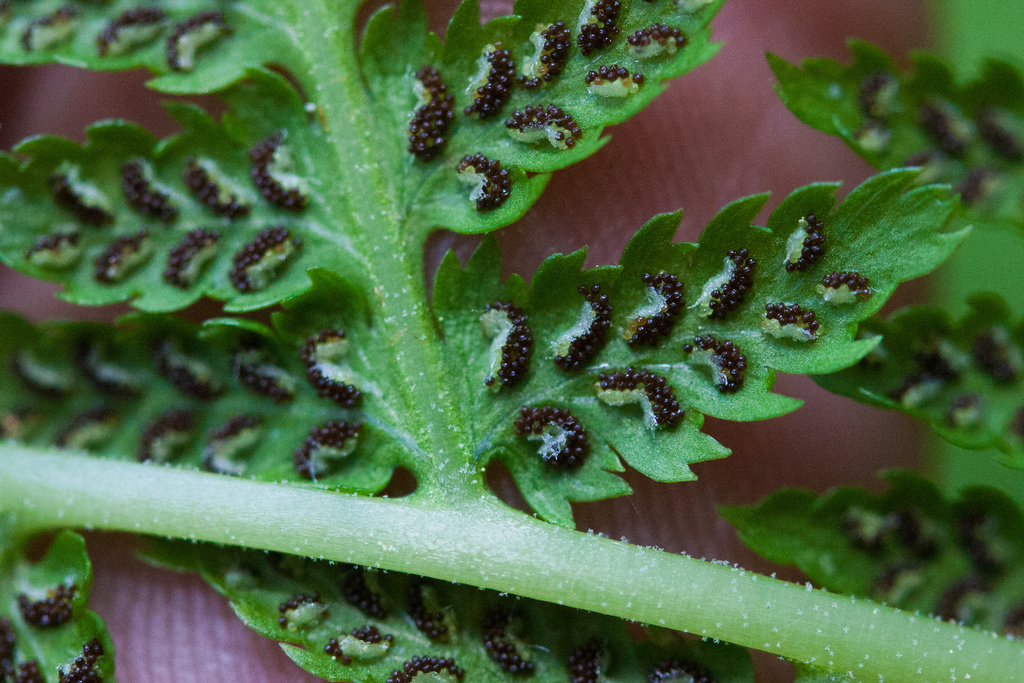
(c) Ken-ichi Ueda, some rights reserved (CC BY) · licence
Family: Athyriaceae · Type: Herb · Native
Athyrium filix-femina var. cyclosorum (Common lady fern) is a native California herb in the Athyriaceae family, recognized by . Key differences: habitat (woodland/streams vs alpine rocky), blade division (1-2-pinnate-pinnatifid vs 2-3-pinnate), broader distribution.
Common lady fern is a California native perennial found in the California Floristic Province and Modoc Plateau in woodland, stream edges, and seepage areas at elevations up to 3,200 meters. Reproducing through spores rather than flowering, this fern has large, intricate fronds with delicate green leaves that are elliptic to lanceolate in shape. Growing to approximately one meter tall, it develops complex multi-pinnate leaves with distinctive lower pinnae pairs smaller than those above. Its leaf blades are elegantly divided, with ultimate segments pinnately lobed and slightly toothed, and the midribs near the base often featuring tiny, branched hairs less than a millimeter long. The fern's intricate leaf structure and ability to thrive in moist woodland environments make it a characteristic species of California's sheltered, shaded ecosystems.
Identification and appearance
Key characters: 1 sympatric species. Key differences: habitat (woodland/streams vs alpine rocky), blade division (1-2-pinnate-pinnatifid vs 2-3-pinnate), broader distribution
Habitat and range
Habitat: Woodland, along streams, seepage areas
Elevation: < 3200 m
California counties: Plumas, Tulare, Mono, San Luis Obispo, Los Angeles, Butte, El Dorado, Amador, Tuolumne, Nevada, San Bernardino, Monterey, San Francisco, Santa Cruz, Placer, Siskiyou, Mariposa, Santa Barbara, Mendocino, Del Norte, Sonoma, Glenn, Contra Costa, Santa Clara, Lassen, San Joaquin, Calaveras, Inyo, San Mateo, Trinity, Tehama, Madera, Riverside, Yuba, Stanislaus, Lake, Shasta, Kern, Napa, Marin, Humboldt, Colusa, Alameda, Alpine, Modoc, Sierra, Fresno
Outside California: to Alaska, western Canada, Idaho, Colorado, northern Central America
How to tell it apart
vs Dryopteris: Athyrium has elongated or J-shaped spore covers; Dryopteris has round, kidney-shaped covers.; vs Pteridium: Athyrium grows in clumps; Pteridium spreads aggressively by underground runners forming large patches.; vs Woodwardia: Athyrium has scattered individual spore clusters; Woodwardia has chain-like rows of spore cases along veins.; vs Cystopteris: Athyrium is large (1-5 feet) with thick stems; Cystopteris is delicate and under 1 foot with hair-thin stems.; vs Dennstaedtia: Athyrium spore covers are on the vein; Dennstaedtia spore covers form cups at leaflet margins.
Frequently asked questions
Is Athyrium filix-femina var. cyclosorum native to California?
Yes. Athyrium filix-femina var. cyclosorum is native to California (recorded as native).
Where in California does Athyrium filix-femina var. cyclosorum grow?
Athyrium filix-femina var. cyclosorum occurs in Plumas, Tulare, Mono, San Luis Obispo, Los Angeles, Butte, El Dorado, Amador and other counties, at elevations of < 3200 m.
What plant family does Athyrium filix-femina var. cyclosorum belong to?
Athyrium filix-femina var. cyclosorum is in the Athyriaceae family, genus Athyrium.
What habitat does Athyrium filix-femina var. cyclosorum grow in?
Athyrium filix-femina var. cyclosorum grows in Woodland, along streams, seepage areas.
Related species
Other California species in the same genus, family, or bioregion.
Sources: Jepson eFlora · Index of California Plant Names · CalPhotos
Last updated 2026-10-07
Data from The California Species Project — 14,000+ California species with verified data from CNPS, CDFW, USFWS, Cal-IPC, and more.