Athysanus pusillus
Athysanus
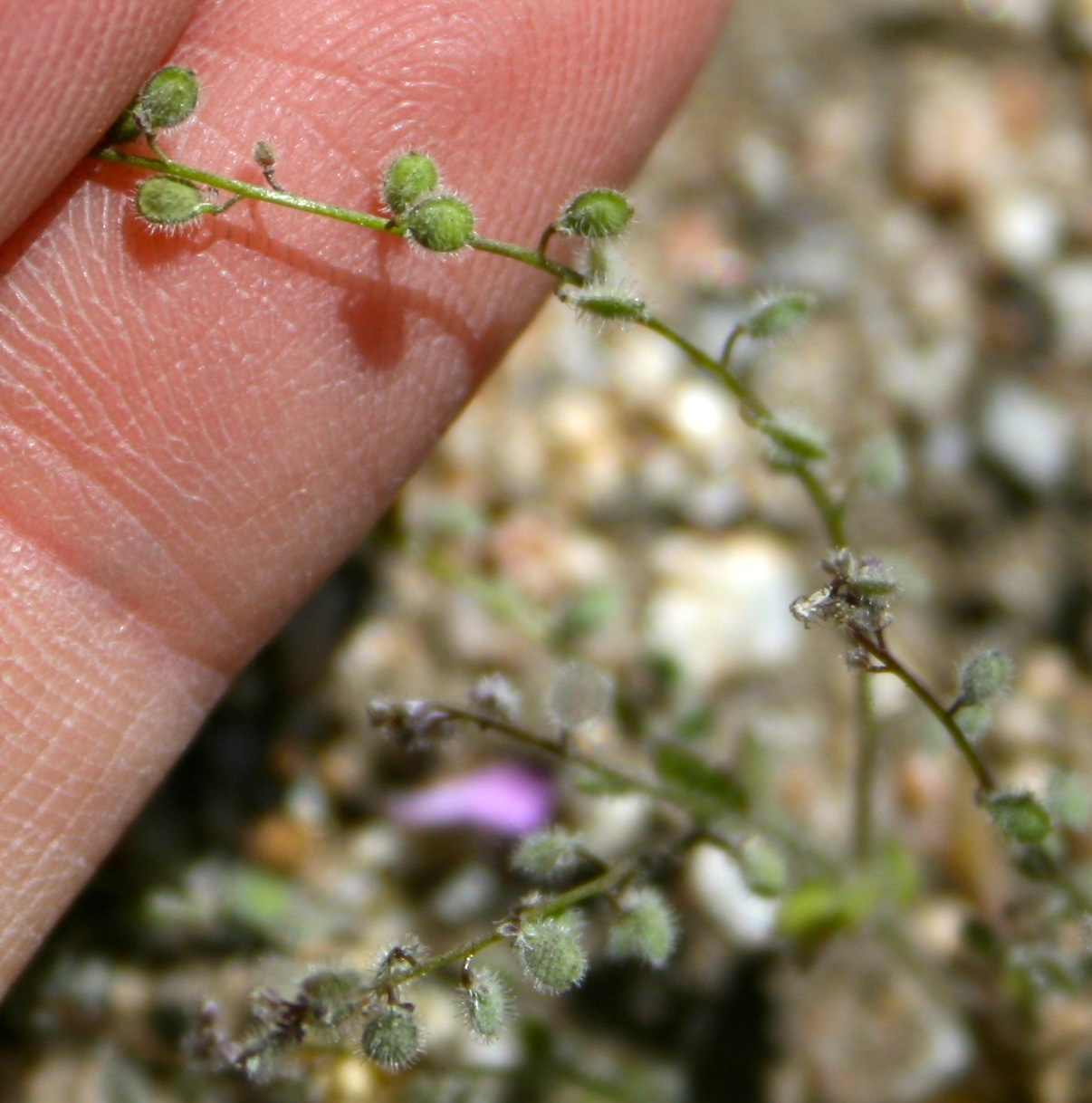
Photo by Chez Brungraber
Family: Brassicaceae · Type: Herb · Native
Athysanus pusillus (Athysanus) is a native California herb in the Brassicaceae family, recognized by (A. unilateralis). Key differences: fruit shape/size and pedicel length.
Athysanus is a California native annual found in the California Floristic Province, Modoc Plateau, and Granite Mountains in grassy, open slopes, rocky outcrops, and chaparral habitats at elevations below 2,000 meters. Flowering from February to June, this delicate plant produces small, spoon-shaped white to pale petals that are occasionally absent. Growing with hairy stems 5 to 30 centimeters tall, it forms a compact, slender structure. Its leaves are oblanceolate to obovate, ranging from 4 to 25 millimeters long, with basal leaves larger than the few sparse cauline leaves, and often featuring entire or slightly toothed edges. The tiny fruits are nearly round, approximately 2 to 2.5 millimeters wide, and adorned with small branched hairs.
Identification and appearance
Key characters: 1 sympatric species (A. unilateralis). Key differences: fruit shape/size and pedicel length
Habitat and range
Habitat: Grassy, open slopes, rocky outcrops, chaparral, flats, floodplains, cliffs, ledges
Elevation: < 2000 m
California counties: Fresno, Kern, Ventura, Alameda, Butte, Contra Costa, Glenn, Lake, Los Angeles, Madera, Modoc, Napa, Riverside, San Bernardino, San Diego, San Luis Obispo, San Mateo, Santa Barbara, Santa Clara, Siskiyou, Sonoma, Tehama, Trinity, Tulare, Tuolumne, Imperial, Monterey, Nevada, Orange, Placer, San Benito, Santa Cruz, Lassen, Mendocino, El Dorado, Sierra, Yuba, Mariposa, Humboldt, Plumas, Calaveras, Colusa, Marin, Shasta, San Joaquin, Sutter, Amador, Stanislaus, Yolo, San Francisco, Merced, Del Norte, Kings, Alpine, Sacramento, Solano
Outside California: to British Columbia, Montana, Nevada, Mexico
Bloom period
Athysanus pusillus blooms Feb-Jun.
How to tell it apart
vs Thysanocarpus: Athysanus fruit is small, round, 1--2-seeded and hooked-hairy without a wing; Thysanocarpus (fringepod) has a flat round fruit encircled by a conspicuous, often perforate wing.; vs Capsella: Athysanus has tiny nearly round 1--2-seeded silicles on down-curved pedicels; Capsella (shepherd's purse) has triangular, notched, many-seeded fruit.; vs Draba: Athysanus fruit is round with hooked hairs; Draba has elliptic to oblong, many-seeded silicles and star-shaped hairs.; vs Lepidium: Athysanus fruit is round, 1--2-seeded and barely opening; Lepidium (pepperweed) has flat, notched, 2-seeded silicles that split open.; vs Tropidocarpum: Athysanus is a minute plant with round 1--2-seeded fruit and white flowers; Tropidocarpum has elongate linear siliques and yellow flowers.
Frequently asked questions
Is Athysanus pusillus native to California?
Yes. Athysanus pusillus is native to California (recorded as native).
When does Athysanus pusillus bloom?
Athysanus pusillus blooms Feb-Jun.
Where in California does Athysanus pusillus grow?
Athysanus pusillus occurs in Fresno, Kern, Ventura, Alameda, Butte, Contra Costa, Glenn, Lake and other counties, at elevations of < 2000 m.
What plant family does Athysanus pusillus belong to?
Athysanus pusillus is in the Brassicaceae family, genus Athysanus.
What habitat does Athysanus pusillus grow in?
Athysanus pusillus grows in Grassy, open slopes, rocky outcrops, chaparral, flats, floodplains, cliffs, ledges.
Related species
Other California species in the same genus, family, or bioregion.
Sources: Jepson eFlora · Index of California Plant Names · CalPhotos
Last updated 2026-10-07
Data from The California Species Project — 14,000+ California species with verified data from CNPS, CDFW, USFWS, Cal-IPC, and more.