Athysanus unilateralis
Ladiestongue mustard
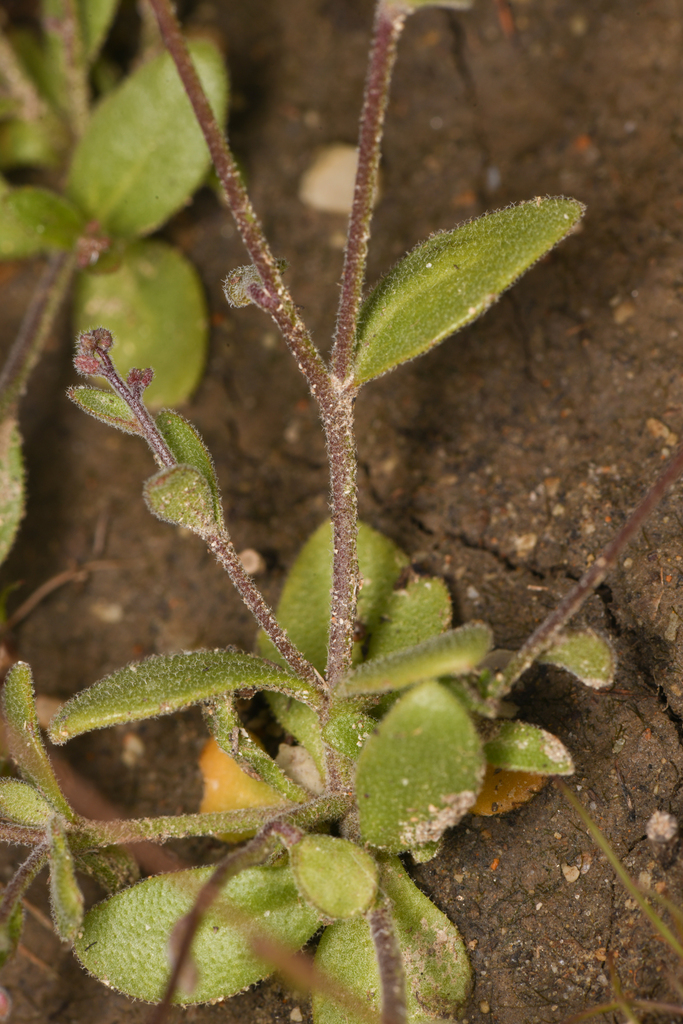
(c) Trevor Van Loon, some rights reserved (CC BY), uploaded by Trevor Van Loon · licence
Family: Brassicaceae · Type: Herb · Native
Athysanus unilateralis (Ladiestongue mustard) is a native California herb in the Brassicaceae family, recognized by (A. pusillus). Key differences: fruit shape/size, pedicel length, and habitat preferences.
Ladiestongue mustard is a California native annual found in the southern Sierra Nevada foothills, Tehachapi, Great Valley, and South Coast Ranges in grassy, open slopes and clay soils at elevations of 100 to 900 meters. Flowering from February to May, this plant produces small white flowers approximately 1.3 to 1.7 millimeters long. Growing with prostrate to ascending stems 7 to 25 centimeters tall, branched near the base and covered with 3 to 4-rayed hairs. Its basal leaves are oblanceolate to obovate, nearly sessile and 0.5 to 2.2 centimeters long, with occasional single teeth along the edges. The fruit is 3 to 5 millimeters long, obovate to elliptic in shape, with a tiny style measuring 0.1 to 0.2 millimeters.
Identification and appearance
Key characters: 1 sympatric species (A. pusillus). Key differences: fruit shape/size, pedicel length, and habitat preferences
Habitat and range
Habitat: Uncommon. Grassy, open slopes, flats, clay soils, floodplains, gypsum-clay slopes
Elevation: 100-900 m
California counties: Kern, San Benito, San Joaquin, Los Angeles, San Luis Obispo, Contra Costa, Alameda, Fresno, Stanislaus, Ventura, Colusa
Outside California: Oregon, Baja California
Bloom period
Athysanus unilateralis blooms Feb-May.
How to tell it apart
vs Thysanocarpus: Athysanus fruit is small, round, 1--2-seeded and hooked-hairy without a wing; Thysanocarpus (fringepod) has a flat round fruit encircled by a conspicuous, often perforate wing.; vs Capsella: Athysanus has tiny nearly round 1--2-seeded silicles on down-curved pedicels; Capsella (shepherd's purse) has triangular, notched, many-seeded fruit.; vs Draba: Athysanus fruit is round with hooked hairs; Draba has elliptic to oblong, many-seeded silicles and star-shaped hairs.; vs Lepidium: Athysanus fruit is round, 1--2-seeded and barely opening; Lepidium (pepperweed) has flat, notched, 2-seeded silicles that split open.; vs Tropidocarpum: Athysanus is a minute plant with round 1--2-seeded fruit and white flowers; Tropidocarpum has elongate linear siliques and yellow flowers.
Frequently asked questions
Is Athysanus unilateralis native to California?
Yes. Athysanus unilateralis is native to California (recorded as native).
When does Athysanus unilateralis bloom?
Athysanus unilateralis blooms Feb-May.
Where in California does Athysanus unilateralis grow?
Athysanus unilateralis occurs in Kern, San Benito, San Joaquin, Los Angeles, San Luis Obispo, Contra Costa, Alameda, Fresno and other counties, at elevations of 100-900 m.
What plant family does Athysanus unilateralis belong to?
Athysanus unilateralis is in the Brassicaceae family, genus Athysanus.
What habitat does Athysanus unilateralis grow in?
Athysanus unilateralis grows in Uncommon. Grassy, open slopes, flats, clay soils, floodplains, gypsum-clay slopes.
Related species
Other California species in the same genus, family, or bioregion.
Sources: Jepson eFlora · Index of California Plant Names · CalPhotos
Last updated 2026-10-07
Data from The California Species Project — 14,000+ California species with verified data from CNPS, CDFW, USFWS, Cal-IPC, and more.